Solution Database / Operations
Daily Needs Agent
Essential household items run out and deadlines slip because life moves faster than manual tracking. A persistent, personal model that learns individual rhythms and acts across messy real-world interfaces, not just structured APIs.
01The offer
For dual-income parents and solo founders, turn calendar, email and purchase history into proactive reorder suggestions and task completions. Address the recurring problem: essential household items run out and deadlines slip because life moves faster than manual tracking. The value hypothesis is reduced mental load with a single-tap approval flow; the pilot must establish whether trust and accuracy hold.
- For
- Dual-income parents and solo founders
- Takes in
- Calendar, email, purchase history and home service account credentials
- Delivers
- Proactive reorder suggestions, task completions and a daily action digest
- Message
- Never run out of milk or miss a deadline again: your daily needs handled with a single tap.
- Lead magnet
- A free two-week silent observation report showing detected patterns and suggested actions without any execution.
02How it works
- Connect calendar, email and home service accounts
- Learn consumption rhythms and recurring commitments
- Detect low-stock signals and upcoming deadlines
- Send a single message with a suggested action
- Execute approved actions across apps and websites
- Adjust confidence threshold based on approval patterns
Workflow
Connect accounts, observe patterns, detect a trigger, draft a suggestion, send for approval, execute if approved, and log the outcome. Start with calendar, email and purchase history and finish with proactive reorder suggestions and task completions.
AI and people
Use language models to parse unstructured emails, receipts and notes, and pattern recognition to spot recurring needs. A deterministic rule engine checks spending limits and calendar conflicts. A human user reviews and approves every action before execution; the system never acts autonomously without explicit consent.
Screens
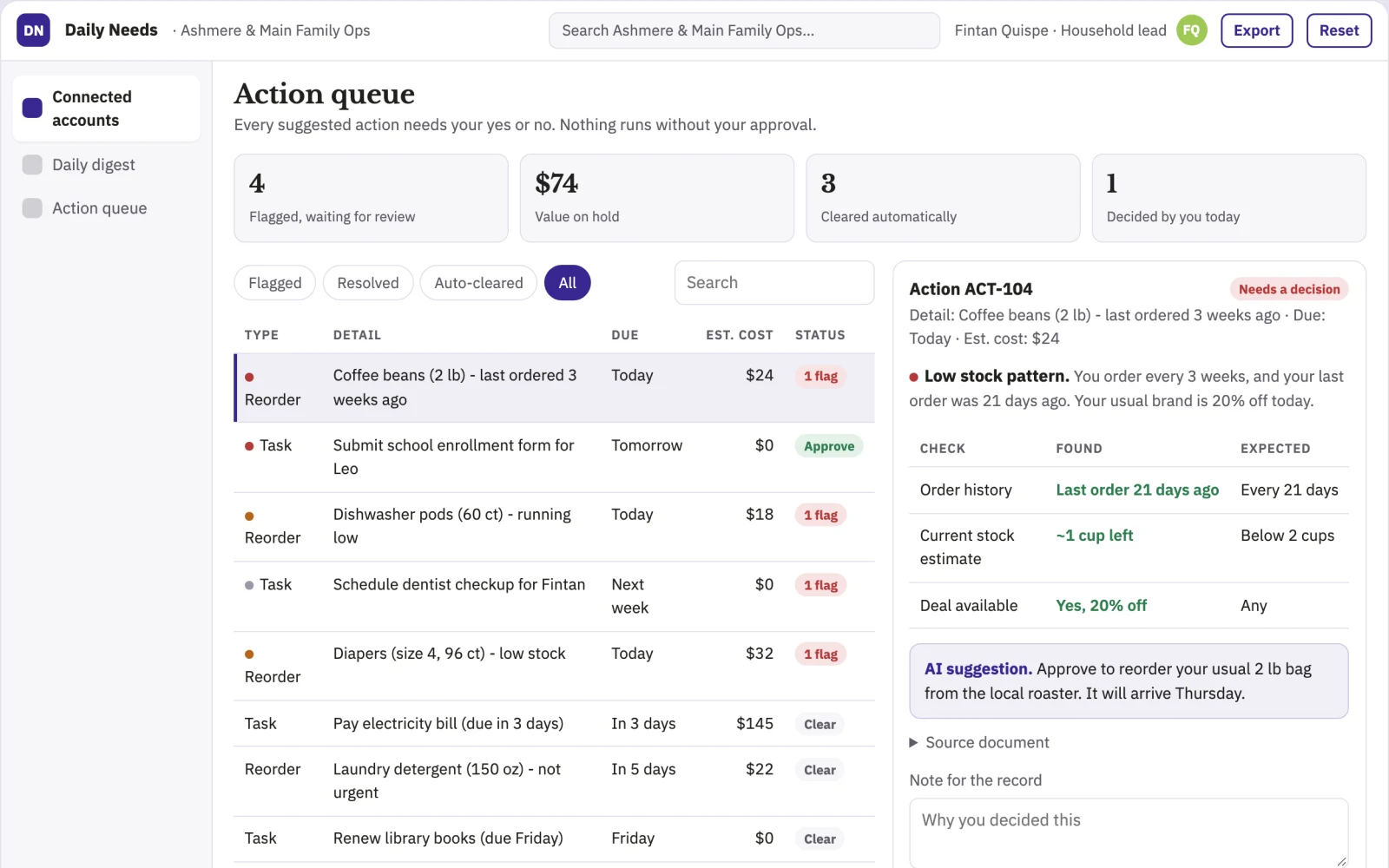
Key screens: Connected accounts, daily digest, action queue. Use a dashboard showing connected services and a timeline of detected patterns. The main screen is a daily digest listing suggested actions with one-tap approve or dismiss. Show confidence levels and history of past approvals. Provide a settings panel for guardrails and spending limits. In this product, the first view is connected accounts, followed by daily digest and action queue.
Admin
User accounts, connected service permissions, approval logs, spending limits, confidence thresholds, action history and a privacy audit trail.
03Market gap
Alternatives buyers use today
People use manual lists, calendar alerts and reminder apps. This differs by acting on behalf of the user, not just reminding, and by learning from unstructured data.
Where this wins
The more data it gathers on a user's habits and approvals, the more accurate and trusted it becomes, making switching costs high and the model harder to replicate.
04Why now
Operations teams are adopting AI for exactly this kind of repeatable work, and the cost of language and vision models has dropped far enough that a narrow, reviewed workflow pays back quickly. The buyer already feels the problem: essential household items run out and deadlines slip because life moves faster than manual tracking.
05Proof & signals
Channels where buyers gather: Parenting forums, productivity newsletters, and social media groups for busy professionals.. Metrics that prove it works: Number of approved actions per week and time saved per household per week..
Paid pilot
A paid pilot with ten households over four weeks proves value by measuring the number of approved actions and time saved. Baseline is self-reported manual tracking time; decision to continue is at least 70% approval rate and positive feedback on usefulness.
06Execution plan
MVP
One buyer: dual-income parents. One use case: grocery reordering. First two modules: silent observer and morning digest. Manual review of every suggestion before any action.
First 30 days
Week 1: Build the observer and connect to calendar and one grocery account. Week 2: Develop pattern detection for reorder frequency. Week 3: Ship the morning digest with suggestions. Week 4: Run a closed test with five households and refine approval flow.
After the pilot
After the paid pilot, automate routine reorders with one-tap approval, then add bill payment reminders and schedule conflict detection, and finally allow multi-step task execution across services.
Retention
The agent becomes more accurate and useful over time, and the daily digest becomes a habit; subscription continues as long as it saves more time than it costs.
Integrations
Google Calendar, Gmail, a grocery delivery service, and a payment method; later add more calendars, email providers and home service accounts.
07Investment and running costs
| Phase | Scope | Time | Budget |
|---|---|---|---|
| MVP | One buyer segment, one recurring use case; first modules: silent observer and morning digest. Manual review in the loop. | 3 days | $6,000 |
| Paid pilot | Accounts, roles, review states, audit trail and the first integration, hardened for two to three paying pilot customers. | 4 days | $5,500 |
| Full product | Self-serve onboarding, billing, monitoring and the wider integration set. | 6 days | $7,500 |
| Total | $19,000 | ||
| Running | Hosting | AI usage | Total a month |
|---|---|---|---|
| MVP and paid pilot (about 3 customers) | $30–$60 | $40–$90 | $70–$150 |
| Full product (about 50 customers) | $110–$210 | $280–$560 | $390–$770 |
Revenue model to test
Test a monthly subscription of USD 15 per household, with a free tier for observation only and a premium tier for automatic fulfilment.
Cost drivers
Model inference for continuous monitoring, integration maintenance for connected services, and customer support for trust and privacy issues.
Safeguards
Users set spending limits, approval requirements and confidence thresholds. The system must not execute any action without explicit approval, must not share data with third parties, and must allow full account disconnection at any time.
Take it further
Solution blueprint, rewritten from an earlier Nexibeo concept. Demand, pricing, build scope and integrations are working assumptions, not verified market findings. The MVP and the paid pilot exist to confirm them for your business before the larger build.