Solution Database / Operations
Loyalty Scan Assistant
Independent shops cannot run loyalty programmes without expensive or complex tools. A no-app, no-integration loyalty programme that uses AI to read till displays and works with existing shop flows.
01The offer
For operations leads at independent shops, turn customer phone numbers, purchase amounts and visit logs into a simple points balance and reward alerts. Address the recurring problem: independent shops cannot run loyalty programmes without expensive or complex tools. The value hypothesis is a low-effort, no-integration loyalty system that increases repeat visits; the pilot must establish whether shopkeepers will adopt it consistently.
- For
- Operations leads at independent shops
- Takes in
- Phone numbers, purchase amounts, visit timestamps
- Delivers
- Points balances, reward alerts, visit history
- Message
- Your shop's loyalty programme, no app, no cards, just a scan.
- Lead magnet
- Free QR code and first month of unlimited customers, no credit card required.
02How it works
- Create a shop account with name and phone number
- Generate a unique QR code for the till
- Log a visit by scanning the QR code and entering a phone number
- Record purchase amount via photo of the till display or manual entry
- Update points balance and check reward thresholds
- Send SMS alerts for rewards and notify the shopkeeper on the tablet
Workflow
Shop signs up, prints QR code, customer scans on first visit, enters name and phone number, returns scan on each visit, AI logs purchase amount, points update, reward triggers SMS and tablet alert, shopkeeper taps to redeem. Start with phone numbers, purchase amounts and visit logs and finish with points balances and reward alerts.
AI and people
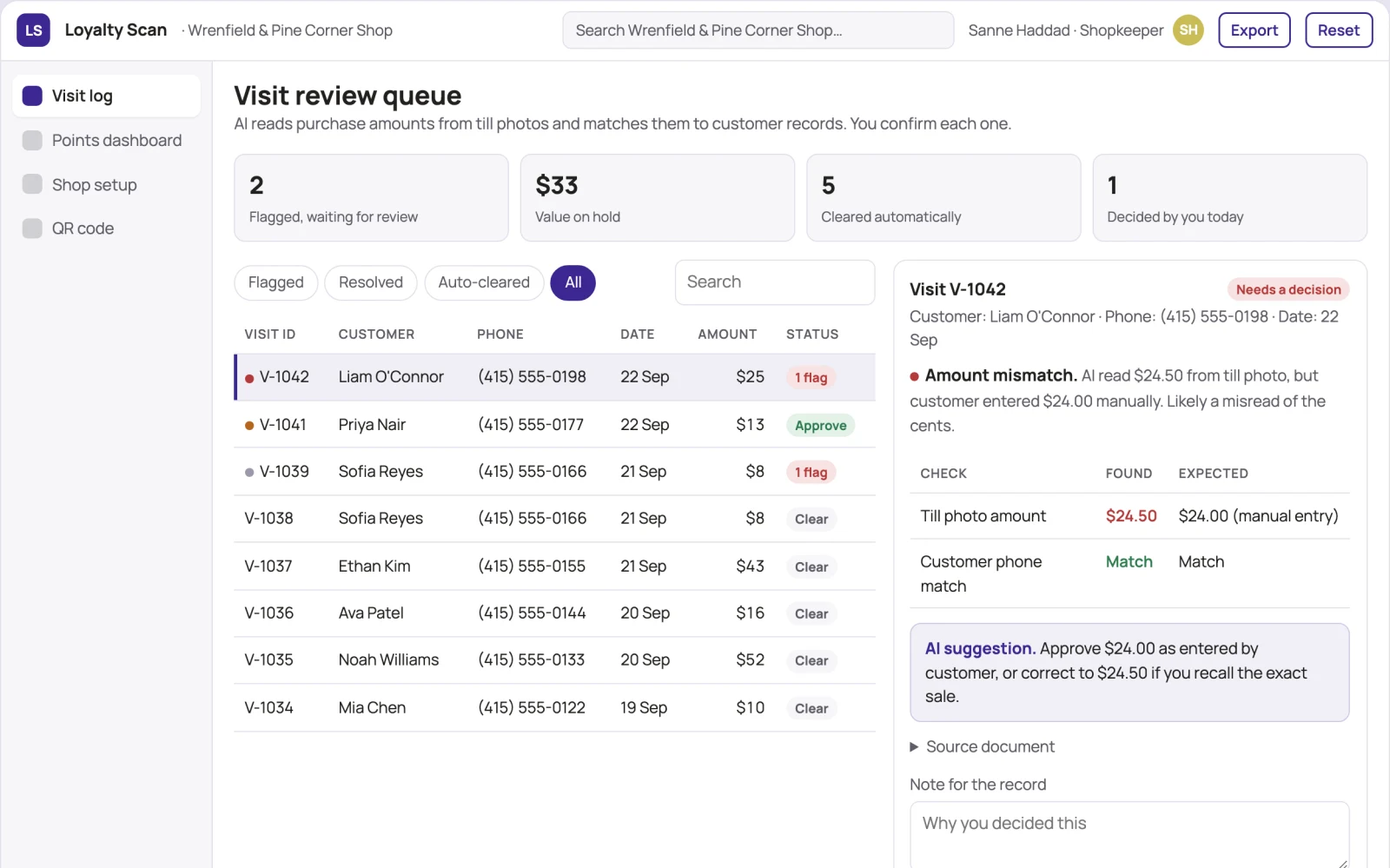
Use AI to read purchase amounts from photos of till displays, matching phone numbers to customer records. A human shopkeeper reviews each logged amount and confirms redemptions before they are applied.
Screens
Key screens: Shop setup, QR code print, visit log, points dashboard. Use a simple home screen with a large QR code for customers to scan. Show recent visits and points on a tablet dashboard. Allow manual entry of purchase amounts as a fallback. Display reward thresholds and alerts for the shopkeeper. In this product, the first view is shop setup, followed by QR code print, visit log and points dashboard.
Admin
Shop owner account, staff permissions, visit logs, points adjustments, reward redemptions, audit trail of all changes
03Market gap
Alternatives buyers use today
Plastic cards, paper loyalty cards, or expensive POS-integrated platforms. This differs by being low-cost, no-integration, and using AI to reduce manual entry.
Where this wins
The more shops use it, the better the AI becomes at reading diverse till displays and recognising customer patterns, creating a data moat.
04Why now
Operations teams are adopting AI for exactly this kind of repeatable work, and the cost of language and vision models has dropped far enough that a narrow, reviewed workflow pays back quickly. The buyer already feels the problem: independent shops cannot run loyalty programmes without expensive or complex tools.
05Proof & signals
Channels where buyers gather: Local business meetups, social media groups for independent shop owners, and partnerships with shop supply distributors.. Metrics that prove it works: Percentage of repeat customers who scan on each visit; reward redemption rate within 30 days..
Paid pilot
Run a 4-week paid pilot with a coffee shop and a hairdresser. Baseline: current loyalty redemption rate. Decision: proceed if at least 30% of customers use the scan and redemption rate increases by 20%.
06Execution plan
MVP
One buyer: a neighbourhood coffee shop. One use case: loyalty points on purchases. First two modules: QR scan and points ledger. Manual review of AI-read amounts by the shopkeeper.
First 30 days
Week 1: Build shop setup and QR generation. Week 2: Implement scan and points logging. Week 3: Add photo reading of till displays. Week 4: Test with two pilot shops and iterate on accuracy.
After the pilot
After the paid pilot, automate photo reading with fewer manual checks, add voice recognition for repeat customers, and integrate with basic POS systems via APIs.
Retention
Continue charging a monthly fee and keep the shop engaged with monthly reports on customer visits and reward usage, plus periodic feature updates.
Integrations
Start with SMS gateway, then add POS systems like Square or Shopify, and later accounting software.
07Investment and running costs
| Phase | Scope | Time | Budget |
|---|---|---|---|
| MVP | One buyer segment, one recurring use case; first modules: QR scan and points ledger. Manual review in the loop. | 3 days | $6,000 |
| Paid pilot | Accounts, roles, review states, audit trail and the first integration, hardened for two to three paying pilot customers. | 4 days | $6,000 |
| Full product | Self-serve onboarding, billing, monitoring and the wider integration set. | 7 days | $8,500 |
| Total | $20,500 | ||
| Running | Hosting | AI usage | Total a month |
|---|---|---|---|
| MVP and paid pilot (about 3 customers) | $30–$60 | $40–$90 | $70–$150 |
| Full product (about 50 customers) | $110–$210 | $280–$560 | $390–$770 |
Revenue model to test
Test pricing at $29 per month per shop after a free tier for up to 50 returning customers.
Cost drivers
Cloud hosting, SMS API costs, AI model inference for image reading, and support staff for shopkeepers.
Safeguards
Limit access to shop owner and staff. Require manual confirmation for every reward redemption. Do not share customer data with third parties. Ensure AI-read amounts are verified by the shopkeeper before points are posted.
Take it further
Solution blueprint, rewritten from an earlier Nexibeo concept. Demand, pricing, build scope and integrations are working assumptions, not verified market findings. The MVP and the paid pilot exist to confirm them for your business before the larger build.