Solution Database / Operations
Action Item Automator
Action items from meetings get lost in the hand-off from conversation to execution. The system learns from human corrections to improve extraction accuracy over time, making it more reliable than generic transcription tools.
01The offer
For team leads at consulting firms and project-based service companies, turn meeting recordings and transcripts into assigned tasks, due dates, and follow-up reminders in existing project tools. The value hypothesis is that this reduces the manual loop of note-taking, task creation, and status chasing, saving time and preventing missed commitments. The pilot must establish whether the automation is accurate enough to trust without heavy review.
- For
- Team leads at consulting firms and project-based service companies
- Takes in
- Meeting recordings or audio files
- Delivers
- Assigned tasks with due dates, meeting summary, and automated reminders
- Message
- Turn every meeting into assigned work without lifting a finger.
- Lead magnet
- A free demo where we process one recorded meeting and show the extracted tasks versus manual notes.
02How it works
- Upload or record meeting audio
- Transcribe and parse for action items, decisions, and owners
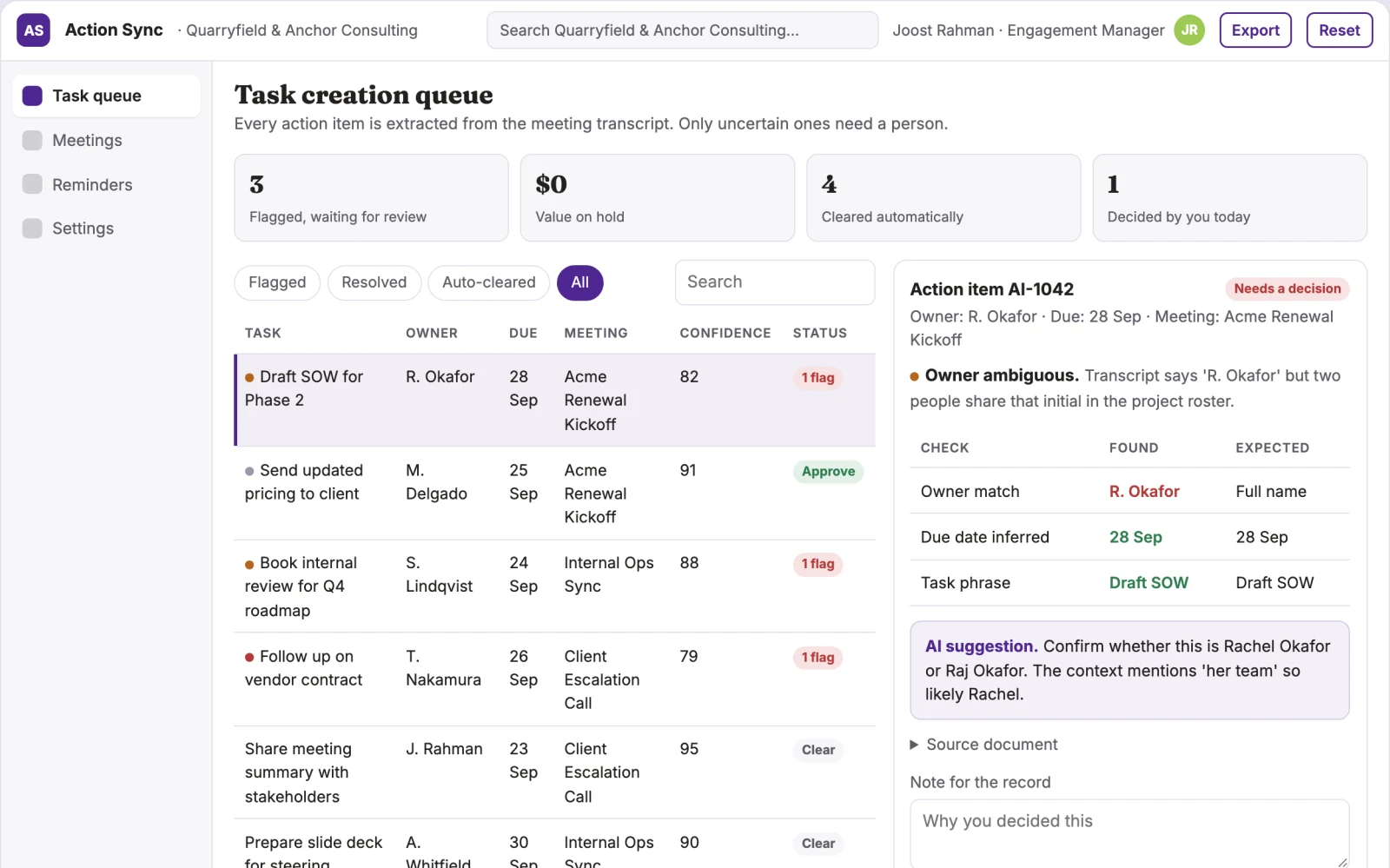
- Review and edit extracted tasks in a queue
- Sync approved tasks to project tools with due dates
- Post summaries to team channels
- Send reminders for overdue tasks
Workflow
Upload recording, transcribe, parse for actions, review tasks in queue, approve and sync to project tool, post summary to channel, then send reminders for overdue items. Start with meeting recordings and finish with assigned tasks and follow-up reminders.
AI and people
Use language models to transcribe and extract action items, decisions, and named owners. A human reviewer checks and edits the extracted tasks before they sync, especially for client-facing work, to avoid misinterpretation of ambiguous names or jargon.
Screens
Key screens: Meeting list, transcript review, task creation queue, reminder dashboard. Use a meeting list for recent recordings, a transcript view with highlighted action items, a queue for reviewing and confirming tasks before they sync, and a dashboard showing open tasks and reminders. The main screen is the task creation queue, where users approve or edit extracted actions before they go live.
Admin
User roles, meeting ownership, task approval states, sync logs, reminder settings, and an audit trail of all extracted and edited items.
03Market gap
Alternatives buyers use today
People use manual note-taking, transcription tools like Otter.ai, or project management templates. This differs by automating the entire loop from recording to task creation and follow-up, not just transcription.
Where this wins
Each correction and approval trains the model on the client's specific jargon and meeting patterns, creating a customised extraction engine that is hard to replicate without the same data.
04Why now
Operations teams are adopting AI for exactly this kind of repeatable work, and the cost of language and vision models has dropped far enough that a narrow, reviewed workflow pays back quickly. The buyer already feels the problem: action items from meetings get lost in the hand-off from conversation to execution.
05Proof & signals
Channels where buyers gather: LinkedIn, industry conferences for consulting firms, and partnerships with project management tool vendors.. Metrics that prove it works: Time saved per meeting on task creation and follow-up. Percentage of tasks correctly extracted without human edits..
Paid pilot
A paid pilot with one consulting firm processes 20 client meetings. Baseline is the time spent on manual note-taking and task creation. Success is a 50% reduction in that time with at least 90% of tasks correctly extracted. Decision to continue based on accuracy and time saved.
06Execution plan
MVP
One buyer: team leads at a small consulting firm. One use case: client-facing project meetings. First two modules: transcription and task extraction, plus manual review queue. Sync to one project tool (e.g., Jira) with manual approval before tasks go live.
First 30 days
Week 1: Set up transcription and parsing pipeline. Week 2: Build review queue and task sync to one tool. Week 3: Add summary posting and reminder logic. Week 4: Test with two client meetings and refine extraction accuracy.
After the pilot
After the paid pilot, automate the reminder nudges, add Slack/Teams posting, and expand to multiple project tools and meeting types without manual review for internal meetings.
Retention
It keeps earning through monthly subscription, with value increasing as the model learns the client's jargon and meeting patterns, reducing review time further.
Integrations
Zoom, Teams, Google Meet for recordings; Jira, Asana, Notion for task creation; Slack and Teams for summaries and reminders.
07Investment and running costs
| Phase | Scope | Time | Budget |
|---|---|---|---|
| MVP | One buyer segment, one recurring use case; first modules: transcription and task extraction, plus manual review queue. Manual review in the loop. | 2 days | $5,500 |
| Paid pilot | Accounts, roles, review states, audit trail and the first integration, hardened for two to three paying pilot customers. | 3 days | $5,000 |
| Full product | Self-serve onboarding, billing, monitoring and the wider integration set. | 6 days | $6,500 |
| Total | $17,000 | ||
| Running | Hosting | AI usage | Total a month |
|---|---|---|---|
| MVP and paid pilot (about 3 customers) | $30–$60 | $40–$90 | $70–$150 |
| Full product (about 50 customers) | $110–$210 | $280–$560 | $390–$770 |
Revenue model to test
Test pricing at USD 99 per user per month, with a setup fee of USD 500 for integration and training.
Cost drivers
Main delivery costs are AI transcription and language model API usage, plus integration development and ongoing support.
Safeguards
Limit access to approved users only. Require human approval before tasks sync to external tools. Never send reminders without a task being approved. Must not auto-assign tasks without confirmation of the owner. Must not share meeting content outside the client's workspace.
Take it further
Solution blueprint, rewritten from an earlier Nexibeo concept. Demand, pricing, build scope and integrations are working assumptions, not verified market findings. The MVP and the paid pilot exist to confirm them for your business before the larger build.