Solution Database / Operations
Automated Process Correction Agent
Customer complaints land in support tickets and surveys but fixes are delayed by weekly meetings and roadmaps causing repeated friction. A single agent reads every signal and drafts the exact fix, removing the need for a committee and weekly meetings
01The offer
For operations leads at direct-to-consumer brands, turn unstructured feedback into process corrections and knowledge base updates. Address the recurring problem of slow feedback loops causing repeated customer frustration. The value hypothesis is a faster resolution cycle that reduces churn; the pilot must establish whether that benefit is real.
- For
- Operations leads at direct-to-consumer brands
- Takes in
- Unstructured text, images, voice transcripts, existing helpdesk and CRM data
- Delivers
- Implemented process corrections, updated knowledge base articles, automated workflow triggers, daily digest of resolved issues
- Message
- One agent reads your feedback and fixes the process, so you never need a committee again
- Lead magnet
- A free audit of current support ticket patterns
02How it works
- Aggregate unstructured feedback from multiple sources
- Identify root causes rather than keywords
- Draft backend configuration changes
- Generate knowledge base articles
- Trigger automated workflows like refunds
- Manage approval requests for changes
Workflow
Connect data sources, ingest feedback, group by root cause, draft the fix, request approval, implement change, log resolution. Start with unstructured feedback and finish with implemented process corrections and updated knowledge bases.
AI and people
Use NLP to read text, images and voice transcripts. Identify intent and root cause. Draft code or configuration changes. A human checks the logic and safety of the draft before execution.
Screens
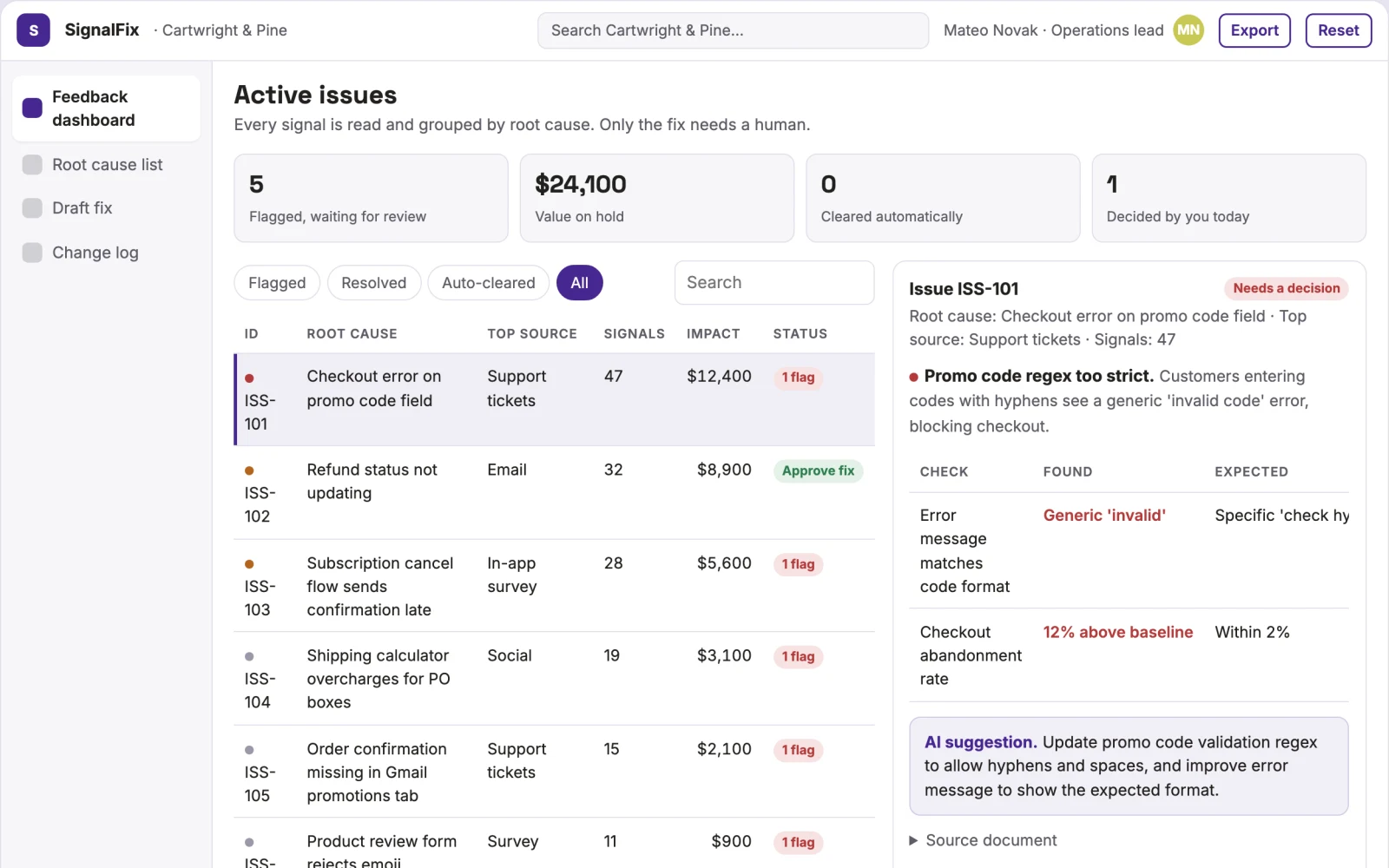
Key screens: Feedback dashboard, root cause analysis, approval workflow, change log. Use a dashboard to aggregate signals, a list view to group by root cause, a form to draft the fix, and a history log. The first view is the feedback dashboard showing active issues.
Admin
User roles for approvers, version history of changes, audit trail of AI actions, approval states, integration credentials
03Market gap
Alternatives buyers use today
Manual ticket triage, weekly operations meetings, quarterly roadmap planning, generic chatbots
Where this wins
The value comes from the specific domain knowledge of the client's business logic and the quality of the root cause analysis, which requires fine-tuning on their specific data
04Why now
Operations teams are adopting AI for exactly this kind of repeatable work, and the cost of language and vision models has dropped far enough that a narrow, reviewed workflow pays back quickly. Rising compliance and audit expectations make a documented, reviewable process worth more than an ad hoc one. The buyer already feels the problem: customer complaints land in support tickets and surveys but fixes are delayed by weekly meetings and roadmaps causing repeated friction.
05Proof & signals
Channels where buyers gather: LinkedIn, industry forums, direct outreach to operations leads. Metrics that prove it works: Reduction in repeat tickets for the specific issue, time saved on weekly meetings.
Paid pilot
Run for 30 days on one complaint type. Establish a baseline of repeat tickets. Measure the reduction in repeat tickets after the agent implements fixes.
06Execution plan
MVP
Connect to one helpdesk and one order system. Focus on one high-volume complaint type like wrong delivery addresses. Read tickets, group them, draft the backend rule change, and send a daily digest with one approval button.
First 30 days
Week 1: Connect to helpdesk and ingest data. Week 2: Train the agent on one complaint type. Week 3: Test the drafting and approval workflow. Week 4: Launch pilot with daily digest.
After the pilot
Automate the approval process, expand to other complaint types, integrate with more backend systems, generate proactive alerts for emerging trends
Retention
Earn recurring fees based on the volume of interactions processed and the number of successful fixes implemented
Integrations
Helpdesk software, CRM, Order Management System, Knowledge Base
07Investment and running costs
| Phase | Scope | Time | Budget |
|---|---|---|---|
| MVP | One buyer segment, one recurring use case. Manual review in the loop. | 3 days | $6,000 |
| Paid pilot | Accounts, roles, review states, audit trail and the first integration, hardened for two to three paying pilot customers. | 4 days | $5,500 |
| Full product | Self-serve onboarding, billing, monitoring and the wider integration set. | 6 days | $8,000 |
| Total | $19,500 | ||
| Running | Hosting | AI usage | Total a month |
|---|---|---|---|
| MVP and paid pilot (about 3 customers) | $30–$60 | $40–$90 | $70–$150 |
| Full product (about 50 customers) | $110–$210 | $280–$560 | $390–$770 |
Revenue model to test
Test pricing at 0.05 USD per interaction read and 50 USD per action taken
Cost drivers
API costs for data ingestion, compute costs for NLP processing, and developer time for initial setup and fine-tuning
Safeguards
Limits on the types of changes the agent can make, mandatory human approval for financial actions, audit logs to track AI decisions
Take it further
Solution blueprint, rewritten from an earlier Nexibeo concept. Demand, pricing, build scope and integrations are working assumptions, not verified market findings. The MVP and the paid pilot exist to confirm them for your business before the larger build.