Textbook Match and Grade
Used textbooks sit in homes and bookstores while other families need the exact edition for the coming semester. Photos of used textbooks become graded listings matched to the right curriculum edition.
01The offer
For parents and school district bookstore managers, turn smartphone photos of used textbooks into graded, matched listings with local demand signals. Address the recurring problem: used textbooks sit in homes and bookstores while other families need the exact edition for the coming semester. The value hypothesis is a faster, more reliable swap with less manual searching; the pilot must establish whether that benefit is real.
- For
- Parents and school district bookstore managers
- Takes in
- Smartphone photos of used textbooks and school curriculum lists
- Delivers
- Graded textbook listings, matched buyer offers and completed sale records
- Message
- Snap a photo, get a match: used textbooks find the next family in days, not weeks.
- Lead magnet
- A free condition grade and match preview for the first 50 uploaded textbooks.
02How it works
- Extract ISBN, title and edition from a photo
- Grade condition from spine and highlight analysis
- Match listings to school curriculum lists
- Suggest pickup times and shipping labels
- Confirm condition on delivery
- Process payment and release funds
Workflow
Upload a photo, extract book details, grade condition, match to curriculum, list for relevant courses, receive an offer, and complete the sale with confirmation. Start with smartphone photos of used textbooks and finish with matched, graded listings and completed transactions.
AI and people
Use vision models to read ISBNs and grade physical condition, and language models to interpret curriculum lists and match requests. Keep edition and course data in structured fields. Validate matches through deterministic checks. A human moderator reviews disputed grades before any refund or penalty is applied.
Screens
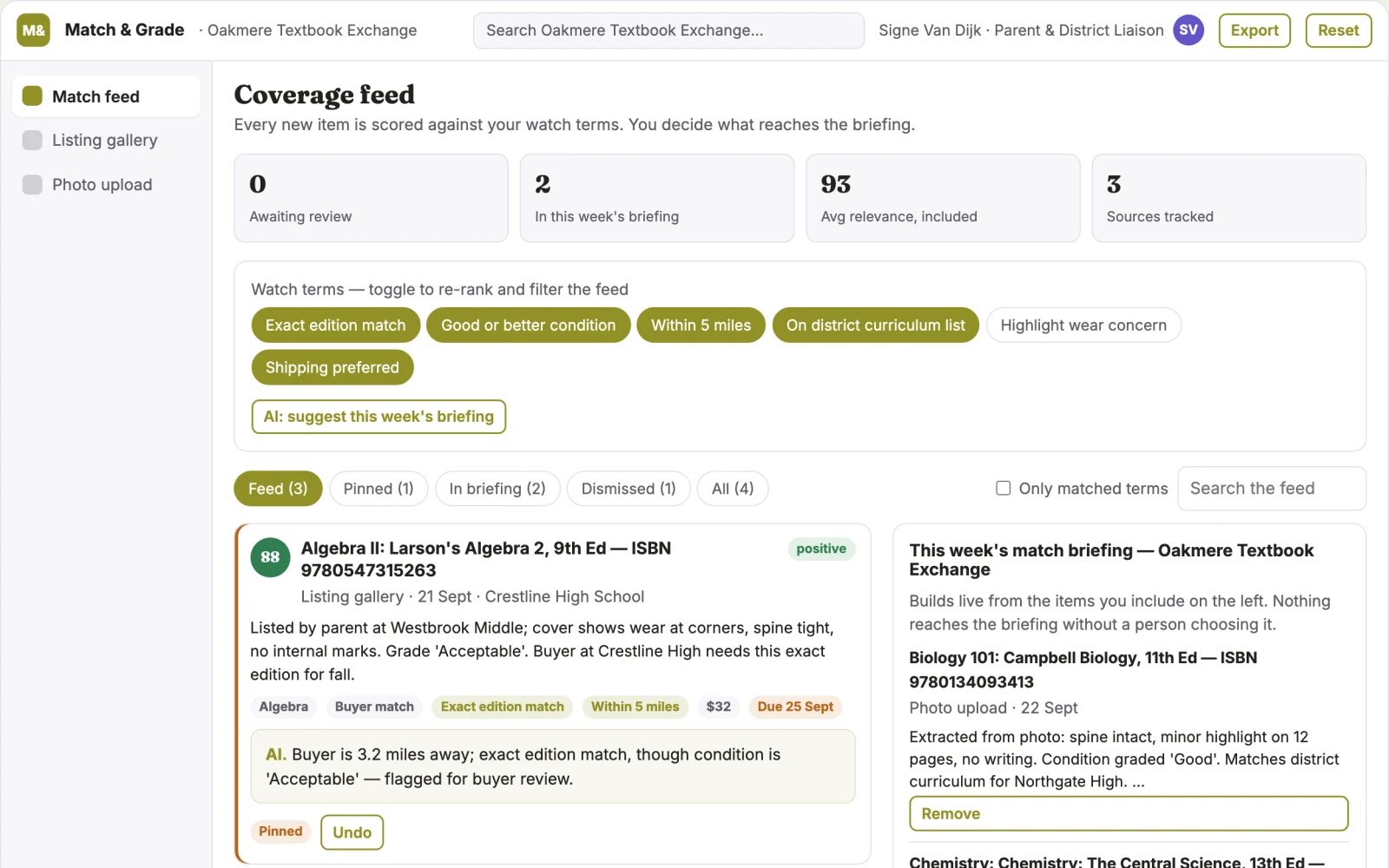
Key screens: Photo upload, listing gallery, match feed. Use a simple upload screen with a camera prompt, a gallery grouped by school and course, and a match feed showing nearby buyers. Let users filter by edition and condition. Display pending, matched and completed states. Provide a chat window for pickup coordination. In this product, the first view is photo upload, followed by listing gallery and match feed.
Admin
User accounts, listing versions, condition dispute states, transaction history, pickup confirmations, refund approvals and an audit trail for every grade and match decision.
03Market gap
Alternatives buyers use today
Facebook groups, swap meets and bookstore dead stock shelves; this differs by automating the listing and matching steps that make those channels slow.
Where this wins
Each semester adds more labelled examples of local book wear and curriculum changes, making the grading and matching more accurate for that district.
04Why now
Education teams are adopting AI for exactly this kind of repeatable work, and the cost of language and vision models has dropped far enough that a narrow, reviewed workflow pays back quickly. The buyer already feels the problem: used textbooks sit in homes and bookstores while other families need the exact edition for the coming semester.
05Proof & signals
Channels where buyers gather: School district parent newsletters, Facebook groups for book swaps and district bookstore counters.. Metrics that prove it works: Median time from upload to accepted offer and percentage of listings with a completed sale..
Paid pilot
Run a paid pilot with 50 parents in one district; measure time from upload to match against the Facebook group baseline, and decide whether to expand based on match rate and dispute count.
06Execution plan
MVP
One school district, one semester, photo upload and listing modules only, with manual matching by a coordinator.
First 30 days
Week 1: Build photo upload and ISBN extraction. Week 2: Add condition grading and listing display. Week 3: Connect curriculum lists and show matches. Week 4: Run a manual pilot with 20 parents and collect feedback.
After the pilot
Automate matching, pricing and shipping label generation after the paid pilot, then add overstock management for district bookstores.
Retention
Charge a small listing fee after the first free matches, and renew the district overstock contract each semester.
Integrations
School district curriculum databases, payment gateways and shipping label APIs, starting with a simple CSV import of course lists.
07Investment and running costs
| Phase | Scope | Time | Budget |
|---|---|---|---|
| MVP | One buyer segment, one recurring use case. Manual review in the loop. | 2 days | $5,000 |
| Paid pilot | Accounts, roles, review states, audit trail and the first integration, hardened for two to three paying pilot customers. | 3 days | $4,000 |
| Full product | Self-serve onboarding, billing, monitoring and the wider integration set. | 5 days | $6,000 |
| Total | $15,000 | ||
| Running | Hosting | AI usage | Total a month |
|---|---|---|---|
| MVP and paid pilot (about 3 customers) | $30–$60 | $40–$90 | $70–$150 |
| Full product (about 50 customers) | $110–$210 | $280–$560 | $390–$770 |
Revenue model to test
Test a 10% transaction fee on completed sales and a USD 500 monthly district fee for overstock management.
Cost drivers
Vision model inference, cloud storage for photos, payment processing fees and a part-time moderator for disputes.
Safeguards
Limit listings to verified school districts, require photo confirmation on delivery, cap dispute refunds, and never share personal addresses without both parties consenting.
Take it further
Solution blueprint, rewritten from an earlier Nexibeo concept. Demand, pricing, build scope and integrations are working assumptions, not verified market findings. The MVP and the paid pilot exist to confirm them for your business before the larger build.