Adaptive Lesson Generator
Teachers spend evenings and weekends building lesson plans that rarely adapt to student pace. Lessons that combine spoken interaction and automatic grading in one sequence, adapted to each pupil.
01The offer
For curriculum leads at charter school networks, turn textbooks, standards, and notes into adaptive daily lessons with voice interaction. Address the problem of repetitive planning and lack of student personalisation. The value hypothesis is a self-running system that tracks mastery and generates interventions; the pilot must establish whether that benefit is real.
- For
- Curriculum leads at charter school networks
- Takes in
- Textbooks, state standards, teacher notes, pacing guides
- Delivers
- Daily adaptive lessons, interactive quizzes, voice discussion prompts, student mastery reports, intervention plans
- Message
- Turn static textbooks into a living, voice-interactive daily lesson plan
- Lead magnet
- Free trial for one math unit
02How it works
- Parse uploaded curriculum documents
- Generate lesson sequences with clear objectives
- Create video-like explanations
- Generate practice problems and quizzes
- Enable voice-based student interaction
- Provide real-time remediation and weekly summaries
Workflow
Upload curriculum, set pacing, generate lessons, run lessons, monitor student progress, receive weekly reports. Start with textbooks and standards and finish with adaptive lessons and mastery reports.
AI and people
Use language models to interpret curriculum and generate explanations. Voice agents handle student interaction. Multimodal models grade math. The AI tracks mastery and prepares interventions. A human reviewer confirms pedagogical accuracy before delivery.
Screens
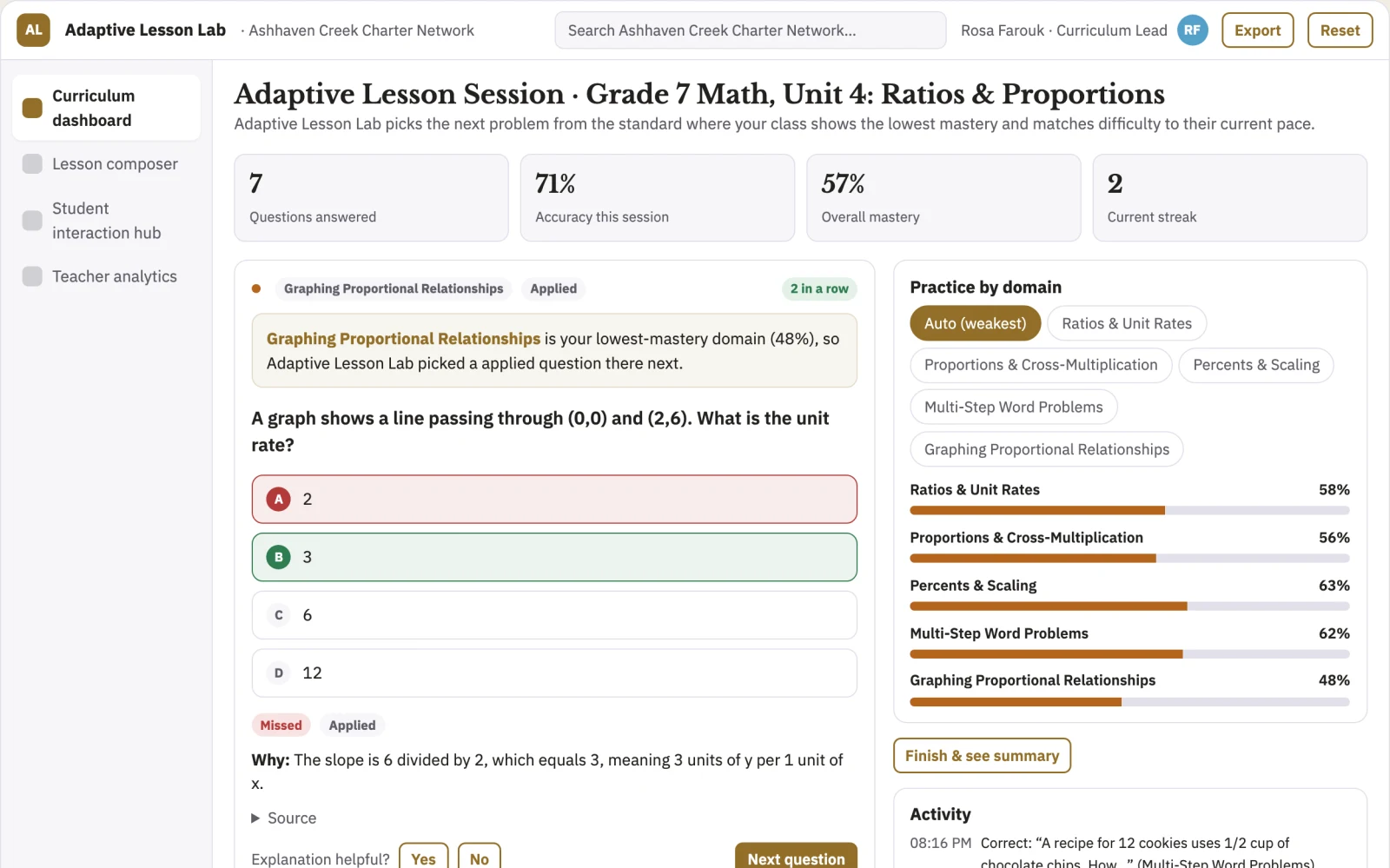
Key screens: Curriculum dashboard, lesson composer, student interaction hub, teacher analytics. Use a dashboard to view pacing and progress. The composer generates lesson content. The hub handles voice and video interaction. The analytics show gaps and strengths.
Admin
User roles, lesson versions, audit trail, permissions for curriculum access
03Market gap
Alternatives buyers use today
Traditional lesson planning software, static worksheets, generic AI chatbots
Where this wins
Rigorous testing of pedagogical sequences prevents hallucinations. Building a library of high-quality generated content over time
04Why now
Education teams are adopting AI for exactly this kind of repeatable work, and the cost of language and vision models has dropped far enough that a narrow, reviewed workflow pays back quickly. Rising compliance and audit expectations make a documented, reviewable process worth more than an ad hoc one. The buyer already feels the problem: teachers spend evenings and weekends building lesson plans that rarely adapt to student pace.
05Proof & signals
Channels where buyers gather: EdTech conferences, charter school networks, direct sales to curriculum directors. Metrics that prove it works: Student engagement rates, reduction in teacher planning time.
Paid pilot
Pilot proves value by comparing student progress in the AI-generated lessons versus traditional methods, establishing a baseline for engagement and mastery
06Execution plan
MVP
First cut: Charter school math lead, single textbook chapter, week of adaptive practice, manual review of generated content
First 30 days
Week 1: Deploy MVP for math curriculum. Week 2: Gather feedback on voice interaction. Week 3: Refine remediation logic. Week 4: Prepare for pilot launch.
After the pilot
Automated grading for all subjects, parent portals, integration with LMS, mobile apps
Retention
Annual subscriptions based on active student counts
Integrations
Learning Management Systems, Student Information Systems, supplementary content libraries
07Investment and running costs
| Phase | Scope | Time | Budget |
|---|---|---|---|
| MVP | One buyer segment, one recurring use case. Manual review in the loop. | 2 days | $5,500 |
| Paid pilot | Accounts, roles, review states, audit trail and the first integration, hardened for two to three paying pilot customers. | 3 days | $5,000 |
| Full product | Self-serve onboarding, billing, monitoring and the wider integration set. | 6 days | $6,500 |
| Total | $17,000 | ||
| Running | Hosting | AI usage | Total a month |
|---|---|---|---|
| MVP and paid pilot (about 3 customers) | $30–$60 | $50–$110 | $80–$170 |
| Full product (about 50 customers) | $110–$210 | $420–$840 | $530–$1,050 |
Revenue model to test
Hypothesis: 5000 USD per school per year capped at 500 students
Cost drivers
AI inference costs, development and maintenance
Safeguards
Strict guardrails on math answers, access controls for curriculum documents, audit logs for AI interactions
Take it further
Solution blueprint, rewritten from an earlier Nexibeo concept. Demand, pricing, build scope and integrations are working assumptions, not verified market findings. The MVP and the paid pilot exist to confirm them for your business before the larger build.