Gap Tutor
A student gets stuck on a math problem because of one earlier concept they never fully grasped, and traditional tutoring is too expensive and too slow to find that hidden gap. A precise diagnosis of the exact missing sub-skill from a photo of handwritten work, combined with a patient voice-led lesson and adaptive practice that checks back days later.
01The offer
For parents of 4th to 8th graders who already pay for tutoring but see no progress, turn photos of handwritten work and spoken confusion into a root-cause diagnosis, a short spoken lesson and adaptive practice that sticks. Address the recurring problem: a student keeps falling behind because the missing sub-skill is never identified and taught properly. The value hypothesis is that a precise, patient, always-available tutor closes the gap faster and more affordably than scheduled human sessions; the pilot must establish whether that benefit is real.
- For
- Parents of 4th to 8th graders who already pay for tutoring but see no progress
- Takes in
- Photos of wrong answers, spoken confusion, and grade level
- Delivers
- Root-cause diagnosis, short voice-led lesson, adaptive practice set, and a scheduled retention check
- Message
- Find the exact gap in your child's math understanding and close it with a patient AI tutor that checks back until it sticks.
- Lead magnet
- A free diagnosis of one photo of a wrong answer, showing the exact missing sub-skill and a sample lesson.
02How it works
- Read a photo of handwritten work and extract the problem and attempt
- Diagnose the exact missing sub-skill from a curated skill map
- Generate a short voice-led lesson with visual aids for that sub-skill
- Create adaptive practice problems that increase in difficulty
- Ask the student to teach the concept back and assess their explanation
- Schedule and run a follow-up quick check three days later
Workflow
Upload a photo or voice note, receive a diagnosis, watch a short lesson, complete adaptive practice, teach the concept back, and receive a scheduled follow-up check. Start with photos of wrong answers and spoken confusion and finish with a mastered sub-skill and a retention check.
AI and people
Use vision models to read handwritten work and language models to diagnose the missing sub-skill against a curated skill map. Generate lesson scripts and practice problems with language models, and use voice synthesis for narration. A human curriculum expert reviews the skill map and a sample of generated lessons and problems before release, and a teacher checks flagged diagnoses before they are shown to the student.
Screens
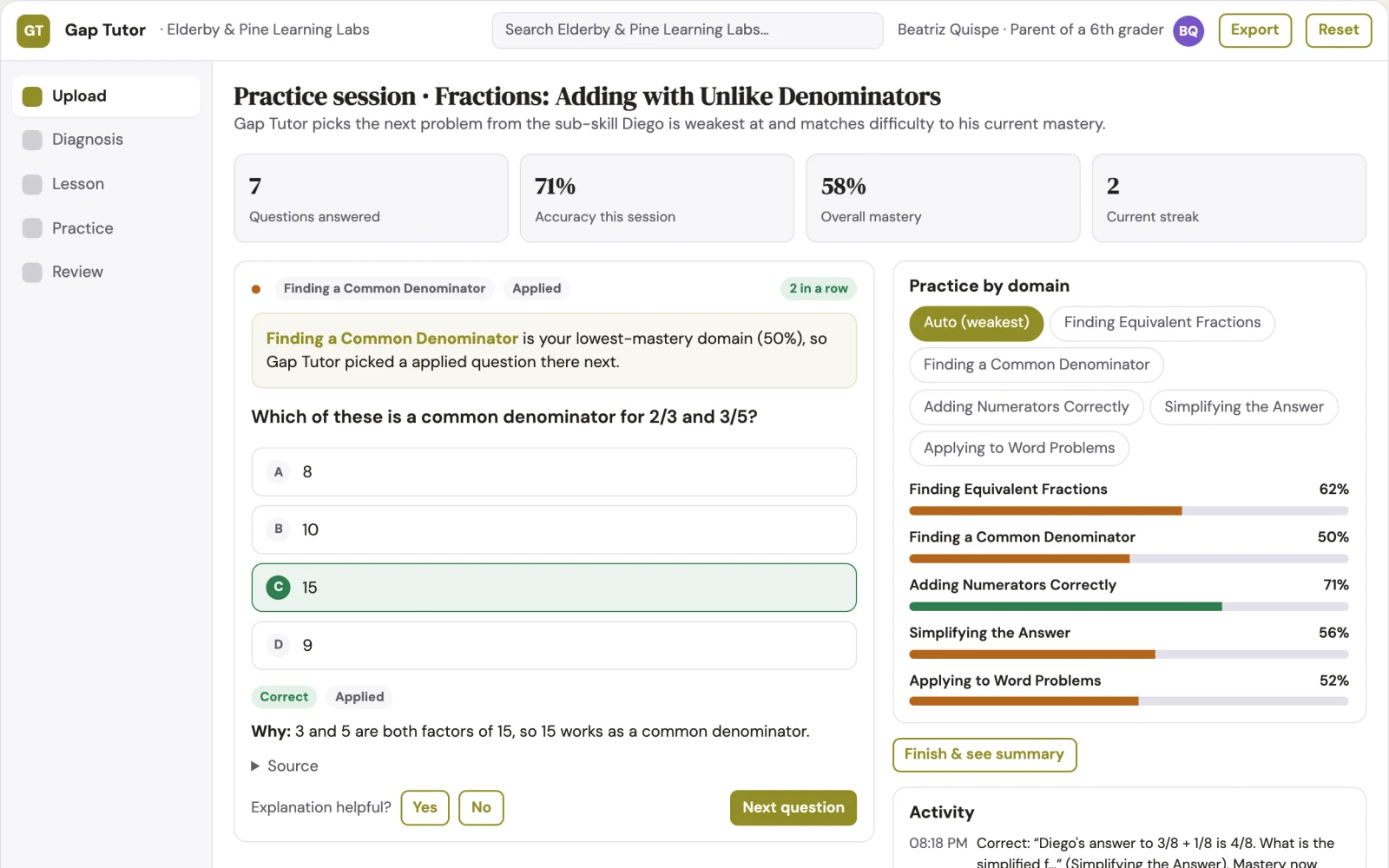
Key screens: Upload, Diagnosis, Lesson, Practice, Review. Use a simple upload screen for photos or voice notes, a diagnosis screen showing the identified sub-skill with evidence, a lesson screen with a short voice-led explainer and visuals, a practice screen with adaptive problems, and a review screen showing progress and scheduled check-ins. In this product, the first view is upload, followed by diagnosis, lesson, practice and review.
Admin
Student profiles, parent accounts, lesson history, practice results, diagnosis flags, review queue for teachers, and an audit trail of all AI-generated content and student responses.
03Market gap
Alternatives buyers use today
Human tutors, tutoring centres, and generic AI chatbots. This differs by pinpointing the exact missing sub-skill from a photo, teaching it in a short voice-led lesson, and scheduling a retention check.
Where this wins
The curated skill map and the corpus of diagnosed student work become more accurate and comprehensive over time, making the diagnosis faster and more reliable than any generic tutor.
04Why now
Education teams are adopting AI for exactly this kind of repeatable work, and the cost of language and vision models has dropped far enough that a narrow, reviewed workflow pays back quickly. The buyer already feels the problem: a student gets stuck on a math problem because of one earlier concept they never fully grasped, and traditional tutoring is too expensive and too slow to find that hidden gap.
05Proof & signals
Channels where buyers gather: Parent Facebook groups, homeschooling forums, school parent newsletters, and search ads for tutoring and math help.. Metrics that prove it works: Number of remediations completed per student per month, and parent-reported confidence improvement after 4 weeks..
Paid pilot
Run a paid pilot with 20 families for 4 weeks. Baseline: current tutoring spend and reported progress. Measure: number of remediations completed and parent-reported confidence. Decision: continue if at least 70% of families complete 5 remediations and report improved confidence.
06Execution plan
MVP
One buyer: parents of 4th to 8th graders. One use case: fractions for grades 4 to 8. First two modules: photo upload and diagnosis, and lesson generation. Manual review: a teacher reviews every diagnosis and lesson before it is sent to the student.
First 30 days
Week 1: Build the photo upload and diagnosis pipeline with a curated skill map for fractions. Week 2: Build the lesson generation and voice synthesis flow. Week 3: Build adaptive practice generation and the teach-back assessment. Week 4: Build the retention check scheduler, run a small pilot with 10 families, and gather feedback.
After the pilot
After the paid pilot, automate the teacher review for high-confidence diagnoses, expand the skill map to all math topics for grades 4 to 8, add voice note input, and automate the retention check scheduling and reporting.
Retention
The scheduled retention check brings students back three days after each remediation, and the subscription renews monthly as long as the student keeps making progress.
Integrations
Photo upload from device, voice recording from device, a learning management system for schools, and a simple payment provider.
07Investment and running costs
| Phase | Scope | Time | Budget |
|---|---|---|---|
| MVP | One buyer segment, one recurring use case; first modules: photo upload and diagnosis, and lesson generation. Manual review in the loop. | 3 days | $7,000 |
| Paid pilot | Accounts, roles, review states, audit trail and the first integration, hardened for two to three paying pilot customers. | 4 days | $7,500 |
| Full product | Self-serve onboarding, billing, monitoring and the wider integration set. | 8 days | $10,000 |
| Total | $24,500 | ||
| Running | Hosting | AI usage | Total a month |
|---|---|---|---|
| MVP and paid pilot (about 3 customers) | $30–$60 | $50–$110 | $80–$170 |
| Full product (about 50 customers) | $110–$210 | $420–$840 | $530–$1,050 |
Revenue model to test
Test pricing: free for 5 remediations a month, unlimited for $9 per month per family, and $500 per year per grade level for schools.
Cost drivers
Cloud compute for vision and language models, voice synthesis, curriculum expert review time, and teacher review time during the pilot.
Safeguards
Age-appropriate content only, no collection of personal data beyond a student profile, teacher review of all diagnoses and lessons before delivery, a limit on practice session length, and a clear statement that the AI must not provide medical or psychological advice. It must not generate content outside the curated math skill map.
Take it further
Solution blueprint, rewritten from an earlier Nexibeo concept. Demand, pricing, build scope and integrations are working assumptions, not verified market findings. The MVP and the paid pilot exist to confirm them for your business before the larger build.