Daily Marketing Brief Agent
Marketing playbooks go stale between updates and teams waste budget on tactics that quietly stopped working. The brief regenerates whenever the underlying source changes, so the team never studies an outdated tactic, and every claim links back to the source it came from.
01The offer
For marketing directors at B2B SaaS companies, turn platform changelogs, competitor ad libraries and campaign context into a daily one-page brief with a two-minute voice summary and one recommended action. Address the recurring problem: marketing playbooks go stale between updates and teams waste budget on tactics that quietly stopped working. The value hypothesis is a continuously current briefing that replaces hours of manual reading; the pilot must establish whether that benefit is real.
- For
- Marketing directors at B2B SaaS companies
- Takes in
- Marketing stack connections, CRM access, competitor and platform watchlist, industry and role context, current campaign goals
- Delivers
- Daily one-page brief, two-minute voice summary, one recommended experiment, source citations and weekly adoption history
- Message
- A daily brief that watches every platform change overnight and tells your marketing team the one thing to act on today.
- Lead magnet
- A free one-week sample brief built from the prospect's three most-used platforms and one competitor, delivered by email.
02How it works
- Monitor changelogs, help centres and ad libraries of selected platforms and competitors
- Rank the three most relevant changes per day for the client's business
- Write a one-page brief and two-minute voice script per change
- Reference the client's own segments and live campaigns in each brief
- Suggest one low-effort experiment per brief
- Adjust follow-up briefs based on which actions were ignored or adopted
Workflow
Connect the marketing stack, add competitors and platforms to the watchlist, confirm priorities, receive the daily brief, listen or read the summary, act on or defer the suggested experiment, and review weekly adoption history. Start with platform changelogs, competitor ad libraries and campaign context and finish with a daily brief, voice summary and recommended action.
AI and people
Use language models to read release notes, help articles and ad library patterns, then synthesise them into role-specific briefs with reasoning tied to the client's context. Deterministic checks confirm sources resolved and citations present. A human reviewer flags misleading or nonsense summaries before each brief ships, at least during the pilot.
Screens
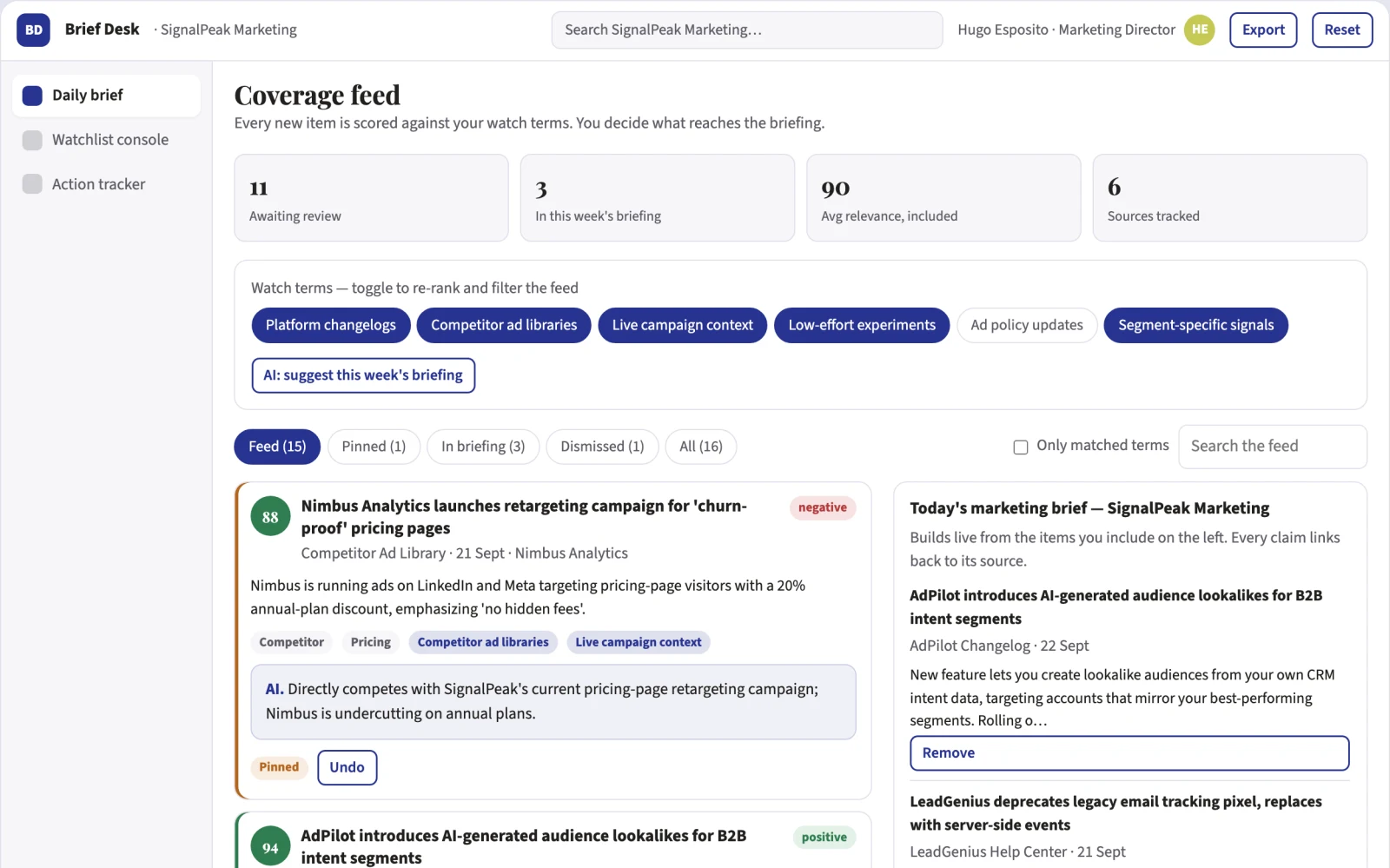
Key screens: Watchlist console, daily brief, action tracker. Use a left-hand panel listing monitored platforms and competitors, a central brief view with the one-page summary and audio player, and a right-hand panel showing why each change was selected with links to sources. Let users mark actions as tried, dismissed or deferred, and show past briefs in a searchable archive. In this product, the first view is daily brief, followed by watchlist console and action tracker.
Admin
Team accounts with role permissions, watchlist ownership per brand, brief versions and archive, review approval states, source citation log and an audit trail of what was published and when.
03Market gap
Alternatives buyers use today
Teams today read platform blogs, changelogs and Twitter threads manually, or buy static courses that date quickly. This differs by watching continuously, writing for the client's specific context and updating itself when sources change.
Where this wins
Each client builds a history of adopted and ignored actions, making the briefs increasingly tuned to that team, and the reviewed source library grows harder to replicate than raw monitoring alone.
04Why now
Marketing teams are adopting AI for exactly this kind of repeatable work, and the cost of language and vision models has dropped far enough that a narrow, reviewed workflow pays back quickly. The buyer already feels the problem: marketing playbooks go stale between updates and teams waste budget on tactics that quietly stopped working.
05Proof & signals
Channels where buyers gather: B2B SaaS marketing communities, marketing operations newsletters, LinkedIn outreach to marketing directors, and conferences for marketing leaders.. Metrics that prove it works: Brief open or listen rate above 80 percent of working days, and at least one adopted experiment per week per team..
Paid pilot
Run four weeks with one team at a discounted rate. Baseline: hours spent weekly reading platform updates and number of tactics adopted from static sources. Decision: if the team reads the brief at least four days a week and acts on at least one suggestion per week, proceed to full pricing.
06Execution plan
MVP
One marketing team as buyer, one use case: a daily email brief covering the changelogs of their three most-used platforms and one top competitor's public ads. Modules: watchlist console and daily brief. Every brief passes manual review before sending, no voice output and no personalisation beyond industry.
First 30 days
Week 1: build the watchlist ingestion for three platforms and one competitor and the brief template. Week 2: run nightly generation for one pilot team with manual review of every brief. Week 3: add the archive, action tracking and weekly adoption summary. Week 4: review accuracy and usefulness with the client and agree the paid pilot terms.
After the pilot
After the paid pilot, automate voice summaries, personalisation against CRM segments and live campaigns, per-brand feeds for larger teams, and adaptive follow-up when briefs are ignored.
Retention
The daily habit, the growing archive of past briefs and the adoption history tuned to the team make the service part of the morning routine, and per-brand feeds expand the account.
Integrations
Start with email delivery and RSS or public changelog pages, then Google Ads and Meta ad libraries, HubSpot or Salesforce CRM, Slack and calendar for delivery timing.
07Investment and running costs
| Phase | Scope | Time | Budget |
|---|---|---|---|
| MVP | One buyer segment, one recurring use case; first modules: watchlist console and daily brief. Manual review in the loop. | 2 days | $5,000 |
| Paid pilot | Accounts, roles, review states, audit trail and the first integration, hardened for two to three paying pilot customers. | 3 days | $4,500 |
| Full product | Self-serve onboarding, billing, monitoring and the wider integration set. | 5 days | $6,000 |
| Total | $15,500 | ||
| Running | Hosting | AI usage | Total a month |
|---|---|---|---|
| MVP and paid pilot (about 3 customers) | $30–$60 | $50–$100 | $80–$160 |
| Full product (about 50 customers) | $110–$210 | $350–$700 | $460–$910 |
Revenue model to test
Flat monthly fee per marketing team, tested at 500 USD per month, with per-brand feeds at 300 USD per additional brand for larger teams.
Cost drivers
Nightly inference for monitoring and brief generation, human review time, voice synthesis, hosting and integration maintenance.
Safeguards
Every brief carries source citations and a review state before release. Permissions limit who can edit watchlists and approve briefs. The agent must not publish unreviewed claims, act on the client's ad accounts, contact competitors, or use non-public data, and misleading release notes must be flagged rather than summarised faithfully.
Take it further
Solution blueprint, rewritten from an earlier Nexibeo concept. Demand, pricing, build scope and integrations are working assumptions, not verified market findings. The MVP and the paid pilot exist to confirm them for your business before the larger build.