Purchase Follow-up Agent
One-size-fits-all thank-you emails miss the chance to turn one-time buyers into repeat customers. Messages that remember what each customer bought and why, trained on the brand's voice, for every single order.
01The offer
For e-commerce managers at small direct-to-consumer brands, turn order data, product descriptions and customer history into personalised follow-up messages that ask the right question at the right time. Address the recurring problem: one-size-fits-all thank-you emails miss the chance to turn one-time buyers into repeat customers. The value hypothesis is higher reply and repeat purchase rates without extra staff time; the pilot must establish whether that benefit is real.
- For
- E-commerce managers at small direct-to-consumer brands
- Takes in
- Order data, product descriptions, customer history and brand voice examples
- Delivers
- Personalised follow-up messages and managed reply conversations
- Message
- Turn every purchase into a conversation that brings buyers back.
- Lead magnet
- A free sample follow-up message for the store's last ten orders, showing how personalisation could look.
02How it works
- Read each new order with product and customer details
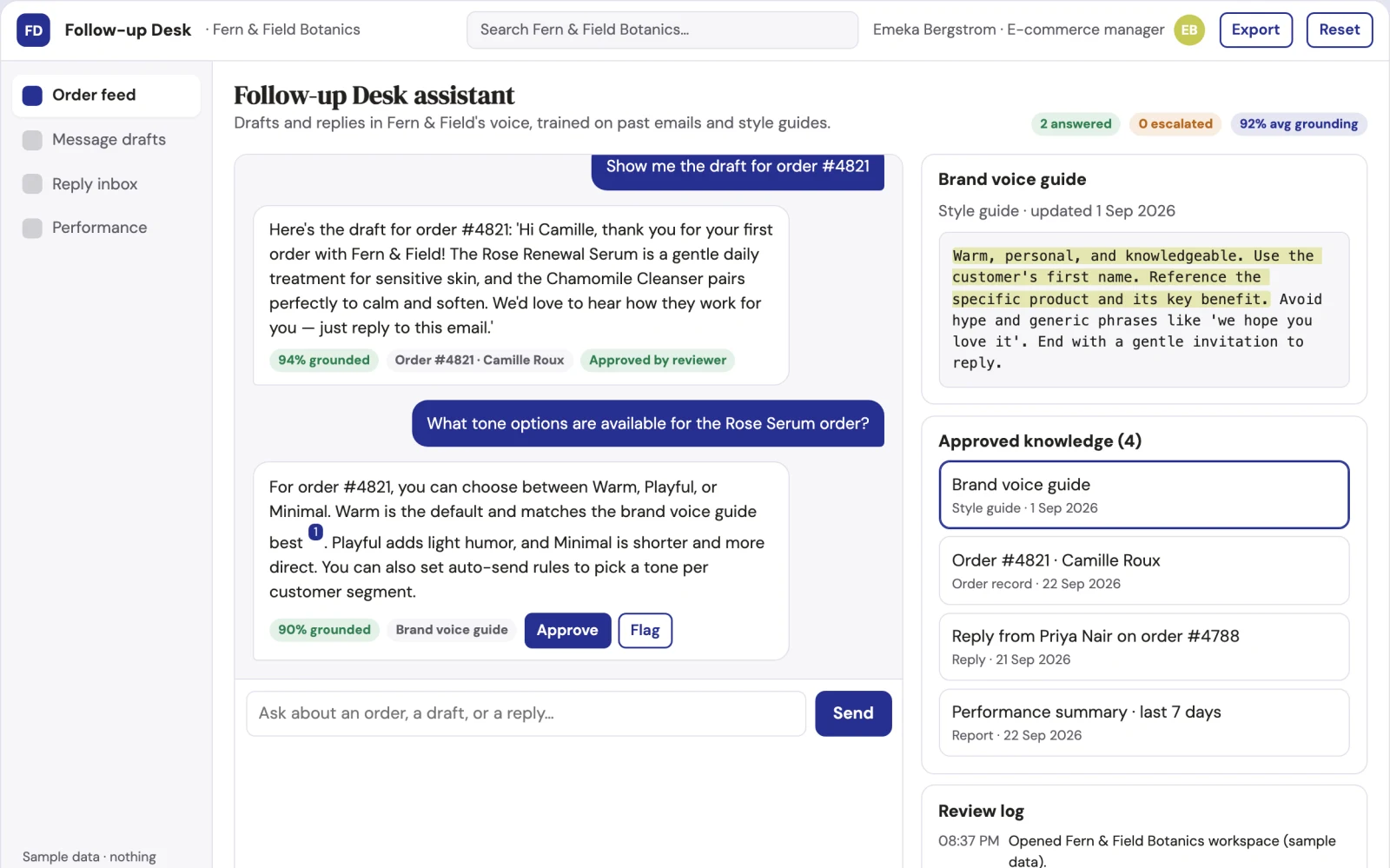
- Draft a personalised follow-up message per order
- Offer tone options trained on the brand's voice
- Let users review drafts or set auto-send rules
- Handle replies with suggested responses for approval
- Track open, reply and repeat purchase rates
Workflow
Connect the store, sync new orders, review drafts, set auto-send rules, send messages, handle replies, and review performance. Start with order data, product descriptions and customer history and finish with personalised follow-up messages and reply handling.
AI and people
Use language models to draft messages based on order details, product descriptions and customer history. Train on the brand's voice using past emails and style guides. A store owner or manager reviews drafts before auto-send is enabled, and checks suggested replies before they go out. The agent learns from open and reply rates to improve tone and timing.
Screens
Key screens: Order feed, message drafts, reply inbox, performance dashboard. Use a list of recent orders on the left, a central preview of the drafted message, and a right-hand panel showing customer history and product details. Let users approve, edit or set auto-send rules per brand. Display draft, sent and replied states. Provide a reply inbox where the agent handles incoming messages. In this product, the first view is order feed, followed by message drafts and reply inbox.
Admin
Store accounts, message templates, auto-send rules, tone settings, approval states, reply permissions, performance reports and an audit trail of all sent messages.
03Market gap
Alternatives buyers use today
People use blast email tools with templates or hire copywriters for high-value orders. This differs by personalising every message at scale and handling replies without extra staff.
Where this wins
The more orders and replies the agent processes, the better it learns each brand's tone and each customer's preferences, making the output harder to replicate with a generic tool.
04Why now
Marketing teams are adopting AI for exactly this kind of repeatable work, and the cost of language and vision models has dropped far enough that a narrow, reviewed workflow pays back quickly. The buyer already feels the problem: one-size-fits-all thank-you emails miss the chance to turn one-time buyers into repeat customers.
05Proof & signals
Channels where buyers gather: E-commerce communities, DTC brand forums, Shopify app marketplace, and social media groups for small online retailers.. Metrics that prove it works: Reply rate on follow-up messages and repeat purchase rate within 60 days of the original order..
Paid pilot
A paid pilot with three DTC brands proves it by comparing reply and repeat purchase rates against their previous blast email campaigns over 30 days. The decision to continue depends on a 20% higher reply rate and a 10% higher repeat purchase rate.
06Execution plan
MVP
One buyer: e-commerce managers at small DTC brands. One use case: follow-up email per order. First two modules: order feed and message drafts. Manual review of every draft before sending.
First 30 days
Week 1: Build the Shopify integration and order feed. Week 2: Develop the drafting engine with brand voice training. Week 3: Build the review interface and auto-send rules. Week 4: Run a pilot with three stores and measure reply rates.
After the pilot
After the paid pilot, automate reply handling with suggested responses, add reorder reminders based on purchase cycles, and integrate with loyalty programmes and subscription tools.
Retention
The agent keeps learning from each order and reply, improving message quality and timing, so stores rely on it for ongoing customer retention rather than one-off campaigns.
Integrations
Start with Shopify and WooCommerce order systems, then add email platforms like Gmail or Outlook, and later connect to loyalty and subscription tools.
07Investment and running costs
| Phase | Scope | Time | Budget |
|---|---|---|---|
| MVP | One buyer segment, one recurring use case; first modules: order feed and message drafts. Manual review in the loop. | 2 days | $5,000 |
| Paid pilot | Accounts, roles, review states, audit trail and the first integration, hardened for two to three paying pilot customers. | 3 days | $4,000 |
| Full product | Self-serve onboarding, billing, monitoring and the wider integration set. | 5 days | $6,000 |
| Total | $15,000 | ||
| Running | Hosting | AI usage | Total a month |
|---|---|---|---|
| MVP and paid pilot (about 3 customers) | $30–$60 | $60–$120 | $90–$180 |
| Full product (about 50 customers) | $110–$210 | $530–$1,050 | $640–$1,260 |
Revenue model to test
Test pricing at $99 per month for up to 500 orders, scaling by order volume, as a hypothesis to validate with early pilots.
Cost drivers
Main delivery costs are AI inference for drafting and replying, integration maintenance for Shopify and WooCommerce, and onboarding support for each store.
Safeguards
Store owners approve drafts before auto-send, set limits on message frequency, restrict replies to approved topics, and the agent must not send promotional content without explicit approval or share customer data outside the store's systems.
Take it further
Solution blueprint, rewritten from an earlier Nexibeo concept. Demand, pricing, build scope and integrations are working assumptions, not verified market findings. The MVP and the paid pilot exist to confirm them for your business before the larger build.