Social Presence Assistant
Silent social accounts and missed customers because there is no time or budget for a dedicated social media manager. A system that learns each brand's unique voice from its own content and tracks what drives clicks and sales, without requiring constant human babysitting.
01The offer
For owners of small e-commerce stores and local service businesses, turn a website, logo, tone notes and past posts into an approved monthly content calendar with scheduled posts and drafted replies. Address the recurring problem: silent social accounts and missed customers because there is no time or budget for a dedicated social media manager. The value hypothesis is a consistent, on-brand presence without hiring staff; the pilot must establish whether that benefit is real.
- For
- Owners of small e-commerce stores and local service businesses
- Takes in
- Website, logo, tone notes and past posts
- Delivers
- Approved monthly content calendar with scheduled posts and drafted replies
- Message
- Keep your social media calm and consistent without hiring a person.
- Lead magnet
- A free one-week sample content calendar for your brand, generated from your website and past posts.
02How it works
- Ingest brand website and past posts
- Generate a monthly content calendar with captions and images
- Schedule posts after approval
- Monitor comments and draft replies
- Flag uncertain questions for human review
- Track post performance and adjust future topics
Workflow
Connect social accounts, share brand details, review generated calendar, approve or edit posts, schedule publishing, monitor engagement, and review flagged replies. Start with website, logo, tone notes and past posts and finish with approved monthly content calendar with scheduled posts and drafted replies.
AI and people
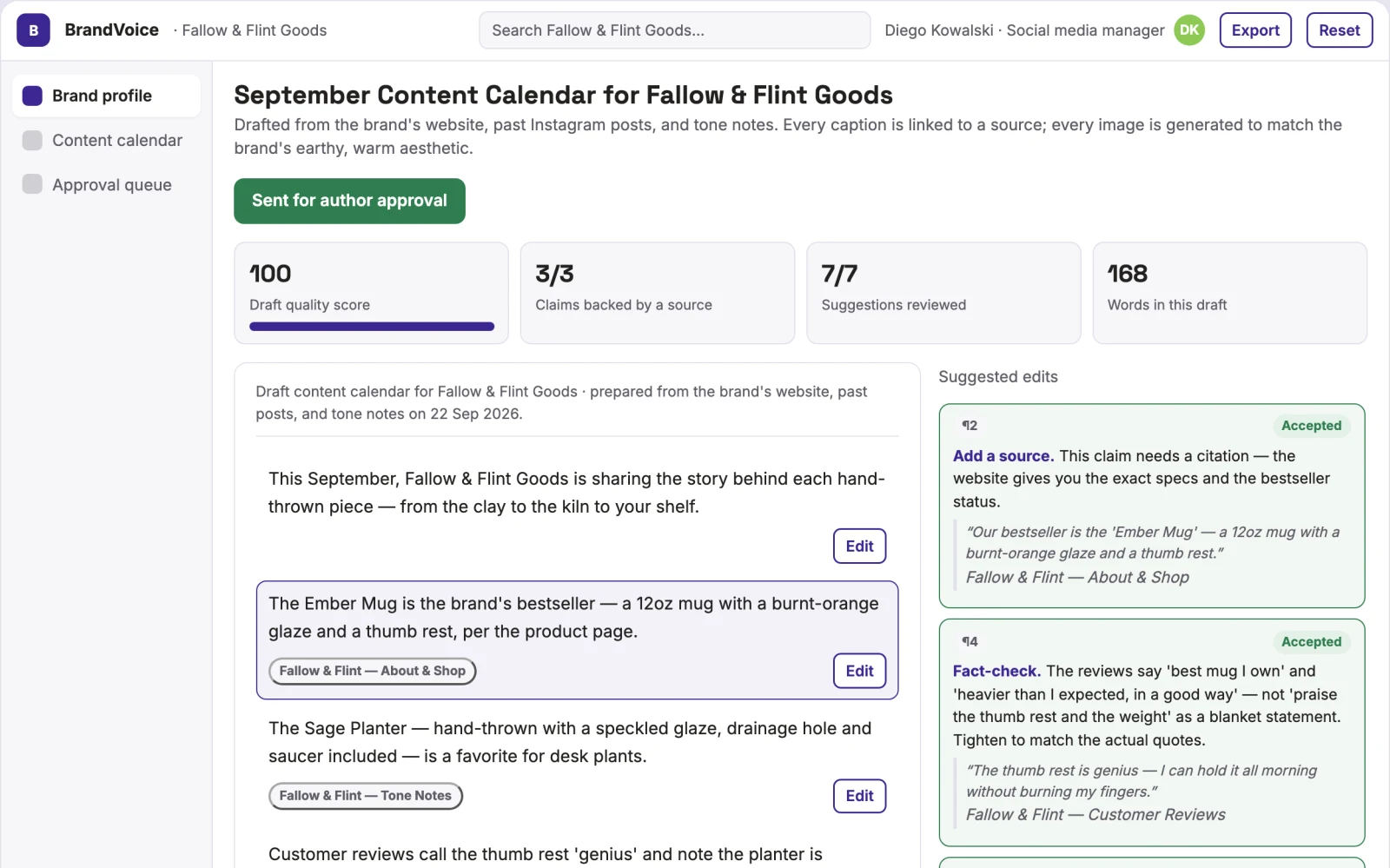
Use language models to generate posts and replies in the brand voice, and image models to create visuals. Track engagement data to learn which topics perform. A human approves all posts before publishing and checks flagged replies before they are sent.
Screens
Key screens: Brand profile, content calendar, approval queue. Use a dashboard showing the monthly calendar with draft posts, images and captions. Let users open each post for editing and approve or request changes. Show a reply inbox with drafted responses and a flag for human review. Display publishing status and engagement metrics. In this product, the first view is brand profile, followed by content calendar and approval queue.
Admin
Brand accounts, user roles, post versions, approval states, publishing logs, reply drafts, engagement history and an audit trail of all generated and published content.
03Market gap
Alternatives buyers use today
Hiring a part-time social media manager or using generic scheduling tools; this differs by generating on-brand content and replies automatically, with human approval only where needed.
Where this wins
The more posts and engagement data it ingests, the better it models each brand's voice and audience, making the output harder to replicate with a generic tool.
04Why now
Marketing teams are adopting AI for exactly this kind of repeatable work, and the cost of language and vision models has dropped far enough that a narrow, reviewed workflow pays back quickly. The buyer already feels the problem: silent social accounts and missed customers because there is no time or budget for a dedicated social media manager.
05Proof & signals
Channels where buyers gather: Small business forums, e-commerce communities, local business groups, and social media marketing webinars.. Metrics that prove it works: Number of posts published per month and engagement rate (likes, comments, clicks) per post..
Paid pilot
Run a paid pilot with three small businesses for one month. Baseline: current posting frequency and engagement. Decision: renew if posting frequency increases by at least 50% and engagement improves without extra staff time.
06Execution plan
MVP
One buyer, one social platform, first two modules: content generation and approval dashboard. Manual review of all posts and replies before publishing.
First 30 days
Week 1: Build brand profile ingestion and content generation for one platform. Week 2: Create approval dashboard and draft calendar view. Week 3: Add scheduling and comment monitoring with manual reply drafts. Week 4: Test with three pilot brands and refine voice accuracy.
After the pilot
Automate publishing and comment replies after pilot approval, then add performance-based topic suggestions and multi-platform support.
Retention
Monthly subscription continues as long as the calendar and replies are used; value grows as the system learns the brand's best-performing topics.
Integrations
Instagram first, then Facebook and LinkedIn; connect via official APIs and webhooks for comments and engagement data.
07Investment and running costs
| Phase | Scope | Time | Budget |
|---|---|---|---|
| MVP | One buyer segment, one recurring use case; first modules: content generation and approval dashboard. Manual review in the loop. | 2 days | $5,000 |
| Paid pilot | Accounts, roles, review states, audit trail and the first integration, hardened for two to three paying pilot customers. | 3 days | $4,500 |
| Full product | Self-serve onboarding, billing, monitoring and the wider integration set. | 5 days | $6,000 |
| Total | $15,500 | ||
| Running | Hosting | AI usage | Total a month |
|---|---|---|---|
| MVP and paid pilot (about 3 customers) | $30–$60 | $70–$140 | $100–$200 |
| Full product (about 50 customers) | $110–$210 | $700–$1,400 | $810–$1,610 |
Revenue model to test
Test a flat monthly fee: $99 per brand account for one platform and 12 posts per month, $299 for auto-publishing and comment replies.
Cost drivers
Cloud compute for AI model calls, image generation, storage for brand data and content, and human review time for flagged items.
Safeguards
Limit publishing to approved posts only, require human approval for any reply flagged as uncertain, restrict access to brand accounts, and never post or reply without explicit user consent. It must not impersonate the brand in a way that misleads customers.
Take it further
Solution blueprint, rewritten from an earlier Nexibeo concept. Demand, pricing, build scope and integrations are working assumptions, not verified market findings. The MVP and the paid pilot exist to confirm them for your business before the larger build.