AI Faculty Coach
Teachers want to teach creativity and resilience but lack the training and time to design these lessons. Teachers rehearse real classroom moments with a patient AI role-play and get line-by-line feedback on how they responded.
01The offer
For heads of teaching and learning at independent schools, turn teacher profiles and lesson plans into trained staff capable of delivering life skills. Address the problem that school systems reward test scores not life outcomes. The value hypothesis is that upskilling adults is more effective than another app for students.
- For
- Heads of teaching and learning at independent schools
- Takes in
- Teacher profiles, lesson plans, classroom recordings or written reflections
- Delivers
- Trained staff, feedback reports, lesson plans
- Message
- Train your staff in life skills without the scheduling headaches
- Lead magnet
- A free demonstration of a financial literacy module
02How it works
- Simulate classroom scenarios
- Adapt training to subject and grade level
- Provide line-by-line feedback on reflections
- Deliver micro-lessons via text and voice
- Track cohort progress and blockers
- Generate progress reports for school leadership
Workflow
Select a module, complete a micro-lesson, practice a simulation, submit a classroom reflection, receive AI feedback, review cohort notes, and apply techniques in class. Start with teacher profiles and lesson plans and finish with trained staff and feedback reports.
AI and people
Use language models to interpret lesson plans and generate role-play scenarios. Keep pedagogical frameworks in structured fields. Validate feedback tone and accuracy through deterministic checks. A pedagogy expert confirms the AI's coaching quality and relevance before deployment.
Screens
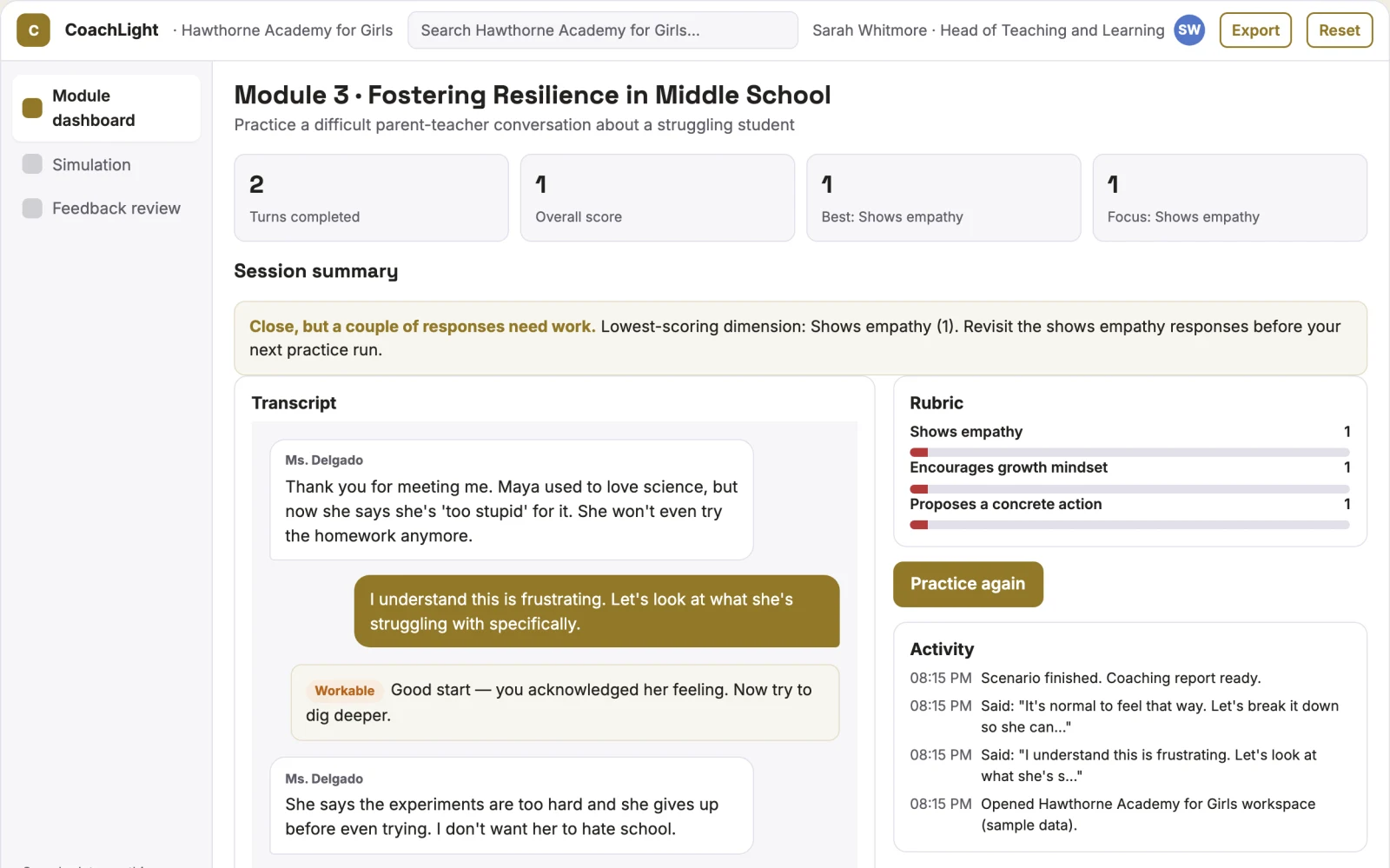
Key screens: Module dashboard, simulation interface, feedback review. Use a central simulation canvas for the role-play and a right-hand panel for references, constraints and feedback. Display the scenario text and the AI's response. Show the teacher's input and the AI's evaluation. In this product, the first view is the module dashboard, followed by the simulation interface and feedback review.
Admin
User accounts, module versions, coaching session history, approval states for feedback, audit trail
03Market gap
Alternatives buyers use today
People use recorded videos and static forums. This differs by offering interactive role-play and real-time feedback.
Where this wins
Fine-tuning on specific pedagogies creates a moat. Data on successful coaching interactions improves the model over time.
04Why now
Education teams are adopting AI for exactly this kind of repeatable work, and the cost of language and vision models has dropped far enough that a narrow, reviewed workflow pays back quickly. The buyer already feels the problem: teachers want to teach creativity and resilience but lack the training and time to design these lessons.
05Proof & signals
Channels where buyers gather: School boards, EdTech conferences, LinkedIn. Metrics that prove it works: Teacher retention rates and student engagement scores.
Paid pilot
The pilot proves value by comparing teacher retention and training costs against current methods. The baseline is the cost of in-person workshops. The decision is whether the license model is viable.
06Execution plan
MVP
One buyer (independent school), one use case (financial literacy), first two modules, manual review of feedback
First 30 days
Week 1: Ship one 4-week module on teaching financial literacy. Week 2: Fine-tune the AI on a specific pedagogy. Week 3: Launch the platform for one teacher. Week 4: Collect audio clips and provide manual feedback.
After the pilot
Automated cohort meetings, integration with LMS, advanced analytics on student outcomes
Retention
Earn through annual licenses and new module releases
Integrations
Learning Management Systems, HR databases
07Investment and running costs
| Phase | Scope | Time | Budget |
|---|---|---|---|
| MVP | One buyer segment, one recurring use case. Manual review in the loop. | 2 days | $5,000 |
| Paid pilot | Accounts, roles, review states, audit trail and the first integration, hardened for two to three paying pilot customers. | 3 days | $4,500 |
| Full product | Self-serve onboarding, billing, monitoring and the wider integration set. | 5 days | $6,500 |
| Total | $16,000 | ||
| Running | Hosting | AI usage | Total a month |
|---|---|---|---|
| MVP and paid pilot (about 3 customers) | $30–$60 | $50–$110 | $80–$170 |
| Full product (about 50 customers) | $110–$210 | $420–$840 | $530–$1,050 |
Revenue model to test
Test pricing at 500 dollars per teacher per year
Cost drivers
Compute costs for LLM inference and voice synthesis
Safeguards
The AI must not grade students or replace human judgment. It must respect data privacy
Take it further
Solution blueprint, rewritten from an earlier Nexibeo concept. Demand, pricing, build scope and integrations are working assumptions, not verified market findings. The MVP and the paid pilot exist to confirm them for your business before the larger build.