Solution Database / Operations
GrowthFit Clothing Cycle
Parents guess sizes, juggle returns, and store piles of outgrown clothes. A closed loop that predicts size, ships, validates fit, and resells outgrown items automatically, all in one subscription.
01The offer
For parents of children aged 0 to 5 who buy clothes online, turn age, measurements, fit photos and style preferences into predicted size boxes and automated resale listings. Address the recurring problem: children outgrow items every few months, making buying expensive and wasteful. The value hypothesis is a smoother, less wasteful clothing cycle with minimal effort; the pilot must establish whether parents trust the size predictions enough to stay subscribed.
- For
- Parents of children aged 0 to 5 who buy clothes online
- Takes in
- Child age, current size, style preferences, fit photos
- Delivers
- Predicted size clothing boxes, resale listings, resale credits
- Message
- Never guess a size again: we predict, deliver, and resell your child's clothes automatically.
- Lead magnet
- A free size forecast report for your child based on age and current measurements.
02How it works
- Enter child age, current size and style preferences
- Receive predicted next size with confidence level
- Review and edit box contents before dispatch
- Upload fit photo for AI analysis
- Approve resale listings and pricing
- Track credits and shipping labels
Workflow
Create child profile, set size and style, receive size forecast, review box contents, ship and receive box, upload fit photo, adjust model, list outgrown items, approve resale, and receive credits. Start with age, measurements and style preferences and finish with predicted size boxes and automated resale credits.
AI and people
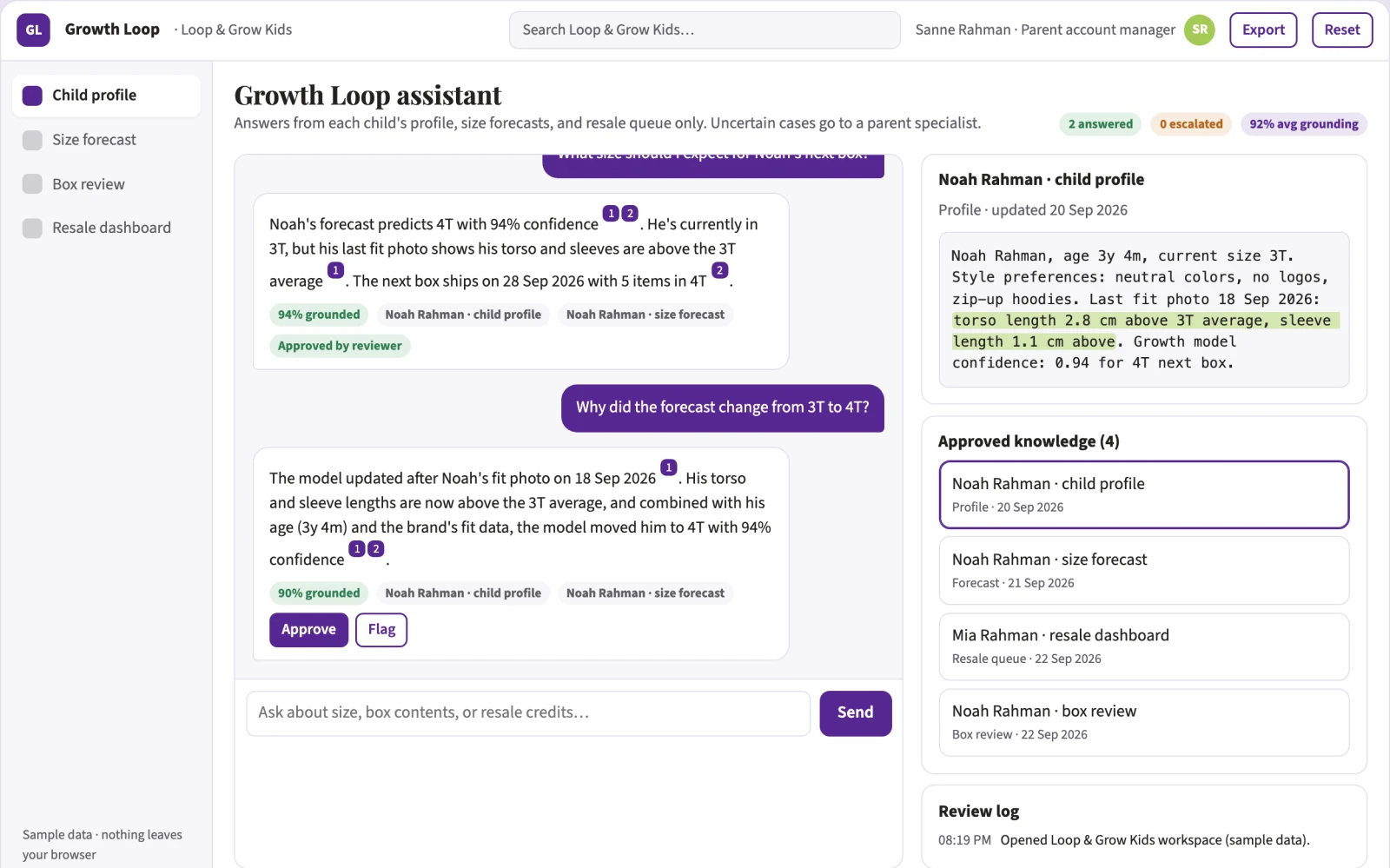
Use growth prediction models to forecast size changes based on age, past measurements and brand fit data. Use computer vision to analyse fit photos and confirm or adjust predictions. An AI agent drafts resale listings with dynamic pricing and generates shipping labels. A human parent reviews and approves each box and each resale listing before anything is used.
Screens
Key screens: Child profile, size forecast, box review, fit photo upload, resale dashboard. Use a dashboard with a child profile at top, a timeline of predicted growth and upcoming boxes, and a queue of outgrown items ready for resale. Let parents confirm or adjust box contents before shipping. Display fit status from recent photos and resale credits. In this product, the first view is child profile, followed by size forecast and box review.
Admin
Child profiles, subscription status, box history, fit photo records, resale approvals, credit ledger, shipping label history and audit trail of all AI decisions.
03Market gap
Alternatives buyers use today
Parents today guess sizes, buy multiple sizes, return items, and sell outgrown clothes manually on marketplaces. This differs by automating the entire cycle with AI-driven prediction and resale.
Where this wins
The more fit photos and size outcomes collected, the more accurate the growth model becomes, making predictions harder for competitors to match.
04Why now
Operations teams are adopting AI for exactly this kind of repeatable work, and the cost of language and vision models has dropped far enough that a narrow, reviewed workflow pays back quickly. The buyer already feels the problem: parents guess sizes, juggle returns, and store piles of outgrown clothes.
05Proof & signals
Channels where buyers gather: Parenting blogs, social media groups for young families, and online kids clothing retailers.. Metrics that prove it works: Percentage of boxes accepted without changes; average time from outgrown to resold..
Paid pilot
Run a paid pilot with 20 families for 3 months. Baseline is current time spent on buying and selling clothes. Success is 80% of boxes accepted without changes and 70% of outgrown items resold within 2 weeks. Decision: continue if retention after 3 months is above 60%.
06Execution plan
MVP
One buyer: parents of children aged 0 to 5. One use case: monthly box of pre-loved clothes in predicted size. First two modules: size forecast and box review. Manual review of fit photos and resale listings by a human stylist.
First 30 days
Week 1: Build child profile and size forecast module. Week 2: Integrate fit photo upload and basic vision analysis. Week 3: Add box review and subscription flow. Week 4: Test resale listing generation with manual approval.
After the pilot
Automate fit photo analysis fully, integrate with resale marketplaces for auto-listing, add voice commands for pause and reorder, and use inventory matching to reduce dead stock across subscribers.
Retention
Monthly subscription continues as long as predictions stay accurate; resale credits encourage ongoing engagement and reduce churn.
Integrations
E-commerce platforms for ordering, resale marketplaces for listings, shipping carriers for labels, and payment systems for credits.
07Investment and running costs
| Phase | Scope | Time | Budget |
|---|---|---|---|
| MVP | One buyer segment, one recurring use case; first modules: size forecast and box review. Manual review in the loop. | 2 days | $5,000 |
| Paid pilot | Accounts, roles, review states, audit trail and the first integration, hardened for two to three paying pilot customers. | 3 days | $4,000 |
| Full product | Self-serve onboarding, billing, monitoring and the wider integration set. | 5 days | $6,000 |
| Total | $15,000 | ||
| Running | Hosting | AI usage | Total a month |
|---|---|---|---|
| MVP and paid pilot (about 3 customers) | $30–$60 | $60–$120 | $90–$180 |
| Full product (about 50 customers) | $110–$210 | $530–$1,050 | $640–$1,260 |
Revenue model to test
Test pricing at USD 29 per month for the subscription, plus a 10% fee on resale value.
Cost drivers
Model inference, photo storage, shipping labels, customer support, and marketplace integration fees.
Safeguards
Parents approve all box contents and resale listings. The AI must not auto-ship or auto-list without approval. Fit photos are stored securely and never shared. Size predictions include confidence levels so parents can override. The system must not use child data for advertising.
Take it further
Solution blueprint, rewritten from an earlier Nexibeo concept. Demand, pricing, build scope and integrations are working assumptions, not verified market findings. The MVP and the paid pilot exist to confirm them for your business before the larger build.