Solution Database / Operations
Predictive Car Care Agent
Car maintenance hits you with surprise bills and wasted mornings. A single agent that watches live data, books the shop and orders parts without any human phone tag.
01The offer
For small fleet operators with 5 to 20 vans and remote workers who drive older cars, turn live vehicle data, service history and local parts inventory into scheduled maintenance bookings, part orders and a digital maintenance log. Address the recurring problem: car maintenance hits you with surprise bills and wasted mornings. The value hypothesis is a more predictable, hands-off upkeep cycle with fewer breakdowns; the pilot must establish whether that benefit is real.
- For
- Small fleet operators with 5 to 20 vans and remote workers who drive older cars
- Takes in
- Live vehicle data, service history, local parts inventory
- Delivers
- Scheduled maintenance bookings, part orders and a digital maintenance log
- Message
- Your car books its own mechanic and orders its own parts, so you never lose a morning to maintenance.
- Lead magnet
- A free one-week vehicle health report showing predicted issues and estimated costs.
02How it works
- Monitor live OBD-II codes and telemetry
- Cross-reference service history and parts inventory
- Predict upcoming maintenance needs
- Book appointments via integrated calendar
- Order parts from preferred suppliers
- Update maintenance log and adjust predictions
Workflow
Connect vehicle, read live data, analyse fault codes and history, flag predicted issues, send plain-text alert, book slot and order parts, then file receipt and update log. Start with live vehicle data, service history and local parts inventory and finish with scheduled maintenance bookings, part orders and a digital maintenance log.
AI and people
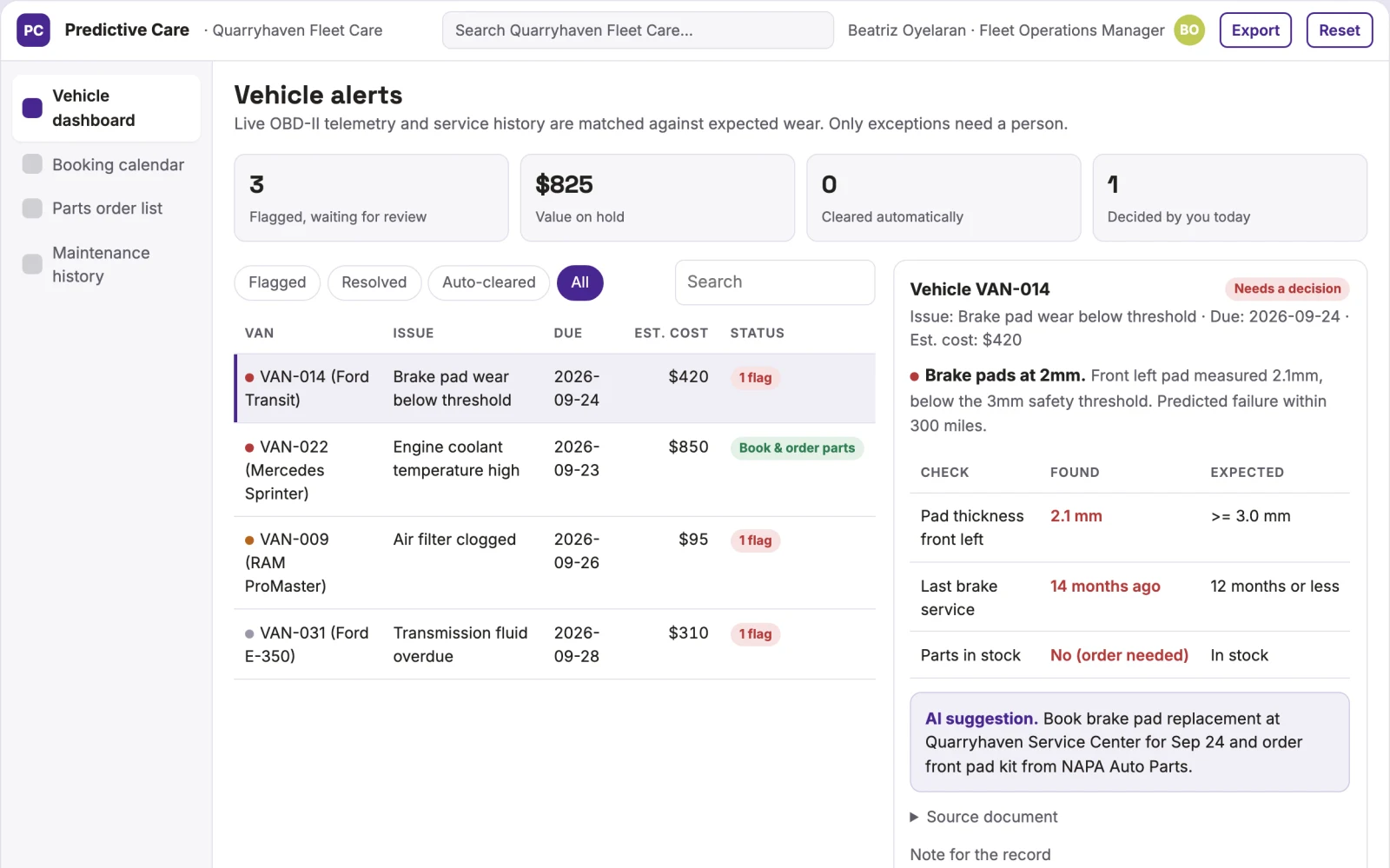
Use language models to interpret alerts and generate plain-text messages, and predictive models to estimate part wear and failure windows. A human operator reviews all bookings and part orders before they are sent. Confirm diagnosis with deterministic thresholds and manual spot checks.
Screens
Key screens: Vehicle dashboard, booking calendar, parts order list. Use a vehicle dashboard showing fault codes and predicted issues, a booking calendar with confirmed slots and a parts order list with supplier status. Let users approve or cancel actions with one tap. Display alerts as plain sentences with a 'book' or 'ignore' button. Provide a history view of past repairs and invoices. In this product, the first view is vehicle dashboard, followed by booking calendar and parts order list.
Admin
Vehicle ownership, user roles, booking approvals, part order limits, spend caps, audit trail of all actions, and a permission setting for automatic versus manual booking.
03Market gap
Alternatives buyers use today
People use manual reminders, garage phone calls and spreadsheets. This differs by automating the entire chain from detection to booking to payment.
Where this wins
It gets harder to copy as the prediction model learns each vehicle's wear patterns and garage preferences, and as it accumulates approved service histories and supplier relationships.
04Why now
Operations teams are adopting AI for exactly this kind of repeatable work, and the cost of language and vision models has dropped far enough that a narrow, reviewed workflow pays back quickly. The buyer already feels the problem: car maintenance hits you with surprise bills and wasted mornings.
05Proof & signals
Channels where buyers gather: Fleet management forums, local garage newsletters, and social media groups for remote workers and van owners.. Metrics that prove it works: Two measurable outcomes: reduction in unplanned maintenance hours per vehicle, and percentage of predicted issues booked without user intervention..
Paid pilot
Run a four-week paid pilot with five vans. Baseline is average hours lost to maintenance and number of surprise repairs. Decision to expand if the agent cuts hours lost by half and books at least 80 percent of predicted maintenance without user follow-up.
06Execution plan
MVP
One car brand, one city, two trusted garages. First two modules: OBD-II code monitoring and calendar booking. Manual review of every alert and order before sending.
First 30 days
Week 1: Build OBD-II reader and alert parser. Week 2: Connect calendar booking and SMS alerts. Week 3: Add parts order draft and manual approval. Week 4: Pilot with two garages and five vehicles, collect feedback.
After the pilot
Automate parts ordering, voice memo intake, and multi-brand support after the paid pilot.
Retention
It keeps earning as a monthly subscription, with the agent continuously updating the maintenance log and prediction model, making the service more accurate and harder to leave.
Integrations
OBD-II adapters, manufacturer APIs, Calendly, Stripe, email and SMS gateways, and parts supplier catalogues.
07Investment and running costs
| Phase | Scope | Time | Budget |
|---|---|---|---|
| MVP | One buyer segment, one recurring use case; first modules: OBD-II code monitoring and calendar booking. Manual review in the loop. | 3 days | $5,500 |
| Paid pilot | Accounts, roles, review states, audit trail and the first integration, hardened for two to three paying pilot customers. | 4 days | $5,500 |
| Full product | Self-serve onboarding, billing, monitoring and the wider integration set. | 6 days | $7,500 |
| Total | $18,500 | ||
| Running | Hosting | AI usage | Total a month |
|---|---|---|---|
| MVP and paid pilot (about 3 customers) | $30–$60 | $40–$90 | $70–$150 |
| Full product (about 50 customers) | $110–$210 | $280–$560 | $390–$770 |
Revenue model to test
Test pricing at USD 19 per vehicle per month, half the average unexpected repair bill.
Cost drivers
Cloud inference, OBD-II adapter subsidies, calendar and payment API fees, and a human reviewer for initial alerts.
Safeguards
Limits on spend per vehicle, approval required for any booking over a set amount, no automatic part ordering without user consent, and a hard stop on driving alerts that could indicate immediate safety risk. It must not book emergency repairs or order parts without explicit approval.
Take it further
Solution blueprint, rewritten from an earlier Nexibeo concept. Demand, pricing, build scope and integrations are working assumptions, not verified market findings. The MVP and the paid pilot exist to confirm them for your business before the larger build.