Solution Database / Operations
Returns Triage Console
A returns inbox fills with blurry photos, missing labels and long threads, so staff open every box just to confirm what the photo already shows, then retype the same reply. The automation reads photos and order history together and drafts a policy-based reply, so staff approve rather than investigate, and the system learns from every approved edit.
01The offer
For operations leads at mid-sized online retailers, turn return requests, photos, order history and customer notes into a predicted outcome with a draft reply queued for staff approval. Address the recurring problem: exceptions sit for days because only a supervisor knows the warranty or restock rules. The value hypothesis is faster triage with less manual opening and retyping; the pilot must establish whether the prediction is accurate enough to save time.
- For
- Operations leads at mid-sized online retailers
- Takes in
- Return requests, photos, order history and customer notes
- Delivers
- Approved outcome with reason and customer reply
- Message
- Stop opening boxes to confirm what the photo already shows; approve the outcome instead.
- Lead magnet
- A free return triage demo using ten anonymised return requests from your own inbox.
02How it works
- Match order and pull return window and purchase history
- Classify outcome as refund, repair or reject with reason
- Draft a customer reply using policy and tone
- Queue draft for staff approval or edit
- Generate refund or repair label on approval
- Log every decision for audit and policy refinement
Workflow
Customer submits a return request with photos and order number, automation matches the order, pulls the return window and item condition, classifies the outcome, writes a draft reply, staff approves or edits, and the reply and any label send. Start with return requests, photos, order history and customer notes and finish with approved outcome and customer reply.
AI and people
Use vision models to read photos and language models to draft replies and classify outcomes. Keep policy rules in structured fields. Validate order matches and return windows through deterministic checks. A staff member approves or edits before anything is sent to the customer.
Screens
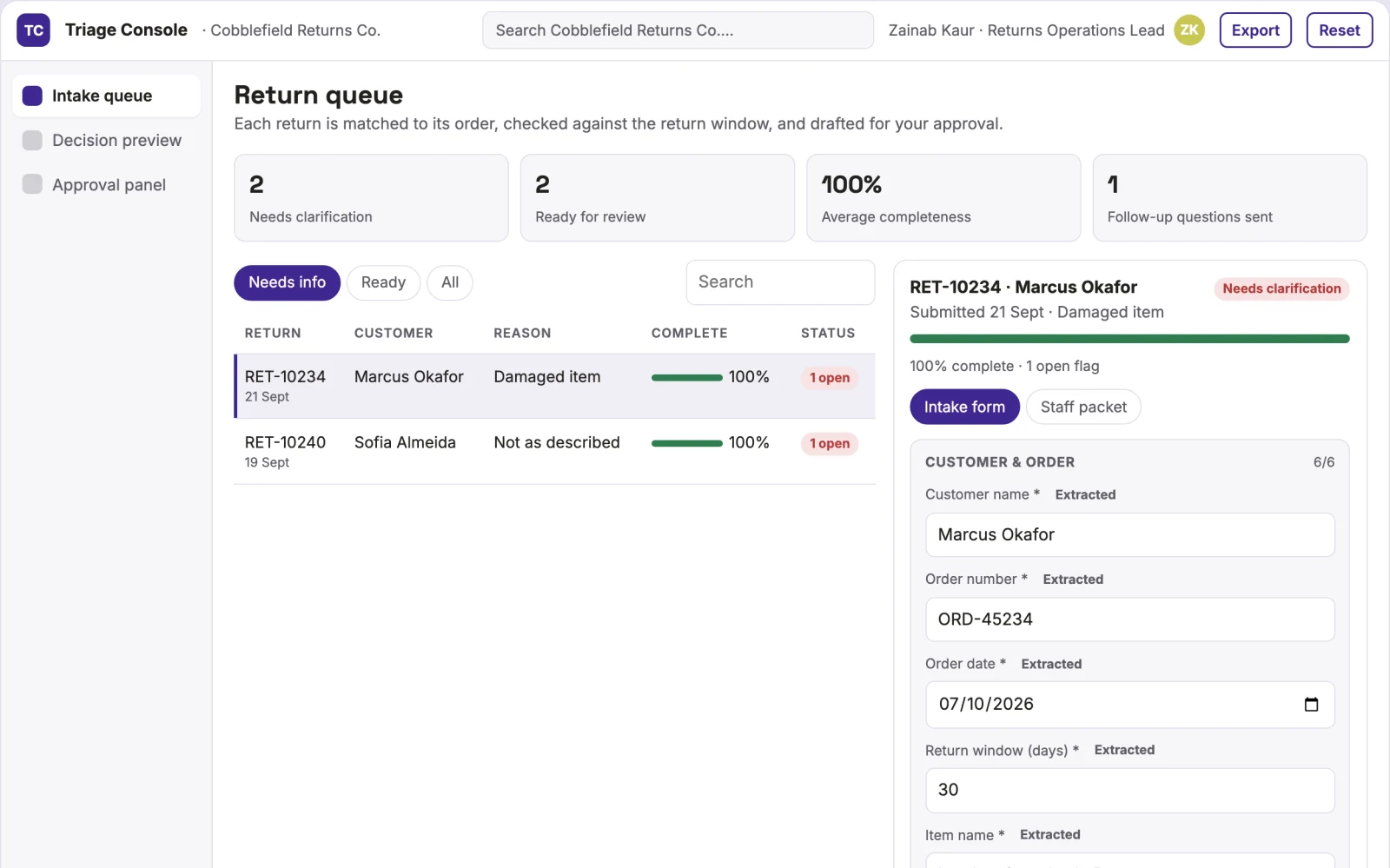
Key screens: Intake queue, decision preview, approval panel. Use a list of return requests needing a decision, each showing the predicted outcome, the reason and a draft reply. Let staff open a detail view with photos, order history and policy notes. Display approve, edit or escalate actions. Show a status filter for pending, approved and rejected. In this product, the first view is intake queue, followed by decision preview and approval panel.
Admin
Staff roles, approval permissions, decision versions, audit trail of every classification and edit, policy version history and a log of what was sent to the customer.
03Market gap
Alternatives buyers use today
People use shared inboxes, spreadsheets and manual policy checks. This differs by predicting the outcome before a human opens the box and drafting the reply in the same step.
Where this wins
The more decisions staff approve or edit, the better the classifier matches your specific policy and tone, and the harder it becomes to switch to a generic tool.
04Why now
Operations teams are adopting AI for exactly this kind of repeatable work, and the cost of language and vision models has dropped far enough that a narrow, reviewed workflow pays back quickly. The buyer already feels the problem: a returns inbox fills with blurry photos, missing labels and long threads, so staff open every box just to confirm what the photo already shows, then retype the same reply.
05Proof & signals
Channels where buyers gather: Ecommerce operations forums, logistics and fulfillment newsletters, and direct outreach to retailers with public return policies.. Metrics that prove it works: Average time from return request to approved decision, and percentage of refunds issued outside the return window..
Paid pilot
A paid pilot with one client proves it by measuring average time to decision and refund leakage before and after, with a decision to continue if time per decision drops by at least 30 percent.
06Execution plan
MVP
One buyer: operations leads at mid-sized online retailers. One use case: simple returns with clear photos and order history. First two modules: intake queue and decision preview. Manual review of every draft before send.
First 30 days
Week 1: Map the returns inbox and policy rules with the client. Week 2: Build the intake queue and order matching. Week 3: Train the classifier on sample photos and draft replies. Week 4: Run a manual review pilot with five staff and measure time saved.
After the pilot
Automate label generation, escalate edge cases to supervisors, and feed approved decisions back into the classifier to reduce manual edits over time.
Retention
It keeps earning by reducing manual review effort and refund leakage, and the classifier improves with each approved decision, making the service more valuable over time.
Integrations
Order management system, returns portal, email or Slack inbox, and refund or label generation service.
07Investment and running costs
| Phase | Scope | Time | Budget |
|---|---|---|---|
| MVP | One buyer segment, one recurring use case; first modules: intake queue and decision preview. Manual review in the loop. | 2 days | $5,500 |
| Paid pilot | Accounts, roles, review states, audit trail and the first integration, hardened for two to three paying pilot customers. | 3 days | $4,500 |
| Full product | Self-serve onboarding, billing, monitoring and the wider integration set. | 5 days | $6,500 |
| Total | $16,500 | ||
| Running | Hosting | AI usage | Total a month |
|---|---|---|---|
| MVP and paid pilot (about 3 customers) | $30–$60 | $40–$90 | $70–$150 |
| Full product (about 50 customers) | $110–$210 | $280–$560 | $390–$770 |
Revenue model to test
Test a fixed fee of USD 1,500 per month per client, with a setup fee of USD 3,000, as a hypothesis.
Cost drivers
Main delivery costs are integration with order and returns systems, vision model usage, and staff time for policy setup and review during the pilot.
Safeguards
Staff must approve every reply before send. The system must not auto-approve refunds or rejections. It logs all decisions and edits, and flags out-of-policy cases for supervisor review.
Take it further
Solution blueprint, rewritten from an earlier Nexibeo concept. Demand, pricing, build scope and integrations are working assumptions, not verified market findings. The MVP and the paid pilot exist to confirm them for your business before the larger build.