Solution Database / Operations
Morning Brief Video
Every morning, you lose 45 minutes scanning Slack, email, news, and dashboards to piece together what happened overnight. A personalized, calendar-aware video brief that synthesizes overnight information into a single, watchable narrative.
01The offer
For operations leads and chiefs of staff, turn calendar, Slack, email, and public sources into a two-minute narrated video brief with chapter markers and source links. Address the problem of scattered information and time lost to manual scanning each morning.
- For
- Operations leads and chiefs of staff at companies with 50 to 200 people
- Takes in
- Calendar, Slack, email, and public sources (competitors, regulators, clients, markets)
- Delivers
- Two-minute narrated video brief with chapter markers and direct source links
- Message
- Wake up to a two-minute video that tells you exactly what changed overnight, so you can start your day informed.
- Lead magnet
- A free one-week trial with a sample brief based on your calendar and sources.
02How it works
- Connect calendar, Slack, email, and public sources
- Schedule nightly scraping and analysis
- Generate a script from top three to five relevant items
- Create a narrated video with synthetic voice and avatar
- Deliver via private link at a set time
- Allow follow-up questions that return clipped source segments
Workflow
Connect sources, set preferences, nightly analysis, script generation, video creation, delivery, and follow-up. Start with calendar, Slack, email, and public sources and finish with a two-minute video brief with source links.
AI and people
AI watches videos, reads documents, and listens to audio to extract relevant items based on calendar and projects. It generates a script and synthesizes a presenter. A human checks relevance and accuracy of the script and video before delivery.
Screens
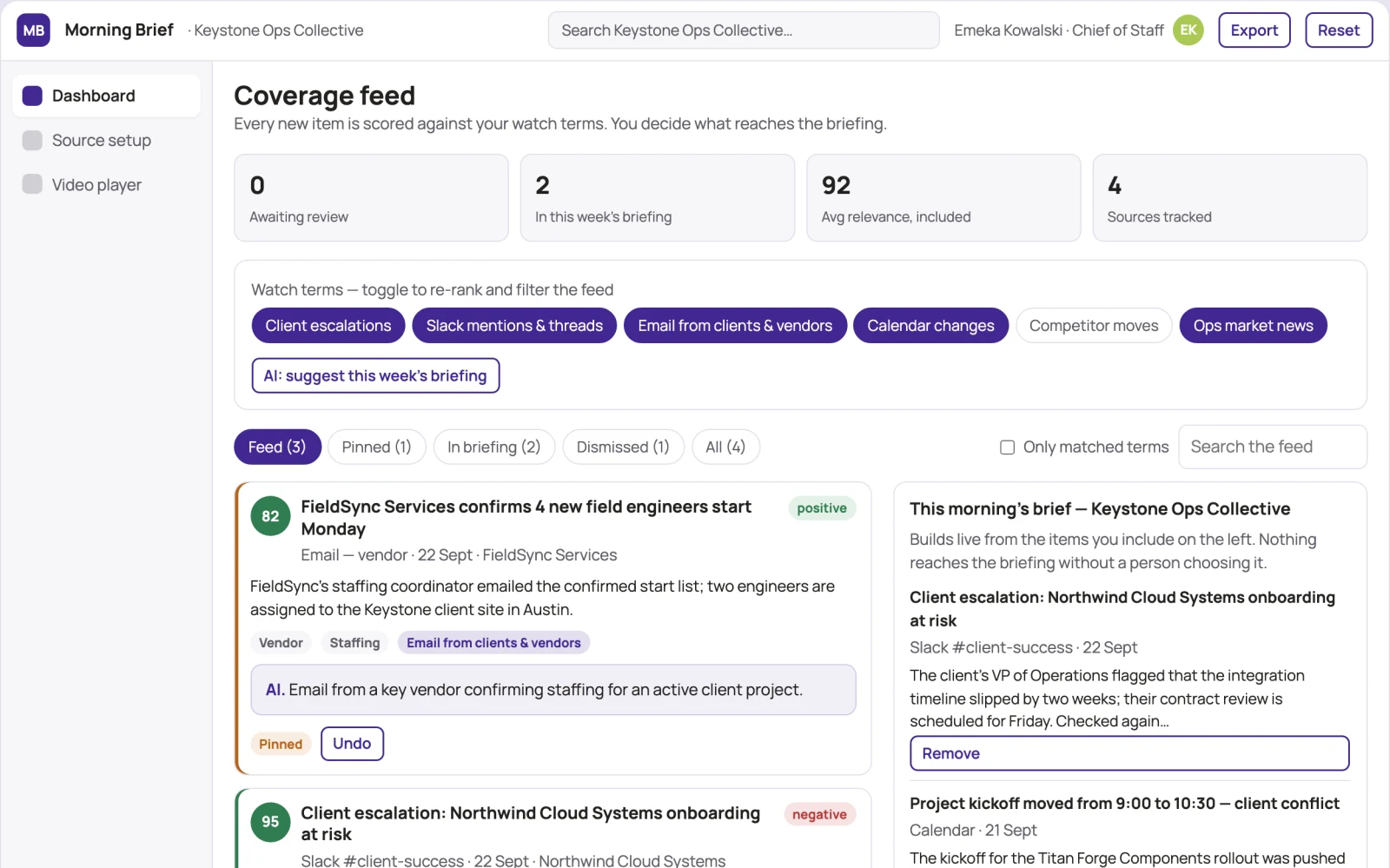
Key screens: Dashboard, Source setup, Video player. Use a dashboard showing today's brief and a list of past briefs. The source setup screen lets users connect calendar, Slack, email, and select public sources. The video player shows the narrated brief with chapter markers and clickable source links. In this product, the first view is the dashboard, followed by source setup and video player.
Admin
User accounts, source permissions, video version history, delivery logs, and audit trail of AI-generated content.
03Market gap
Alternatives buyers use today
Manual summary by a junior team member, RSS readers, or checking multiple apps individually. This differs by automating the entire process into a single video.
Where this wins
The relevance filter improves with each user interaction, making the product more accurate and harder to replicate as data accumulates.
04Why now
Operations teams are adopting AI for exactly this kind of repeatable work, and the cost of language and vision models has dropped far enough that a narrow, reviewed workflow pays back quickly. The buyer already feels the problem: every morning, you lose 45 minutes scanning Slack, email, news, and dashboards to piece together what happened overnight.
05Proof & signals
Channels where buyers gather: LinkedIn, industry newsletters, and direct outreach to operations leads and chiefs of staff.. Metrics that prove it works: Time saved per user per day, and percentage of critical items correctly identified in the brief..
Paid pilot
Run a paid pilot with one operations lead for two weeks. Measure time saved and accuracy of briefs compared to manual summary. Success if user adopts it daily and reports at least 30 minutes saved per day.
06Execution plan
MVP
One buyer (operations lead), one use case (daily morning brief), first two modules (source connection and video generation), manual review of script and video before delivery.
First 30 days
Week 1: Build source connectors and basic analysis. Week 2: Generate script and video with synthetic voice. Week 3: Deliver via email link and test with one pilot user. Week 4: Iterate on relevance and add follow-up questions.
After the pilot
Automate the review process with confidence scoring and user feedback loops to improve relevance over time.
Retention
The daily habit becomes sticky as users rely on the brief and provide feedback that improves relevance, reducing churn.
Integrations
Google Calendar, Outlook, Slack, Gmail, Microsoft 365, and public RSS feeds.
07Investment and running costs
| Phase | Scope | Time | Budget |
|---|---|---|---|
| MVP | One buyer segment, one recurring use case. Manual review in the loop. | 3 days | $6,000 |
| Paid pilot | Accounts, roles, review states, audit trail and the first integration, hardened for two to three paying pilot customers. | 4 days | $5,500 |
| Full product | Self-serve onboarding, billing, monitoring and the wider integration set. | 6 days | $7,500 |
| Total | $19,000 | ||
| Running | Hosting | AI usage | Total a month |
|---|---|---|---|
| MVP and paid pilot (about 3 customers) | $30–$60 | $50–$100 | $80–$160 |
| Full product (about 50 customers) | $110–$210 | $350–$700 | $460–$910 |
Revenue model to test
Test pricing at $49 per seat per month, with a free tier for generic industry briefs and paid plans for personal agent and custom sources.
Cost drivers
Cloud compute for AI inference, video generation, storage, and support staff.
Safeguards
Users control which sources are included and can exclude sensitive data. The AI must not access private messages without explicit permission, and all data is encrypted in transit and at rest. Human review ensures no misinformation is delivered.
Take it further
Solution blueprint, rewritten from an earlier Nexibeo concept. Demand, pricing, build scope and integrations are working assumptions, not verified market findings. The MVP and the paid pilot exist to confirm them for your business before the larger build.