Solution Database / Operations
Pantry Restock Agent
Households run out of basics and make costly last-minute trips. A vision-based inventory that learns household depletion rates and automates restock without any shopping trip, at dollar-store margins.
01The offer
For operations leads at dollar-store supply chains, turn pantry photos and usage patterns into a prepaid restock subscription with predictable delivery. Address the recurring problem: households run out of basics and make costly last-minute trips. The value hypothesis is a more convenient, cost-effective restock method; the pilot must establish whether the prediction accuracy and margin hold.
- For
- Operations leads at dollar-store supply chains
- Takes in
- Pantry photos, usage patterns, prepaid credit amount
- Delivers
- Weekly restock list, consolidated flat-box shipment, credit balance updates
- Message
- Never run out of cling film again: your pantry, photographed, restocked automatically at dollar-store prices.
- Lead magnet
- Free pantry scan and a one-week personalized depletion forecast.
02How it works
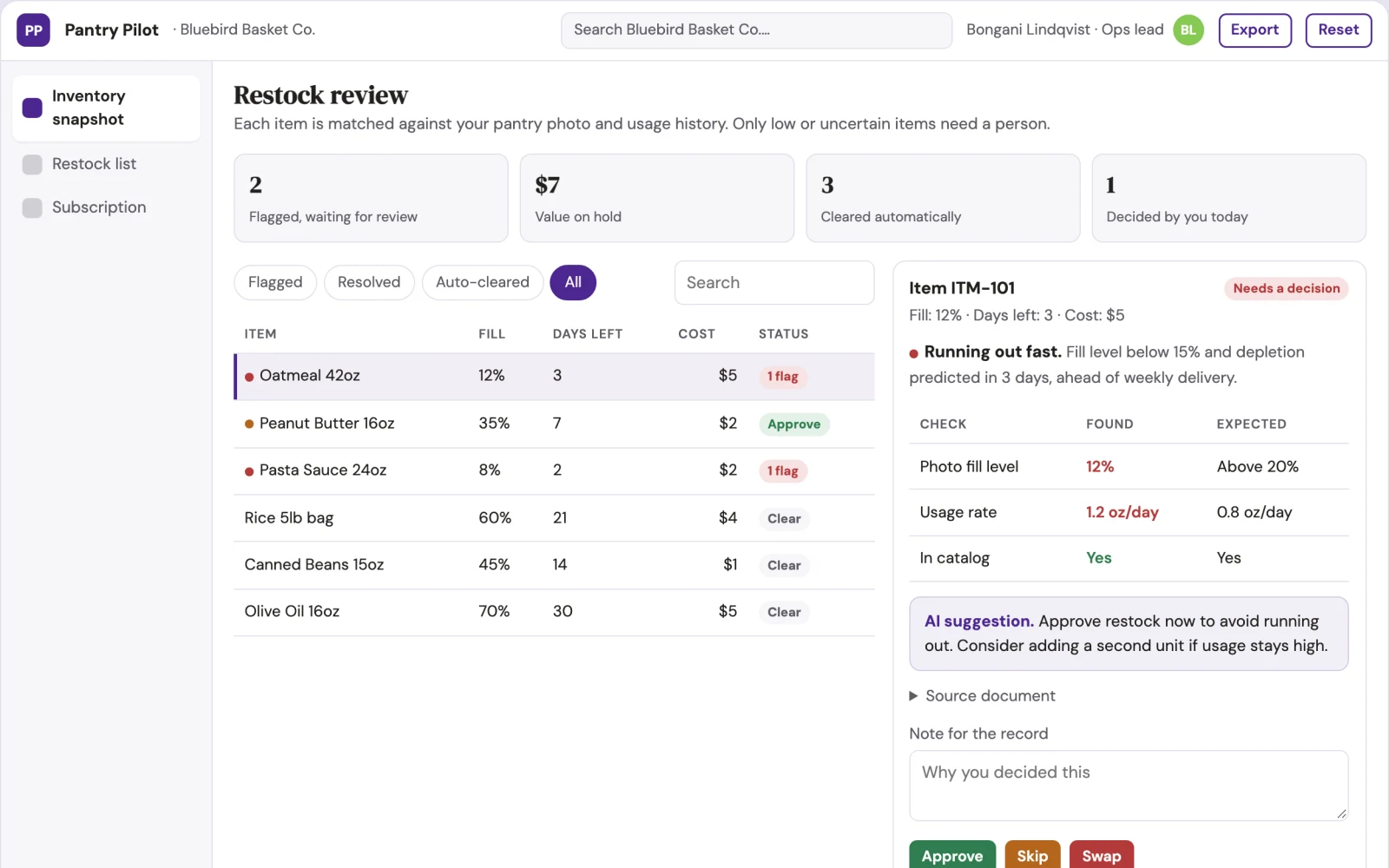
- Parse pantry photos into item inventory with fill levels
- Predict depletion rates per item
- Generate a weekly restock list
- Manage prepaid credit drawdown
- Handle substitution suggestions for out-of-stock items
- Schedule consolidated flat-box deliveries
Workflow
Upload photos, set credit and cadence, review suggested list, approve or skip items, receive shipment, text unexpected empties, and adjust next list. Start with pantry photos and usage patterns and finish with a prepaid restock subscription with predictable delivery.
AI and people
Use vision models to identify items and fill levels from photos, and time-series models to predict depletion. Keep inventory counts in structured fields. Validate substitutions against a product catalog. A human operator reviews substitution suggestions and any low-confidence predictions before shipment.
Screens
Key screens: Inventory snapshot, restock list, subscription dashboard. Use a photo upload screen for onboarding, a visual inventory grid with fill levels, and a restock list with approve or skip actions. Show delivery schedule and credit balance. Provide a text-in photo intake for unexpected empties. In this product, the first view is inventory snapshot, followed by restock list and subscription dashboard.
Admin
Subscriber accounts, credit balances, delivery schedules, substitution logs, photo history, approval records, and audit trail for all changes.
03Market gap
Alternatives buyers use today
People use manual shopping lists, reminder apps, or subscription boxes like Amazon Subscribe & Save. This differs by using visual inventory to predict needs before they run out, with no catalog browsing.
Where this wins
Each subscriber's usage data and substitution preferences create switching costs; the more households served, the better the prediction models become, making it harder for competitors to match accuracy.
04Why now
Operations teams are adopting AI for exactly this kind of repeatable work, and the cost of language and vision models has dropped far enough that a narrow, reviewed workflow pays back quickly. The buyer already feels the problem: households run out of basics and make costly last-minute trips.
05Proof & signals
Channels where buyers gather: Social media ads targeting working parents, partnerships with dollar-store chains, and local parenting groups.. Metrics that prove it works: Reduction in last-minute trips per household; prediction accuracy of restock list items..
Paid pilot
Run a 4-week paid pilot with 10 households. Baseline: current number of last-minute trips and average restock cost. Decision: proceed if at least 80% of predicted items are correct and households report fewer trips.
06Execution plan
MVP
First cut: one buyer (working parents), one use case (weekly restock of ten categories), first two modules (photo inventory and restock list), manual review of substitutions.
First 30 days
Week 1: Build photo upload and vision parsing. Week 2: Create inventory baseline and depletion prediction. Week 3: Set up Stripe subscription and delivery scheduling. Week 4: Pilot with 10 households and manual review.
After the pilot
After paid pilot, automate substitution approvals based on historical preferences, integrate with delivery carriers for real-time tracking, and add dynamic pricing based on wholesale changes.
Retention
Recurring subscription with prepaid credit; the system learns preferences and becomes more accurate, reducing churn. Add-ons like cleaning supplies or office restock increase revenue per account.
Integrations
Stripe for payments, shipping API for labels, and a product catalog database for SKU mapping.
07Investment and running costs
| Phase | Scope | Time | Budget |
|---|---|---|---|
| MVP | One buyer segment, one recurring use case. Manual review in the loop. | 2 days | $5,000 |
| Paid pilot | Accounts, roles, review states, audit trail and the first integration, hardened for two to three paying pilot customers. | 3 days | $4,500 |
| Full product | Self-serve onboarding, billing, monitoring and the wider integration set. | 5 days | $6,000 |
| Total | $15,500 | ||
| Running | Hosting | AI usage | Total a month |
|---|---|---|---|
| MVP and paid pilot (about 3 customers) | $30–$60 | $40–$90 | $70–$150 |
| Full product (about 50 customers) | $110–$210 | $280–$560 | $390–$770 |
Revenue model to test
Test pricing at $20/month for a weekly restock of ten items, with a $50 prepaid credit top-up option.
Cost drivers
Vision model inference per photo, scheduled prediction compute, flat-box packaging and local shipping, Stripe transaction fees.
Safeguards
Limit photo access to authorized users only, require opt-in for data sharing, and never share personal usage data with third parties. Must not auto-order without subscriber approval; must not exceed credit balance without explicit consent.
Take it further
Solution blueprint, rewritten from an earlier Nexibeo concept. Demand, pricing, build scope and integrations are working assumptions, not verified market findings. The MVP and the paid pilot exist to confirm them for your business before the larger build.