Solution Database / Operations
FitCycle Shoe Rotation
Shoe subscriptions fail because sizing is unreliable and returns are costly. A size profile that improves with every keep and return, tied to a managed swap loop.
01The offer
For operations leads at fashion rental and subscription services, turn foot photos, style preferences and wear context into a personalised monthly shoe rotation with size-matched recommendations and managed logistics. Address the recurring problem: shoe subscriptions fail because sizing is unreliable and returns are costly. The value hypothesis is a lower return rate and higher keep rate; the pilot must establish whether the size prediction and swap coordination genuinely reduce friction.
- For
- Operations leads at fashion rental and subscription services
- Takes in
- Foot photos, style quiz answers, calendar and weather data
- Delivers
- Personalised monthly shoe rotation, size-matched recommendations, managed swap logistics
- Message
- Never buy another shoe that pinches.
- Lead magnet
- Free foot scan and size profile for 50 brands.
02How it works
- Extract foot measurements from photos
- Predict size across brands from profile
- Suggest three pairs based on calendar and weather
- Schedule pickup and next delivery
- Track keep or return decisions
- Update profile from every outcome
Workflow
Upload foot photos, complete style quiz, receive size profile, review monthly suggestions, approve three pairs, wear and swap, and settle keep or return. Start with foot photos and style quiz and finish with a personalised monthly shoe rotation and size-matched recommendations.
AI and people
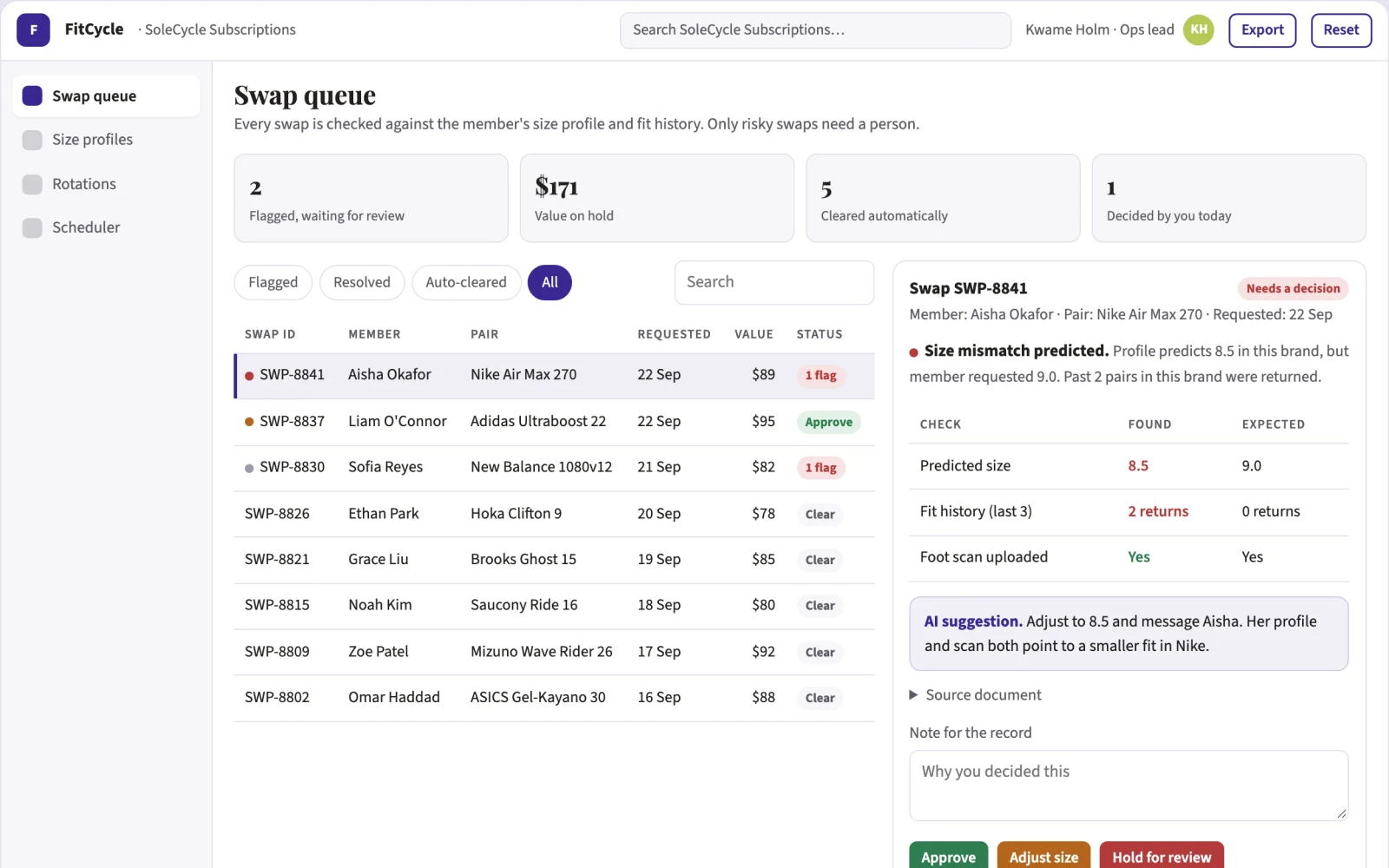
Use vision models to estimate foot dimensions from photos and language models to interpret style quiz and calendar context. A human reviewer checks size predictions against known brand charts and confirms logistics details before dispatch.
Screens
Key screens: Foot scan upload, size profile dashboard, monthly rotation queue, swap scheduler, keep or return review. Use a guided upload flow for foot photos and style quiz, a profile view showing predicted sizes across brands, a queue of three recommended pairs with event and weather context, and a scheduler for pickup and delivery. Show swap status and keep or return decisions. In this product, the first view is foot scan upload, followed by size profile dashboard and monthly rotation queue.
Admin
User profiles, size prediction versions, swap history, keep or return records, logistics audit trail, and approval states for each dispatch.
03Market gap
Alternatives buyers use today
People buy shoes online with size charts and free returns, or use generic clothing rental services. This differs by combining foot scanning, brand-specific size prediction and swap coordination in one loop.
Where this wins
The size prediction model gets more accurate as more users keep or return shoes, and the logistics coordination data becomes harder to replicate.
04Why now
Operations teams are adopting AI for exactly this kind of repeatable work, and the cost of language and vision models has dropped far enough that a narrow, reviewed workflow pays back quickly. The buyer already feels the problem: shoe subscriptions fail because sizing is unreliable and returns are costly.
05Proof & signals
Channels where buyers gather: Social media ads targeting busy professionals, partnerships with clothing rental services, and fashion subscription comparison sites.. Metrics that prove it works: Return rate per pair, keep rate per member..
Paid pilot
A paid pilot with one clothing rental service proves it by measuring return rate and keep rate over three months against their current baseline. Decision to expand if return rate drops by 20 percent and keep rate rises by 15 percent.
06Execution plan
MVP
One buyer, one use case: operations lead at a clothing rental service. First two modules: foot scan upload and size profile dashboard. Manual review of size predictions and swap scheduling.
First 30 days
Week 1: Build foot scan upload and size profile dashboard. Week 2: Integrate brand size database and style quiz. Week 3: Build swap scheduler and logistics API connection. Week 4: Pilot with one rental service and manual review.
After the pilot
Automate pickup scheduling, inventory forecasting, and brand-specific size corrections after the paid pilot.
Retention
Monthly rotation fee and margin on kept shoes keep earning after the first delivery.
Integrations
Calendar apps, weather APIs, shoe brand size databases, courier and logistics systems, and payment processing.
07Investment and running costs
| Phase | Scope | Time | Budget |
|---|---|---|---|
| MVP | One buyer segment, one recurring use case; first modules: foot scan upload and size profile dashboard. Manual review in the loop. | 2 days | $5,500 |
| Paid pilot | Accounts, roles, review states, audit trail and the first integration, hardened for two to three paying pilot customers. | 3 days | $5,000 |
| Full product | Self-serve onboarding, billing, monitoring and the wider integration set. | 6 days | $7,000 |
| Total | $17,500 | ||
| Running | Hosting | AI usage | Total a month |
|---|---|---|---|
| MVP and paid pilot (about 3 customers) | $30–$60 | $40–$90 | $70–$150 |
| Full product (about 50 customers) | $110–$210 | $280–$560 | $390–$770 |
Revenue model to test
Test pricing at USD 49 per month for the rotation, plus a margin on shoes kept.
Cost drivers
Shoe inventory, reverse logistics, cleaning, vision model inference, and support staff.
Safeguards
Limit swaps per month, require photo quality checks, restrict access to size profile data, and log all logistics actions. Must not share foot measurements without consent.
Take it further
Solution blueprint, rewritten from an earlier Nexibeo concept. Demand, pricing, build scope and integrations are working assumptions, not verified market findings. The MVP and the paid pilot exist to confirm them for your business before the larger build.