Micro-Payment Aggregation Engine
Sub-cent transactions die on card fees, so creators cannot sell individual articles or recipes. A payment rail that makes sub-cent transactions profitable by pooling intents and verifying content at near-zero cost.
01The offer
For independent publishers and newsletter writers, turn reader purchase intent and content URLs into aggregated micropayment settlements with verified content checks. Address the recurring problem: sub-cent transactions die on card fees, so creators cannot sell individual articles or recipes. The value hypothesis is a viable low-value payment rail with fraud protection; the pilot must establish whether readers will actually say 'pay' and whether aggregation holds up.
- For
- Independent publishers and newsletter writers charging per article or recipe
- Takes in
- Reader purchase intent, content URLs, creator bank details
- Delivers
- Aggregated micropayment settlements with verified content checks
- Message
- Sell every article for a nickel without losing a cent to fees.
- Lead magnet
- A free demo showing how a 5-cent article payment settles with zero fee loss.
02How it works
- Capture voice or click payment intents under 50 cents
- Pool intents into secure batches
- Run content originality checks per URL
- Flag devices with chargeback history
- Settle aggregated transfers to creators
- Deduct fees and show net payouts
Workflow
Reader expresses intent, system pools the amount, AI scans the content for plagiarism, device risk is checked, batch settles, fees are deducted, and creator receives payout. Start with reader purchase intent and content URLs and finish with aggregated micropayment settlements with verified content checks.
AI and people
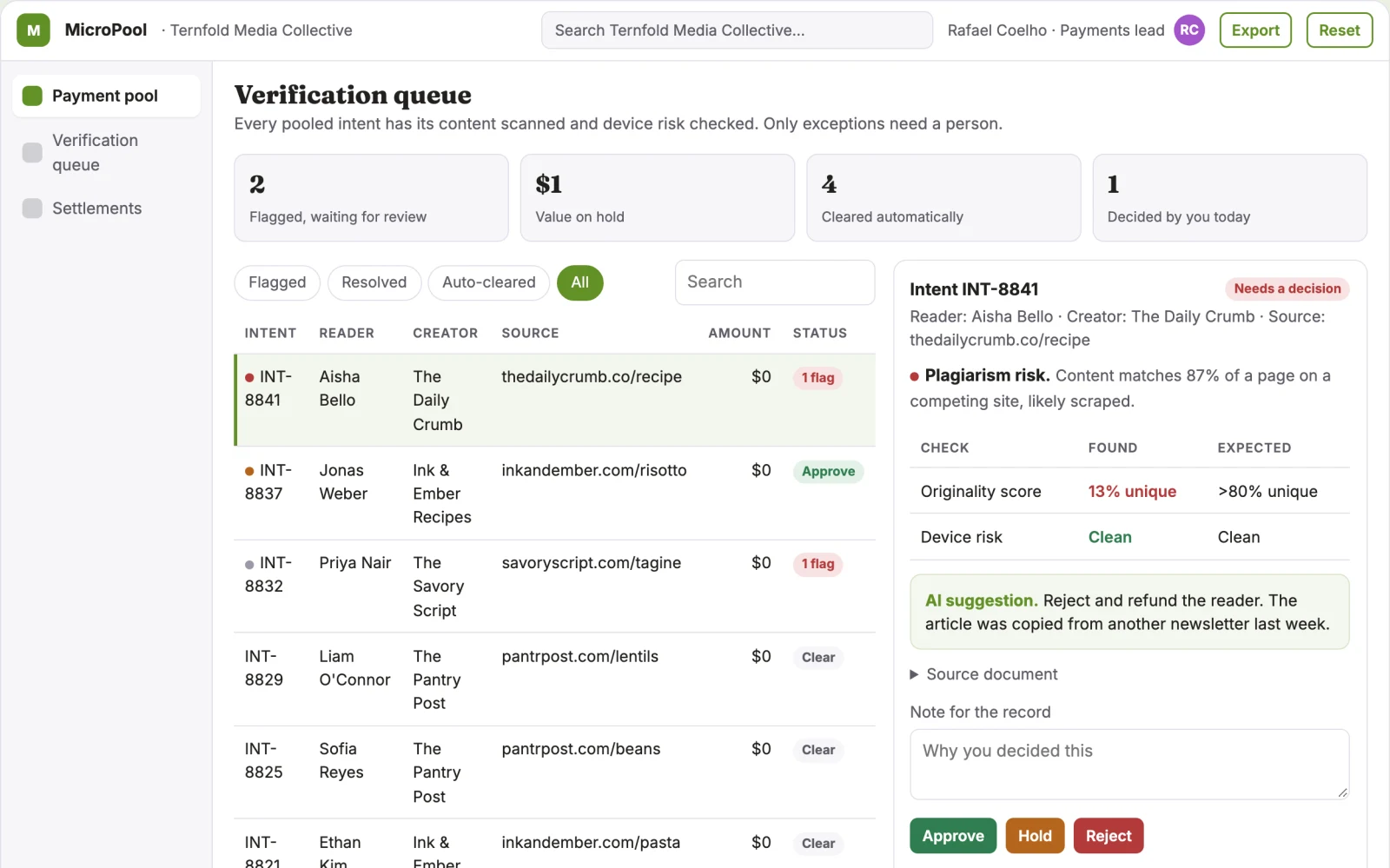
Use language models to scan pages for originality and spam in milliseconds, and risk models to flag chargeback-prone devices. A human operator reviews flagged content and disputed transactions before any payout is released.
Screens
Key screens: Payment pool, content verification queue, settlement dashboard. Use a live feed of pending micro-intents with amounts and source URLs, a verification panel showing originality and fraud flags, and a settlement view with batch transfers and per-creator payouts. Let operators drill into any pooled transaction. Display pool balance, pending checks and settlement history. In this product, the first view is payment pool, followed by content verification queue and settlement dashboard.
Admin
Creator accounts, payout schedules, fee structures, dispute logs, verification flags, settlement audit trail and bank transfer records.
03Market gap
Alternatives buyers use today
Subscriptions, paywalls, or free content with ads. This differs by enabling true micro-pricing without fee overhead.
Where this wins
The aggregation network grows with more creators and readers, making fraud detection smarter and settlement batches larger, which lowers costs further and locks in both sides.
04Why now
Finance teams are adopting AI for exactly this kind of repeatable work, and the cost of language and vision models has dropped far enough that a narrow, reviewed workflow pays back quickly. The buyer already feels the problem: sub-cent transactions die on card fees, so creators cannot sell individual articles or recipes.
05Proof & signals
Channels where buyers gather: Independent publishing forums, newsletter creator communities, and food blogging networks.. Metrics that prove it works: Number of micro-transactions settled per week and percentage of content flagged for plagiarism..
Paid pilot
Run a 30-day pilot with 10 food bloggers. Baseline: current per-article revenue is zero due to fees. Success: at least 500 paid micro-transactions and a settlement accuracy of 99%. Decision: proceed if fee revenue covers hosting and support.
06Execution plan
MVP
One buyer: independent food bloggers. One use case: per-recipe payments. First two modules: payment pool and content verification. Manual review of all flagged content before settlement.
First 30 days
Week 1: Build payment pool and intent capture. Week 2: Integrate content originality checks. Week 3: Connect Stripe for batch settlement. Week 4: Launch browser extension with 10 test bloggers.
After the pilot
Automate originality checks fully, add voice authorization for hands-free payment, and integrate with newsletter platforms for per-issue charges.
Retention
Keep earning per transaction fee on every settlement, plus a small percentage on larger payments, creating recurring revenue as reader volume grows.
Integrations
Stripe or bank APIs for settlement, WordPress and Substack for content URLs, and browser extension for voice capture.
07Investment and running costs
| Phase | Scope | Time | Budget |
|---|---|---|---|
| MVP | One buyer segment, one recurring use case; first modules: payment pool and content verification. Manual review in the loop. | 4 days | $8,000 |
| Paid pilot | Accounts, roles, review states, audit trail and the first integration, hardened for two to three paying pilot customers. | 5 days | $9,500 |
| Full product | Self-serve onboarding, billing, monitoring and the wider integration set. | 10 days | $13,500 |
| Total | $31,000 | ||
| Running | Hosting | AI usage | Total a month |
|---|---|---|---|
| MVP and paid pilot (about 3 customers) | $50–$100 | $40–$90 | $90–$190 |
| Full product (about 50 customers) | $190–$380 | $280–$560 | $470–$940 |
Revenue model to test
Test a flat 1 cent fee per transaction under 50 cents, and 5% above that. Hypothesis: 10,000 transactions per week yields $100 in fees.
Cost drivers
Cloud hosting for pooling engine, LLM API costs for content scans, bank integration fees, and support staff for disputes.
Safeguards
Limit individual payments to under 50 cents, require voice or click confirmation, block flagged devices, and never release funds without content verification. Must not process payments over 50 cents without switching to the flat fee model.
Take it further
Solution blueprint, rewritten from an earlier Nexibeo concept. Demand, pricing, build scope and integrations are working assumptions, not verified market findings. The MVP and the paid pilot exist to confirm them for your business before the larger build.