Solution Database / Real Estate and Construction
Survey to Listing Draft
Agents retype survey notes, photos and floor plans into portal listings by hand every evening. Property listings drafted from messy floor plans and handwritten notes, with every uncertain fact held for review.
01The offer
For listing teams at independent estate and letting agencies, turn survey notes, floor plan sketches, photos and voice memos into a portal-ready draft listing with description, room-by-room bullets, key features and ordered photos. Address the recurring problem: agents retype survey notes, photos and floor plans into portal listings by hand every evening. The value hypothesis is a faster, more accurate draft that needs only one review screen before publication.
- For
- Listing teams at independent estate and letting agencies
- Takes in
- Survey notes, floor plan sketches, photos and voice memos
- Delivers
- Portal-ready draft listing with description, room-by-room bullets, key features and ordered photos
- Message
- Turn your survey pack into a portal-ready listing in minutes, not evenings.
- Lead magnet
- Free draft of three listings from your own survey packs, no commitment.
02How it works
- Extract rooms, dimensions and features from floor plans and notes
- Draft description and room-by-room bullets in house style
- Match and order photos to rooms
- Fill portal fields for price, rooms, address, EPC and tenure
- Flag low-confidence readings for human review
- Export a copy-ready listing for manual portal paste
Workflow
Drop survey pack into shared folder, model reads floor plan and notes, draft is generated, reviewer checks highlighted changes, edits if needed, approves, and copies into portal. Start with survey notes, floor plan sketches, photos and voice memos and finish with portal-ready draft listing with description, features and ordered photos.
AI and people
Use vision models to read floor plans and photos, and language models to draft copy in the agency's tone. Keep room count, dimensions and price in structured fields. Flag uncertainty on handwriting or incomplete plans. A human reviewer confirms all facts and edits before anything is published.
Screens
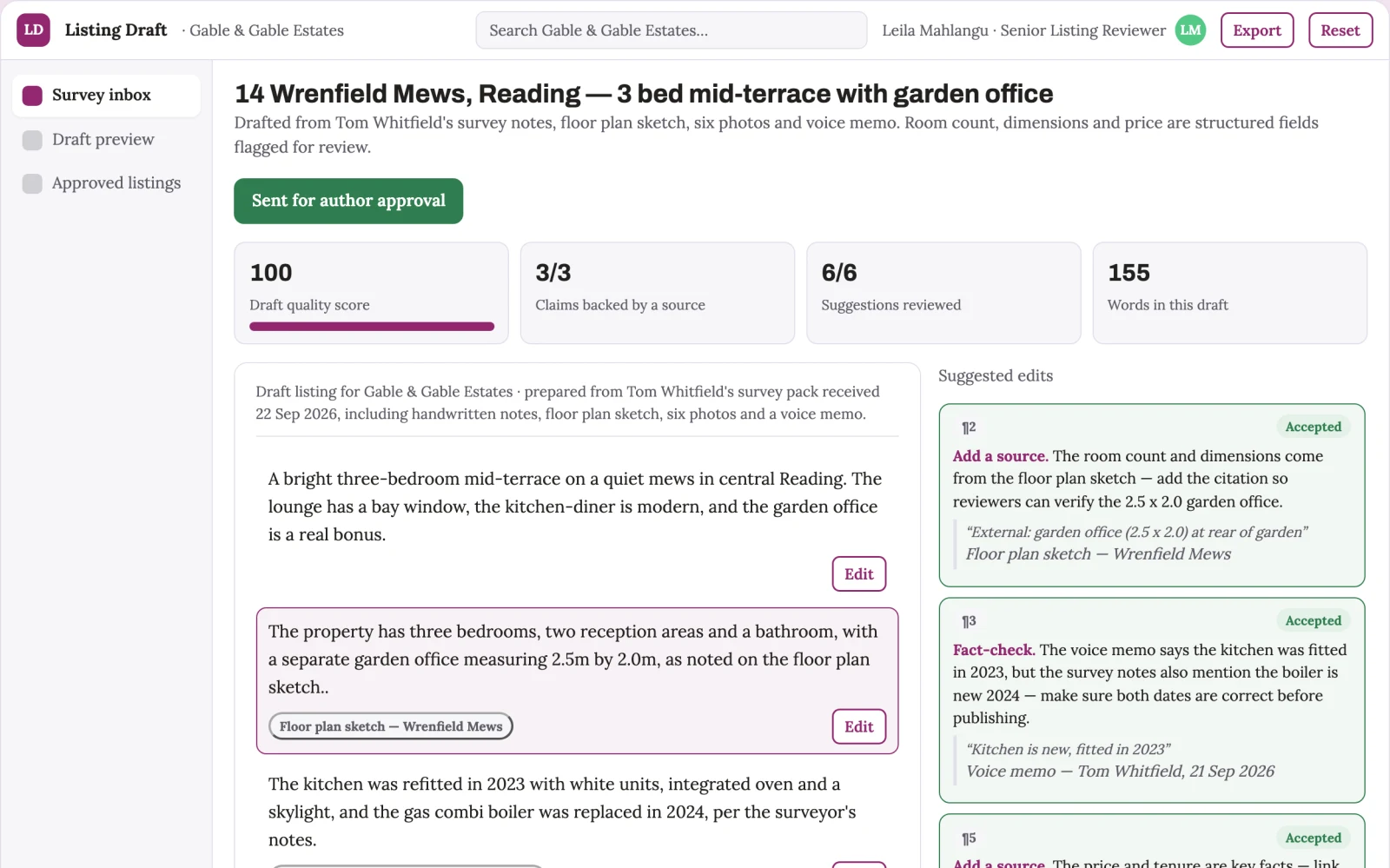
Key screens: Survey inbox, draft preview, edit and approve. Use a list of incoming survey packs, a central preview showing the drafted listing with highlighted changes, and a right-hand panel for field-by-field edits and confidence flags. Show room count, price and tenure as structured fields. Display draft, needs review and approved states. Provide a copy-to-portal button. In this product, the first view is survey inbox, followed by draft preview and edit and approve.
Admin
Agency accounts, listing versions, reviewer assignments, approval timestamps, edit history, confidence flags and an audit trail of what was changed after draft.
03Market gap
Alternatives buyers use today
Agents type listings manually into portals, use generic templates or hire copywriters. This differs by automating the entire survey-to-draft path with visual understanding.
Where this wins
The pipeline improves with each reviewed listing, learning agency-specific tone and common floor plan quirks, making it harder to switch.
04Why now
Real Estate and Construction teams are adopting AI for exactly this kind of repeatable work, and the cost of language and vision models has dropped far enough that a narrow, reviewed workflow pays back quickly. The buyer already feels the problem: agents retype survey notes, photos and floor plans into portal listings by hand every evening.
05Proof & signals
Channels where buyers gather: Local estate agency networks, property management software communities, and industry trade shows.. Metrics that prove it works: Time from survey pack to approved draft, and percentage of drafts accepted without edits..
Paid pilot
Paid pilot with one agency for 30 days, baseline of average time per listing before and after, decision to continue based on at least 50% time saved and no increase in listing errors.
06Execution plan
MVP
One agency, one listing workflow, two modules: survey intake and draft generation. Manual review of every output with no portal API.
First 30 days
Week 1: Map one agency's workflow and collect sample survey packs. Week 2: Build survey intake and draft generation pipeline. Week 3: Test with live packs and refine confidence flags. Week 4: Deliver drafts for review and gather feedback on accuracy and speed.
After the pilot
Automate portal API submission, integrate with CRM and property management systems, and add batch processing for portfolio listings.
Retention
Monthly fee includes ongoing model tuning for the agency's tone and floor plan styles, plus priority support for new portal field changes.
Integrations
Shared folders, email inbox, Rightmove and Zillow manual copy fields, later CRM and property management APIs.
07Investment and running costs
| Phase | Scope | Time | Budget |
|---|---|---|---|
| MVP | One buyer segment, one recurring use case; first modules: survey intake and draft generation. Manual review in the loop. | 3 days | $6,500 |
| Paid pilot | Accounts, roles, review states, audit trail and the first integration, hardened for two to three paying pilot customers. | 4 days | $7,000 |
| Full product | Self-serve onboarding, billing, monitoring and the wider integration set. | 7 days | $9,500 |
| Total | $23,000 | ||
| Running | Hosting | AI usage | Total a month |
|---|---|---|---|
| MVP and paid pilot (about 3 customers) | $30–$60 | $70–$140 | $100–$200 |
| Full product (about 50 customers) | $110–$210 | $700–$1,400 | $810–$1,610 |
Revenue model to test
Test at USD 200 per agency per month, flat fee for up to 20 listings, as a hypothesis.
Cost drivers
Vision model API usage, prompt engineering, cloud storage for survey packs, and support time for setup and review handholding.
Safeguards
Must not publish directly without human approval, must flag uncertain room counts or prices, and must not invent features not present in the survey. Access limited to agency staff with role-based permissions.
Take it further
Solution blueprint, rewritten from an earlier Nexibeo concept. Demand, pricing, build scope and integrations are working assumptions, not verified market findings. The MVP and the paid pilot exist to confirm them for your business before the larger build.