Solution Database / Operations
Fleet Service Orchestrator
Fleet managers wait for driver complaints or dashboard lights, then lose days to unplanned downtime because sensor data is never read. The orchestration layer that matches telematics thresholds, garage live calendars and supplier history into a single confirmable card, without requiring any party to change their existing tools.
01The offer
For fleet managers at 15 to 80 vehicle light commercial fleets, turn telematics usage counters, fault codes and garage calendars into confirmed service bookings with parts orders and a three-day slot in the fleet calendar. Address the recurring problem: vans sit idle for days because a sensor knew about wear but nobody acted on it. The value hypothesis is fewer breakdowns and less admin; the pilot must establish whether the booking loop closes reliably.
- For
- Fleet managers at 15 to 80 vehicle light commercial fleets
- Takes in
- Telematics API data, garage calendar links, vehicle service plans, supplier purchase history
- Delivers
- Confirmed service bookings, parts purchase orders, fleet calendar slots, booking confirmation cards
- Message
- Stop waiting for the dashboard light; let your van book its own service before the driver notices.
- Lead magnet
- A free one-week demo connecting one vehicle to your garage calendar, showing the first booking card generated from live data.
02How it works
- Ingest telematics usage counters and fault codes hourly
- Match thresholds against service intervals and ignore transient faults
- Fetch garage availability via CalDAV or API
- Rank slots by distance from overnight GPS fix
- Draft booking request and purchase order
- Post confirmable card to messaging channel
Workflow
Connect telematics source, sync garage calendars, define service thresholds, monitor vehicle data, trigger on rule match, generate booking card, and finalise on confirmation. Start with telematics usage counters and fault codes and finish with confirmed service booking and parts order.
AI and people
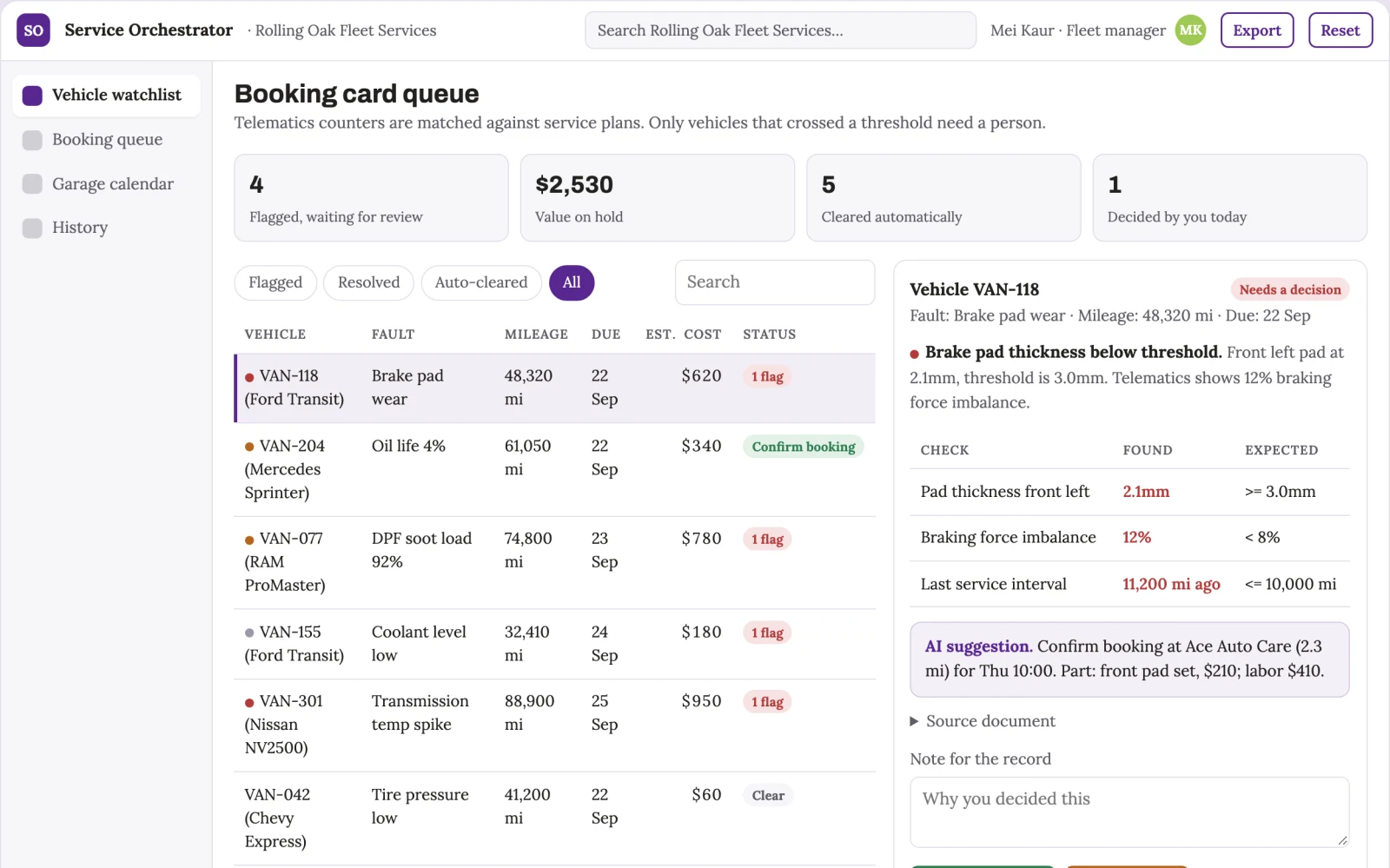
Use rule-based threshold matching to detect wear and fault patterns, and language models to draft the booking request and part order text. A fleet manager reviews the card and confirms or snoozes before anything is sent to the garage.
Screens
Key screens: Vehicle watchlist, booking card queue, garage calendar view. Use a dashboard of vehicles with status flags, a queue of confirmable booking cards, and a calendar grid showing proposed slots. Let users click a card to see fault details, part number, supplier price and garage distance. Display confirm, snooze and defer actions. Show a history of confirmed bookings and false triggers. In this product, the first view is vehicle watchlist, followed by booking card queue and garage calendar view.
Admin
Fleet manager accounts, vehicle permissions, booking approval states, audit trail of confirmations and snoozes, supplier and garage records, and a log of all triggered rules and false positives.
03Market gap
Alternatives buyers use today
Fleet managers today use manual phone calls, email threads and spreadsheets to track service dates and invoices. This differs by closing the loop from sensor to booking without a human chasing each step.
Where this wins
Each connected vehicle and garage adds historical data on false triggers and booking outcomes, making the threshold engine more accurate and the supplier and garage network stickier over time.
04Why now
Operations teams are adopting AI for exactly this kind of repeatable work, and the cost of language and vision models has dropped far enough that a narrow, reviewed workflow pays back quickly. The buyer already feels the problem: fleet managers wait for driver complaints or dashboard lights, then lose days to unplanned downtime because sensor data is never read.
05Proof & signals
Channels where buyers gather: Fleet management conferences, telematics provider partner programmes, and LinkedIn groups for fleet operators.. Metrics that prove it works: Reduction in unplanned downtime days per vehicle per month; percentage of booking cards confirmed without manual rework..
Paid pilot
Run a paid pilot with one fleet of 10 vans for 8 weeks. Baseline current average downtime per service event and admin hours spent. Decision: proceed if confirmed bookings reduce downtime by at least 30% and false triggers stay under 10%.
06Execution plan
MVP
One vehicle type, one telematics source, one garage calendar, and the confirmable booking card. Cover brake pad wear and one common DTC mapped to a known part. Manual review of every card before sending.
First 30 days
Week 1: Connect one telematics source and stage data. Week 2: Build threshold engine for brake wear and one DTC. Week 3: Integrate one garage calendar and draft booking card. Week 4: Deploy confirmable card to messaging channel and test with two vehicles.
After the pilot
Automate part ordering directly with supplier APIs, add predictive failure models based on usage trends, and expand to multiple garages with automatic rebooking on rejection.
Retention
The system keeps learning vehicle-specific thresholds and garage preferences, so each month the cards get more accurate and the fleet becomes more dependent on the automated loop.
Integrations
Telematics APIs, garage CalDAV calendars, messaging platforms like Slack, supplier purchase order systems, and fleet calendar tools.
07Investment and running costs
| Phase | Scope | Time | Budget |
|---|---|---|---|
| MVP | One buyer segment, one recurring use case. Manual review in the loop. | 4 days | $7,500 |
| Paid pilot | Accounts, roles, review states, audit trail and the first integration, hardened for two to three paying pilot customers. | 5 days | $8,000 |
| Full product | Self-serve onboarding, billing, monitoring and the wider integration set. | 8 days | $11,000 |
| Total | $26,500 | ||
| Running | Hosting | AI usage | Total a month |
|---|---|---|---|
| MVP and paid pilot (about 3 customers) | $30–$60 | $40–$90 | $70–$150 |
| Full product (about 50 customers) | $110–$210 | $280–$560 | $390–$770 |
Revenue model to test
Test at $49 per vehicle per month, with a minimum of 10 vehicles, as a hypothesis to validate willingness to pay against avoided downtime.
Cost drivers
Telematics API integration, garage calendar sync maintenance, cloud hosting, and support for the booking card workflow.
Safeguards
Only authorised fleet managers can confirm bookings. The system must not send anything to a garage without human confirmation. It must not order parts above a set value without a second approval. It must ignore transient faults that clear within a cycle and must not book slots outside agreed working hours.
Take it further
Solution blueprint, rewritten from an earlier Nexibeo concept. Demand, pricing, build scope and integrations are working assumptions, not verified market findings. The MVP and the paid pilot exist to confirm them for your business before the larger build.