Solution Database / Operations
Mall Trip Companion Agent
Loyalty cards sit unused in wallets, shoppers forget errands and miss live promotions, and centres lose footfall to online retail. An agent that reads live store promotions and acts on the shopper's behalf inside the physical trip, which no map, app or loyalty card does today.
01The offer
For marketing and operations leads at mid-sized shopping centres, turn shopper voice notes, centre maps, store inventories and active promotions into a personalised shopping route, timed stop reminders and automatic discount application at checkout. Address the recurring problem: loyalty cards sit unused, shoppers forget errands and miss live promotions, and centres lose footfall to online retail. The value hypothesis is measurable gains in footfall, basket size and shopper data; the pilot must establish whether that benefit is real.
- For
- Marketing and operations leads at mid-sized shopping centres
- Takes in
- Centre floor plan and store directory, store inventories and active promotions, loyalty programme terms, shopper voice notes and location pings during trips
- Delivers
- Personalised shopping route with timed reminders, automatic discount application at checkout, trip receipts with total savings, and centre footfall, dwell and redemption dashboards
- Message
- Give shoppers a card that plans the trip, finds every live deal and reminds them of each errand, and give your centre the footfall online retail cannot touch.
- Lead magnet
- A free two-week footfall and errand-mapping pilot at one centre, where shoppers speak errands and the centre receives a baseline report of trips, dwell time and missed promotion exposure.
02How it works
- Capture spoken errand lists and convert them to structured stops
- Build an efficient walking route across centre stores
- Read live store promotions, PDFs and images as they change
- Vibrate or notify at each stop, including errands like dry cleaning passed en route
- Apply eligible discounts and loyalty credits automatically at checkout
- Feed anonymised footfall and basket insights back to centre management
Workflow
Tap the card or app to start a trip, speak the errand list, match stops against inventories and promotions, review the suggested route, walk the route with timed reminders, check out with automatic discount application, and close the trip with a receipt and insights record. Start with spoken errand lists, centre map data, store inventories and active promotions and finish with a completed route, redeemed savings report and centre footfall insights.
AI and people
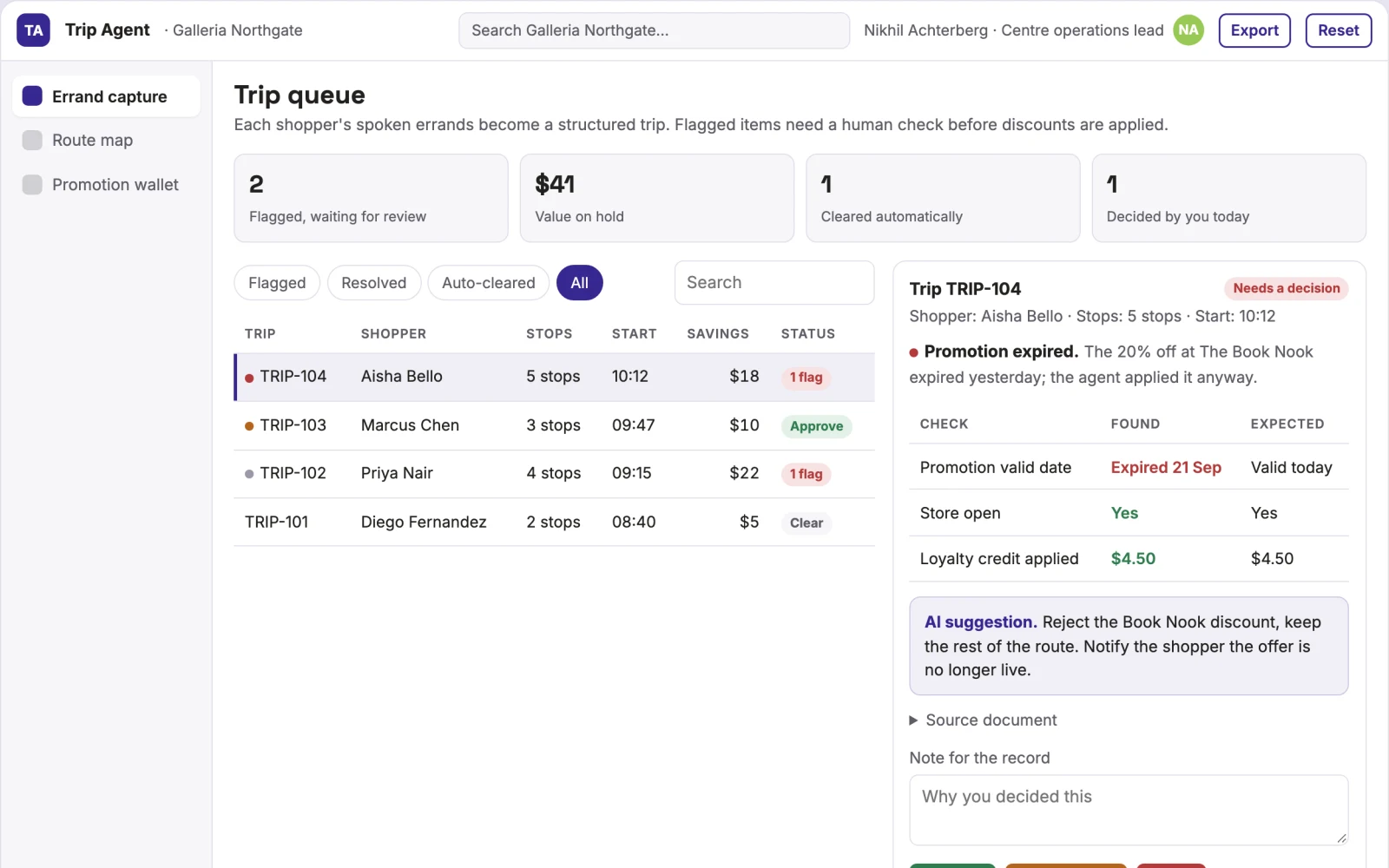
Use speech models to transcribe errand notes, language models to extract structured stops, document and image models to read promotions as they are published, and routing logic to sequence stops by location and opening hours. Deterministic checks confirm store locations, opening times and discount rules before anything is applied. A centre-side administrator reviews promotion matches and redemption rules before they go live, and no discount is charged without a valid store-authored promotion on file.
Screens
Key screens: Errand capture, route map, promotion wallet. Use a voice-first capture screen where shoppers speak their errands for the day, a central map of the centre with the fastest ordered route and live store pins, and a wallet showing applied deals, loyalty credits and dry cleaning reminders. Let shoppers reorder stops and see a vibration cue on each arrival. Display planned, in progress and completed trips. Provide a centre-side dashboard with footfall, dwell time and redemption data. In this product, the first view is errand capture, followed by route map and promotion wallet.
Admin
Centre administrator accounts with role-based access, store-level promotion authors, versioned promotion records, approval states for live offers, audit trail of applied discounts and redemptions, shopper data permissions with location tracking opt in, and anonymised analytics exports.
03Market gap
Alternatives buyers use today
Shoppers use paper lists, plastic loyalty cards, mall directory screens and coupon apps that require manual scanning. This differs by combining route planning, live deal application and proactive reminders into one agent that works while the shopper walks.
Where this wins
Each centre contributes exclusive real-time inventory, promotion and shopper pattern data, and store integrations deepen with every redemption cycle, making the dataset hard for a competitor to replicate.
04Why now
Operations teams are adopting AI for exactly this kind of repeatable work, and the cost of language and vision models has dropped far enough that a narrow, reviewed workflow pays back quickly. The buyer already feels the problem: loyalty cards sit unused in wallets, shoppers forget errands and miss live promotions, and centres lose footfall to online retail.
05Proof & signals
Channels where buyers gather: Shopping centre industry conferences, retail property management networks, regional shopping centre associations, trade publications, and direct outreach to centre marketing managers.. Metrics that prove it works: 1. Uplift in average basket size among active card users against the centre baseline. 2. Share of errand lists completed as a full route with at least one promotion redeemed..
Paid pilot
Run a paid four to eight week pilot at one centre with 200 to 500 shoppers. Baseline footfall, dwell time and average basket from the preceding four weeks. Decision: proceed if active-user route completion and redemption rates lift basket size by an agreed threshold, for example five percent, otherwise revisit store data coverage before expanding.
06Execution plan
MVP
One mid-sized shopping centre with 50 or more stores, one use case: speak an errand list and receive a fastest route across those stores on a static centre map. First two modules are voice capture with stop extraction and the route map with ordered reminders. Every promotion suggestion is manually reviewed by the centre team before shoppers see it.
First 30 days
Week 1: secure one centre partner, collect the floor plan, store directory and baseline footfall data. Week 2: ship voice capture and stop extraction with the static route map for a closed shopper group. Week 3: run in-centre trials, gather trip recordings and manually review promotion matches with the centre team. Week 4: deliver the first footfall and basket comparison report and agree a paid monthly rollout.
After the pilot
After the paid pilot, automate promotion ingestion from store PDFs and images, automatic discount application at point of sale, dry cleaning and service reminders based on location and past trips, and weekly footfall and basket insight reports for centre management.
Retention
The centre pays monthly because shopper pattern data and footfall gains compound over time, stores contribute promotions each season, and switching means rebuilding store data feeds and shopper habits from scratch.
Integrations
Start with a static centre map and store directory supplied as spreadsheets, then add point of sale and loyalty systems for discount application, store promotion feeds or PDF drops, and location services on the shopper's phone.
07Investment and running costs
| Phase | Scope | Time | Budget |
|---|---|---|---|
| MVP | One buyer segment, one recurring use case. Manual review in the loop. | 3 days | $6,500 |
| Paid pilot | Accounts, roles, review states, audit trail and the first integration, hardened for two to three paying pilot customers. | 4 days | $6,500 |
| Full product | Self-serve onboarding, billing, monitoring and the wider integration set. | 7 days | $9,000 |
| Total | $22,000 | ||
| Running | Hosting | AI usage | Total a month |
|---|---|---|---|
| MVP and paid pilot (about 3 customers) | $30–$60 | $40–$90 | $70–$150 |
| Full product (about 50 customers) | $110–$210 | $280–$560 | $390–$770 |
Revenue model to test
Hypothesis: charge the shopping centre a monthly fee of 2 to 5 USD per active card user, with a centre minimum of 1,500 USD per month, plus a setup fee for store promotion onboarding.
Cost drivers
Model inference for transcription, promotion reading and routing, mobile and card integration development, centre onboarding and store data collection, cloud hosting, and ongoing account support.
Safeguards
Location tracking is opt in and trips can be deleted by the shopper. Discount application is limited to store-authored promotions with valid terms and an approval record, and never changes prices without a confirmed integration. The system must not share individual shopper identities with stores, must not apply expired or unauthorised promotions, must not route shoppers to closed stores, and centre dashboards only expose aggregated anonymised data.
Take it further
Solution blueprint, rewritten from an earlier Nexibeo concept. Demand, pricing, build scope and integrations are working assumptions, not verified market findings. The MVP and the paid pilot exist to confirm them for your business before the larger build.