Finance team training simulator
New staff need practice investigating realistic accounting discrepancies. Practice investigation using controlled data with explainable answers.
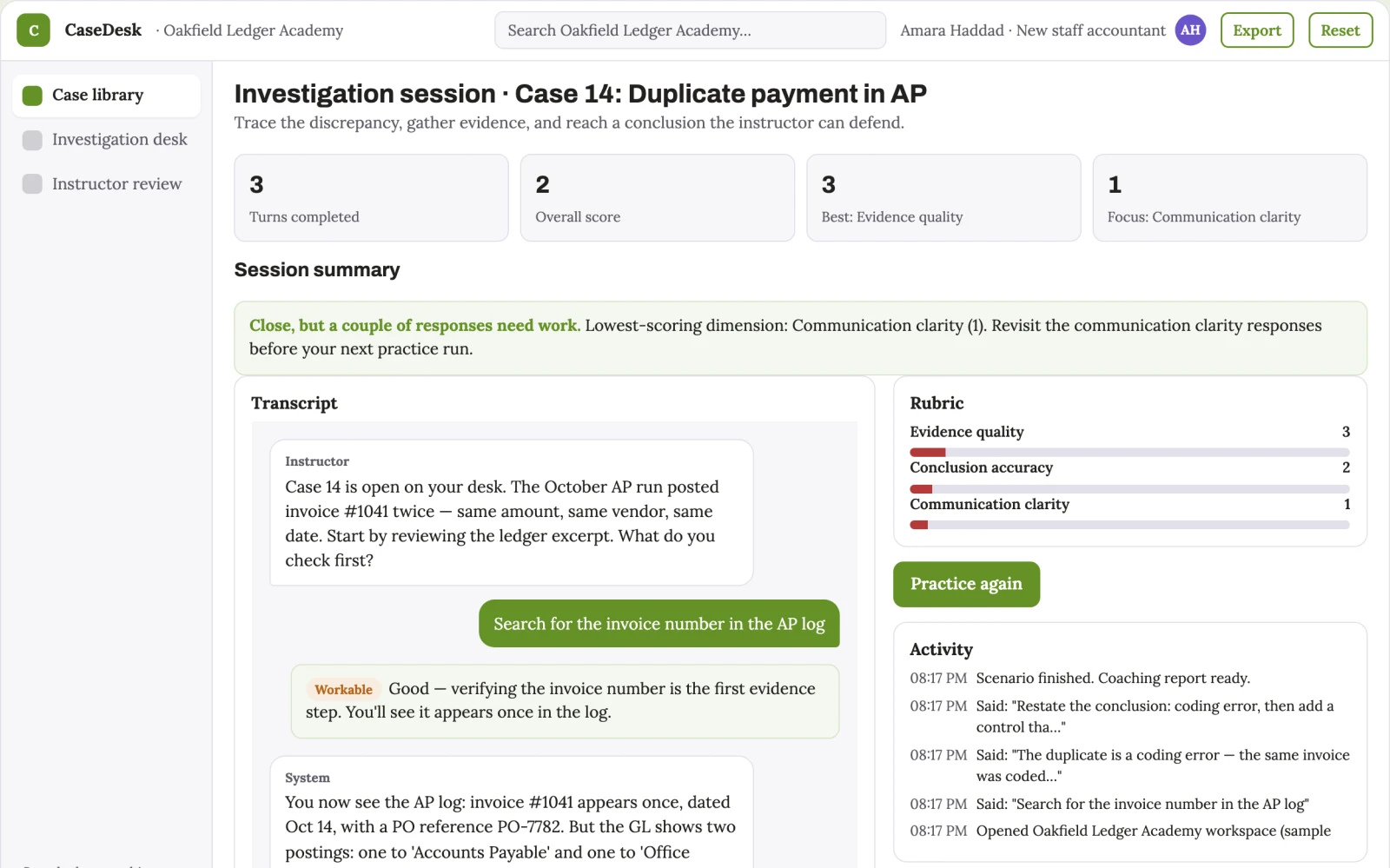
01The offer
For finance training leads at growing companies, turn synthetic ledgers, policies and task rubrics into completed case files and coaching feedback. Address the recurring problem: new staff need practice investigating realistic accounting discrepancies. The value hypothesis is a more complete, reviewable deliverable with less repeated preparation; the pilot must establish whether that benefit is real.
- For
- Finance training leads at growing companies
- Takes in
- Synthetic ledgers, policies and task rubrics
- Delivers
- Completed case files and coaching feedback
- Message
- Finance team training simulator for finance training leads at growing companies. Practice investigation using controlled data with explainable answers. Demonstrate the claim through a duplicate-payment investigation exercise.
- Lead magnet
- A duplicate-payment investigation exercise
02How it works
- Create realistic discrepancies
- Provide investigation clues
- Require evidence-based conclusions
- Explain accounting logic
- Score agreed criteria
- Track skills
Workflow
Set the participant’s goal, choose or customize a scenario, conduct an interactive session, record choices or dialogue, review evidence-based feedback with a facilitator when needed, and repeat selected parts with changed constraints. Start with synthetic ledgers, policies and task rubrics and finish with completed case files and coaching feedback.
AI and people
Generate responsive dialogue, alternative situations and structured reflection prompts. Ground feedback in agreed goals or rubrics. Treat creative choices and facilitator judgment as authoritative. Evaluate specific actions rather than infer personality or hidden traits.
Screens
Key screens: Case library, investigation desk, instructor review. Use a scenario catalog with clear goals and difficulty settings. The main session area supports text, optional voice and visible context. Follow it with a replay or decision map, annotated feedback and a next-practice plan. Facilitators can author scenarios and review participant-selected sessions. In this product, the first view is case library, followed by investigation desk and instructor review.
Admin
Participant-controlled session sharing, scenario versions, facilitator tools, replay history, rubric calibration, practice goals and exportable feedback.
03Market gap
Alternatives buyers use today
Human coaching, workshops, static courses, roleplay with colleagues and general chat tools. Differentiate on this specific proposed advantage: practice investigation using controlled data with explainable answers. Test it against the buyer's current method on the same task. Competitor coverage and uniqueness have not been established.
Where this wins
Realistic domain scenarios, qualified facilitator relationships and reviewed examples of useful feedback and successful practice. For this solution, build around practice investigation using controlled data with explainable answers. This advantage requires execution and accumulated customer trust; the base model alone is not a defensible asset.
04Why now
Finance teams are adopting AI for exactly this kind of repeatable work, and the cost of language and vision models has dropped far enough that a narrow, reviewed workflow pays back quickly. The buyer already feels the problem: new staff need practice investigating realistic accounting discrepancies.
05Proof & signals
Channels where buyers gather: Accounting training providers. Metrics that prove it works: Instructor agreement, task proficiency.
Paid pilot
Run a short scenario with representative participants, then repeat with a different case. Ask a qualified coach or facilitator to assess usefulness and observable improvement independently of the AI feedback. For this solution, use synthetic ledgers, policies and task rubrics and evaluate completed case files and coaching feedback. Agree success thresholds with the buyer before starting; collect a baseline for instructor agreement, task proficiency. A positive signal is payment and repeat use with acceptable quality and delivery cost, not a favorable demo reaction alone.
06Execution plan
MVP
Begin with finance training leads at growing companies and one recurring use case. Build the first two modules: create realistic discrepancies; provide investigation clues. Provide operator assistance for the third module: require evidence-based conclusions. Deliver completed case files and coaching feedback through a manual review queue. Perform other necessary full-scope functions manually during the pilot. Include all applicable access, accuracy and professional-review controls from the start.
First 30 days
Week 1: interview five prospective buyers in this segment: finance training leads at growing companies. Ask to see a recent example of the problem and their current process. Week 2: prepare this demonstration using authorized or synthetic material: a duplicate-payment investigation exercise. Week 3: present it through accounting training providers and seek one narrowly scoped paid pilot. Week 4: review instructor agreement, task proficiency, total delivery effort and a concrete renewal decision before increasing scope.
After the pilot
After paid pilots establish value, automate the remaining modules: explain accounting logic; score agreed criteria; track skills. Add one validated source integration, reusable customer configuration and recurring delivery. Expand to additional teams, document formats or languages only after testing the new scope.
Retention
Release relevant new scenarios, support repeat practice and offer facilitator review. Expand to another role only with appropriate scenarios and calibrated feedback.
Integrations
Accounting exports, invoice records and finance review processes. Learning portals, calendar scheduling and authorized session exports. Make recording, sharing and retention controls explicit in the product. These are candidate integration categories, not verified supported connectors.
07Investment and running costs
| Phase | Scope | Time | Budget |
|---|---|---|---|
| MVP | One buyer segment, one recurring use case; first modules: create realistic discrepancies; provide investigation clues. Manual review in the loop. | 6 days | $10,500 |
| Paid pilot | Accounts, roles, review states, audit trail and the first integration, hardened for two to three paying pilot customers. | 7 days | $13,000 |
| Full product | Remaining modules: explain accounting logic; score agreed criteria; track skills. Self-serve onboarding, billing, monitoring and the wider integration set. | 3 weeks | $18,000 |
| Total | $41,500 | ||
| Running | Hosting | AI usage | Total a month |
|---|---|---|---|
| MVP and paid pilot (about 3 customers) | $50–$100 | $50–$110 | $100–$210 |
| Full product (about 50 customers) | $190–$380 | $420–$840 | $610–$1,220 |
Revenue model to test
Test USD 300-1,500 for a facilitated team pilot, or USD 20-80 per participant monthly for self-serve practice with limited usage. Bespoke workshops and expert coaching are separately scoped. Pricing is hypothetical.
Cost drivers
Scenario design, voice processing if used, model interaction length, facilitator review, rubric calibration and learner support.
Safeguards
Reconcile calculations to approved records. Keep proposed entries and payment actions under finance-team control. Never invent missing financial inputs. Validate source access and reviewer availability during the pilot. Maintain customer-level access, data deletion controls and a record of final approvals.
Take it further
Concept proposal expanded from the 315-solution conversation. Demand, pricing, differentiation, build scope and integration feasibility are hypotheses, not verified market findings. Category link is inspiration rather than evidence of business viability.