Living Strategy Workspace
Static marketing plans become obsolete quickly and teams execute from memory A living strategic document that connects directly to execution, ensuring the team always acts on the most current market intelligence
01The offer
For marketing directors at mid-sized consumer brands, turn market data and competitor insights into an updated strategic playbook and campaign briefs. Address the problem of static plans that become obsolete by the time they are finished. The value hypothesis is a living strategy that connects directly to execution, reducing the gap between planning and action
- For
- Marketing directors at mid-sized consumer brands
- Takes in
- Website, CRM, social accounts, competitor URLs, last three campaign briefs
- Delivers
- Updated strategy document, weekly tactical moves, campaign briefs and copy
- Message
- Stop writing static marketing plans. An AI agent reads your market, updates your strategy, and drafts the next campaign
- Lead magnet
- A free demonstration of a one-page strategy document generated from their own website
02How it works
- Connect data sources and build baseline strategy
- Monitor market signals and competitor moves
- Update strategic playbook automatically
- Flag changes and suggest tactical moves
- Draft campaign briefs and copy
- Measure results against the current strategy
Workflow
Connect data sources, build baseline strategy, monitor market signals, update strategic playbook, flag changes and suggest tactical moves, draft campaign briefs, measure results against the current strategy. Start with website, CRM and competitor URLs and finish with updated strategy document and drafted campaign briefs
AI and people
Use language models to read competitor websites, customer reviews and sales transcripts. Detect signals like price changes or new trends. Update the strategic playbook automatically and draft briefs aligned with the current strategy. A human reviewer checks the generated strategy updates for brand voice and relevance before deployment
Screens
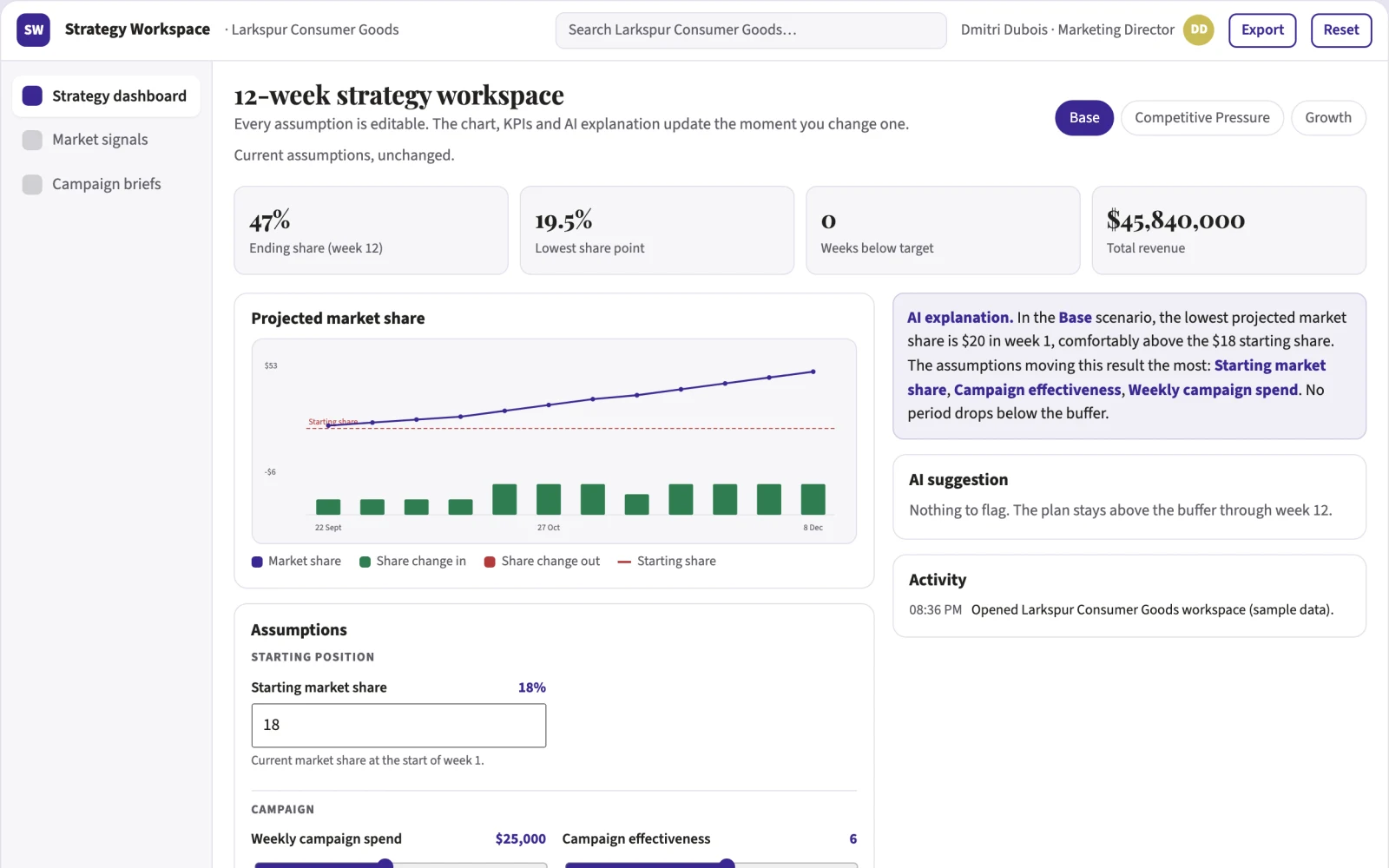
Key screens: Strategy dashboard, market signal feed, campaign brief generator. Use a central dashboard to display the current strategy, a feed to show detected market shifts, and a brief generator to draft campaign content. The first view is the strategy dashboard, followed by the market signal feed and campaign brief generator
Admin
User accounts, data source permissions, strategy version history, approval workflows, audit trail of changes
03Market gap
Alternatives buyers use today
Manual spreadsheets, static marketing plans, general AI writing tools without market context
Where this wins
Data accumulation and model fine-tuning over time make the strategy updates more accurate and specific to the client's brand voice
04Why now
Marketing teams are adopting AI for exactly this kind of repeatable work, and the cost of language and vision models has dropped far enough that a narrow, reviewed workflow pays back quickly. The buyer already feels the problem: static marketing plans become obsolete quickly and teams execute from memory
05Proof & signals
Channels where buyers gather: LinkedIn, marketing industry publications, SaaS directories. Metrics that prove it works: Percentage of strategy updates adopted by the team, reduction in time spent on market research.
Paid pilot
Establish a baseline of current strategy effectiveness and compare it against the AI generated weekly suggestions to prove value
06Execution plan
MVP
Ship a simple dashboard that ingests website data, a handful of competitor sites and last three campaign briefs. It generates a one-page strategy document and a weekly email with three suggested tactical moves. The first buyer is a marketing director at a mid-sized consumer brand
First 30 days
Week 1: Build dashboard and ingest website data. Week 2: Add competitor site monitoring and baseline strategy generation. Week 3: Implement weekly email alerts and tactical move suggestions. Week 4: Launch to first customer and gather feedback on strategy quality
After the pilot
Automated continuous monitoring, full campaign drafting, sentiment analysis, and integration with ad platforms
Retention
Monthly subscription based on the number of brands and data sources connected
Integrations
CRM systems, social media APIs, competitor website scrapers
07Investment and running costs
| Phase | Scope | Time | Budget |
|---|---|---|---|
| MVP | One buyer segment, one recurring use case. Manual review in the loop. | 2 days | $5,500 |
| Paid pilot | Accounts, roles, review states, audit trail and the first integration, hardened for two to three paying pilot customers. | 3 days | $5,000 |
| Full product | Self-serve onboarding, billing, monitoring and the wider integration set. | 6 days | $6,500 |
| Total | $17,000 | ||
| Running | Hosting | AI usage | Total a month |
|---|---|---|---|
| MVP and paid pilot (about 3 customers) | $30–$60 | $50–$100 | $80–$160 |
| Full product (about 50 customers) | $110–$210 | $350–$700 | $460–$910 |
Revenue model to test
$299 per month per brand for the paid tier
Cost drivers
Compute costs for data ingestion and model inference
Safeguards
Brand voice guardrails, notification filtering to avoid spam, human approval loops for major strategy shifts
Take it further
Solution blueprint, rewritten from an earlier Nexibeo concept. Demand, pricing, build scope and integrations are working assumptions, not verified market findings. The MVP and the paid pilot exist to confirm them for your business before the larger build.