Local Shop Social Agent
Independent shops lose customers to chains that post daily while they have no time to maintain a social presence. The agent learns each shop's actual products, hours and voice from their own documents and past posts, so every post and reply is specific rather than generic.
01The offer
For owners of independent food and retail shops, turn menus, price lists, product photos and opening hours into a month of on-voice social posts, specific replies and a weekly performance summary. Address the recurring problem: independent shops lose customers to chains that post daily while they have no time to maintain a social presence. The value hypothesis is a genuine local voice without the daily labour; the pilot must establish whether customers trust the replies and posts enough to visit.
- For
- Owners of independent food and retail shops
- Takes in
- Menus, price lists, product photos, opening hours and account access
- Delivers
- Month of scheduled posts, routine customer replies and weekly performance summary
- Message
- Your shop's social media, written in your voice, posted daily, while you sleep.
- Lead magnet
- A free two-week trial where the agent posts three times and replies to five sample questions using the shop's own menu.
02How it works
- Connect Instagram and Facebook accounts with a one-time authorisation
- Pull location, hours, menus and price lists from a shared folder
- Generate a month of captions and images from actual products
- Reply to common questions using stock and schedule facts
- Alert the owner only for unusual questions
- Deliver a two-minute voice summary every Sunday
Workflow
Connect accounts, drop in materials, review the first week of posts, approve the calendar, let the agent reply to routine questions, review alerts, and listen to the weekly summary. Start with menus, price lists, product photos and opening hours and finish with a month of scheduled posts, routine replies and a weekly performance summary.
AI and people
Use multimodal models to read menus and flyers, language models to draft captions and replies, and image generation to create product-specific visuals. A human owner reviews the first week of posts and any flagged unusual replies before they are used. Routine replies use only confirmed facts from supplied documents.
Screens
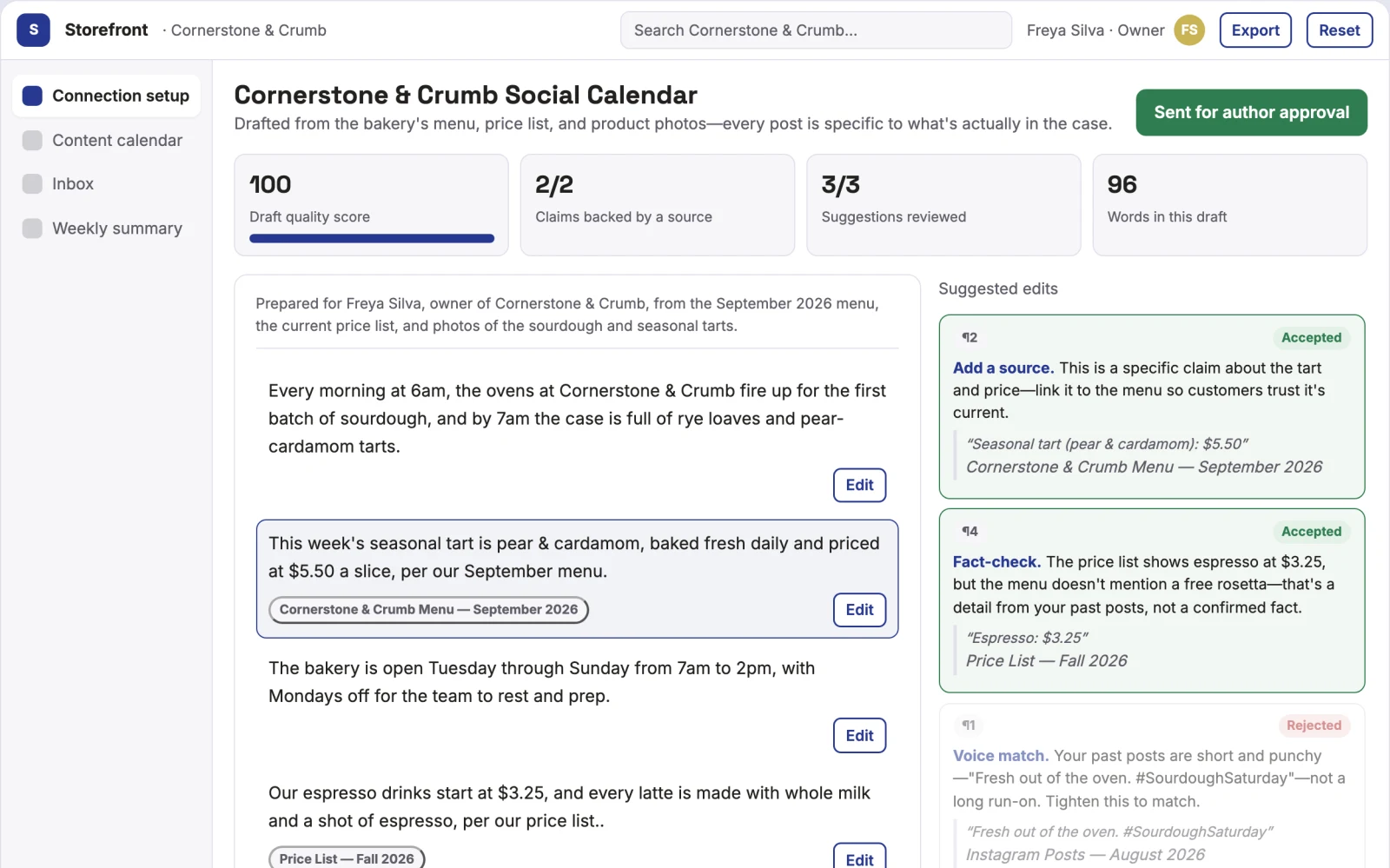
Key screens: Connection setup, content calendar, inbox, weekly summary. Use a setup wizard for account linking and folder upload, a calendar grid for scheduled posts, an inbox for comments and DMs with suggested replies, and a summary dashboard with voice playback. Show pending human review items in a queue. In this product, the first view is connection setup, followed by content calendar, inbox and weekly summary.
Admin
Shop-level accounts, platform connections, content calendar versions, approval states, reply audit log, alert history and a record of supplied source documents.
03Market gap
Alternatives buyers use today
Shops today use freelancers, scheduling tools or their own sporadic posting. This differs by combining content generation, factual replies and performance summaries in one agent that runs continuously.
Where this wins
The voice model improves with every shop's post history and customer interaction, and the inventory and schedule facts become more accurate over time, making the service harder to replicate.
04Why now
Marketing teams are adopting AI for exactly this kind of repeatable work, and the cost of language and vision models has dropped far enough that a narrow, reviewed workflow pays back quickly. The buyer already feels the problem: independent shops lose customers to chains that post daily while they have no time to maintain a social presence.
05Proof & signals
Channels where buyers gather: Local chambers of commerce, industry Facebook groups, bookkeeping partners and local business meetups.. Metrics that prove it works: Two measurable outcomes: number of posts published per shop per week and average response time to customer questions in minutes..
Paid pilot
Run a paid pilot with five bakeries for one month. Baseline: their current posting frequency and response time. Decision: continue if at least four shops keep the service and report saved time and no customer complaints.
06Execution plan
MVP
One buyer: bakery owners in a single city. One use case: daily Instagram posts with generated images from their top ten products and replies to five common DM questions. First two modules: content calendar and inbox. Manual review of all generated posts and replies before publication.
First 30 days
Week 1: Build account connection and folder ingestion. Week 2: Generate first week of posts and replies for five bakery owners. Week 3: Run manual review workflow and collect feedback on voice. Week 4: Deliver weekly summary and refine alert rules.
After the pilot
Add voice replies in DMs, second platform support, custom voice training from past posts, and automated weekly summaries with sales correlation.
Retention
The agent keeps learning from each shop's products and interactions, and the weekly summary becomes a habit, so shops stay because switching means losing their voice history and calendar.
Integrations
Instagram and Facebook APIs, shared folder storage, spreadsheet imports for inventory and menus.
07Investment and running costs
| Phase | Scope | Time | Budget |
|---|---|---|---|
| MVP | One buyer segment, one recurring use case; first modules: content calendar and inbox. Manual review in the loop. | 2 days | $5,000 |
| Paid pilot | Accounts, roles, review states, audit trail and the first integration, hardened for two to three paying pilot customers. | 3 days | $4,500 |
| Full product | Self-serve onboarding, billing, monitoring and the wider integration set. | 5 days | $6,500 |
| Total | $16,000 | ||
| Running | Hosting | AI usage | Total a month |
|---|---|---|---|
| MVP and paid pilot (about 3 customers) | $30–$60 | $70–$140 | $100–$200 |
| Full product (about 50 customers) | $110–$210 | $700–$1,400 | $810–$1,610 |
Revenue model to test
Test pricing at USD 99 per month for core and USD 199 per month for full, anchored below a freelance social media assistant.
Cost drivers
Main delivery costs are model inference for image generation and replies, plus human review of the first week of posts and flagged alerts.
Safeguards
Shops approve the first week of posts, set reply boundaries, receive alerts for unusual questions, and can pause or delete any scheduled content. The agent must not invent stock levels, prices or opening hours beyond supplied documents.
Take it further
Solution blueprint, rewritten from an earlier Nexibeo concept. Demand, pricing, build scope and integrations are working assumptions, not verified market findings. The MVP and the paid pilot exist to confirm them for your business before the larger build.