Self-updating Compliance Training
Regulatory updates require manual cross-referencing and weeks of rewriting to keep training materials current. Training courses that detect regulatory changes and draft compliant updates in minutes instead of weeks.
01The offer
For compliance leads at financial services firms, turn regulatory feeds and training libraries into updated course materials and audit logs. Address the recurring problem: regulatory updates require manual cross-referencing and weeks of rewriting to keep training materials current.
- For
- Compliance leads at financial services firms
- Takes in
- Regulatory feeds, policy documents, product changelogs, and existing training content library
- Delivers
- Updated training modules, change diffs, and audit ready compliance records
- Message
- Turn regulatory updates into updated training in hours, not weeks
- Lead magnet
- A free audit of your current compliance training materials against a specific regulation
02How it works
- Monitor designated regulatory and policy sources
- Identify affected training modules and slides
- Draft revised content preserving instructional tone
- Generate change diffs and context tags
- Manage review and approval workflow
- Publish updates and log audit trails
Workflow
Connect data sources, monitor for updates, identify affected content, generate draft revisions, review and approve changes, publish updated materials, log audit records. Start with regulatory feeds, policy documents, product changelogs and existing training content library and finish with updated training modules, change diffs and audit ready compliance records.
AI and people
The AI scans sources for changes, maps them to training assets, and rewrites text while preserving tone. A subject matter expert checks the AI draft for accuracy and compliance nuance before approval.
Screens
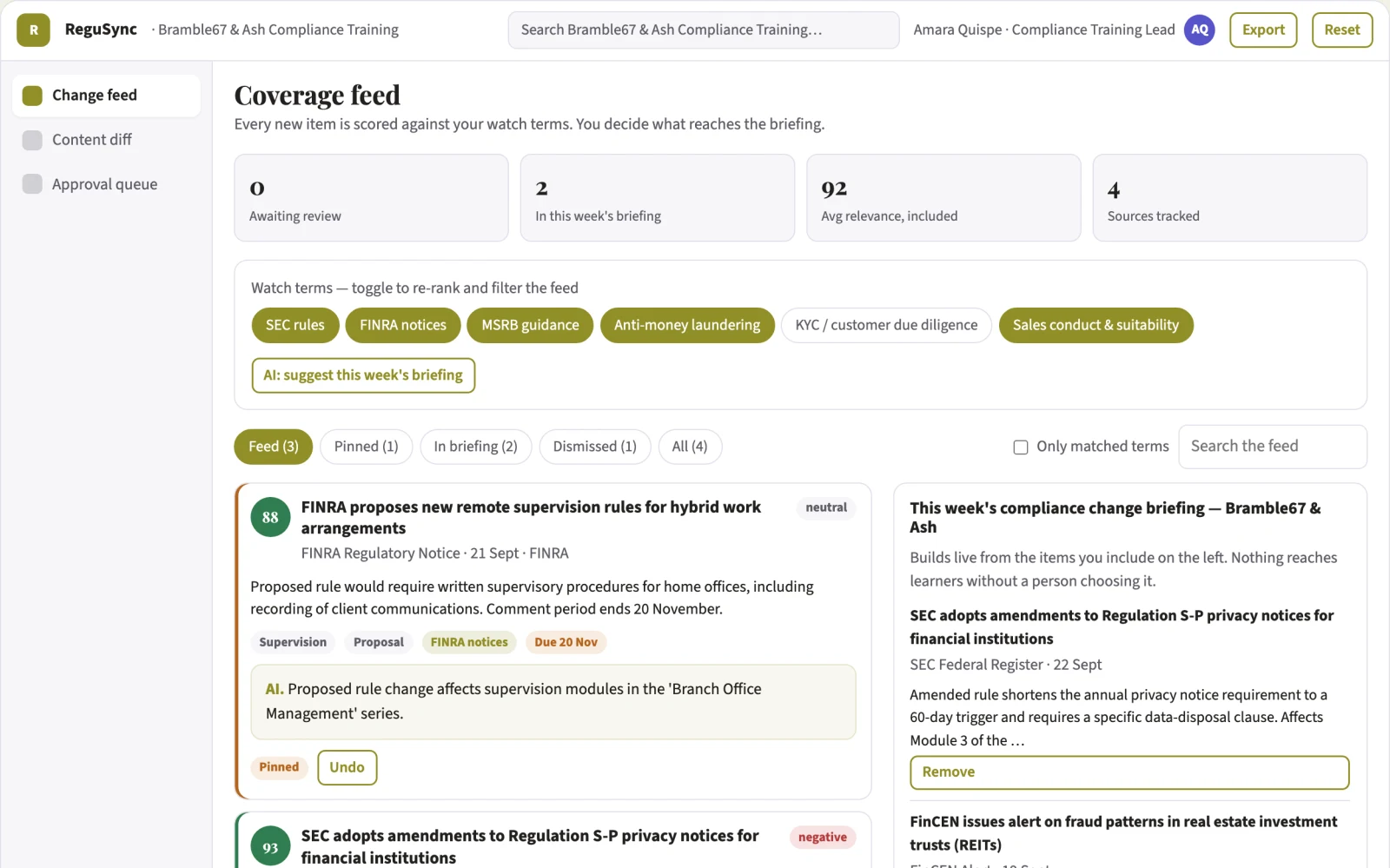
Key screens: Change feed, content diff, approval queue. Use a dashboard to show detected changes, a side by side view of old versus new text, and a queue for trainer review. Highlight the specific rule triggering the change and the affected slide.
Admin
User roles for trainers and admins, version control for course materials, approval workflows, and a complete history of changes for audits
03Market gap
Alternatives buyers use today
Manual review by SMEs or generic document editors, which are slow and error prone compared to this targeted AI agent
Where this wins
Building a proprietary database of regulatory language and training best practices creates a moat
04Why now
Education teams are adopting AI for exactly this kind of repeatable work, and the cost of language and vision models has dropped far enough that a narrow, reviewed workflow pays back quickly. Rising compliance and audit expectations make a documented, reviewable process worth more than an ad hoc one. The buyer already feels the problem: regulatory updates require manual cross-referencing and weeks of rewriting to keep training materials current.
05Proof & signals
Channels where buyers gather: LinkedIn, industry conferences, and compliance software forums. Metrics that prove it works: Reduction in time to update training materials and number of compliance issues identified.
Paid pilot
Compare the time taken to update a module manually versus using the system over one month
06Execution plan
MVP
One compliance lead at a mid-sized bank, one specific regulation source, and two core onboarding modules, with manual review of AI drafts
First 30 days
Week 1: Connect one regulatory source and one training module. Week 2: Test change detection and draft generation. Week 3: Refine the review workflow and accuracy. Week 4: Launch the pilot and measure time saved.
After the pilot
Automated publishing, multi-source monitoring, and integration with authoring tools
Retention
Recurring subscription for ongoing monitoring and updates
Integrations
Government portals, internal policy repositories, LMS systems, and document storage
07Investment and running costs
| Phase | Scope | Time | Budget |
|---|---|---|---|
| MVP | One buyer segment, one recurring use case. Manual review in the loop. | 4 days | $7,000 |
| Paid pilot | Accounts, roles, review states, audit trail and the first integration, hardened for two to three paying pilot customers. | 5 days | $8,000 |
| Full product | Self-serve onboarding, billing, monitoring and the wider integration set. | 8 days | $11,000 |
| Total | $26,000 | ||
| Running | Hosting | AI usage | Total a month |
|---|---|---|---|
| MVP and paid pilot (about 3 customers) | $30–$60 | $50–$100 | $80–$160 |
| Full product (about 50 customers) | $110–$210 | $350–$700 | $460–$910 |
Revenue model to test
5000 USD per month per client
Cost drivers
AI compute costs for text processing and storage
Safeguards
Strict access controls on sensitive data, mandatory human review for compliance, and refusal to generate content for unapproved sources
Take it further
Solution blueprint, rewritten from an earlier Nexibeo concept. Demand, pricing, build scope and integrations are working assumptions, not verified market findings. The MVP and the paid pilot exist to confirm them for your business before the larger build.