Solution Database / IT and Development
Unified Voice Command Interface
Staff spend excessive time switching between disparate software systems to answer simple questions or perform routine tasks. One voice interface for staff that works across old and new business software without rebuilding either.
01The offer
For operations leads at mid-sized logistics companies, turn spoken questions and commands into direct data queries and task executions across multiple software systems. Address the problem of fragmented workflows and slow information retrieval. The value hypothesis is a unified voice layer that reduces context switching; the pilot must establish whether this significantly improves operational efficiency.
- For
- Operations leads at mid-sized logistics companies
- Takes in
- Voice recordings, user authentication tokens, API credentials.
- Delivers
- Structured data summaries, executed task confirmations, interaction logs.
- Message
- Speak your data, not your apps.
- Lead magnet
- Free 30-day trial of the command centre.
02How it works
- Parse natural language voice commands
- Route queries to specific software APIs
- Execute routine administrative tasks
- Summarise complex data sets
- Maintain user context across sessions
- Provide feedback on command accuracy
Workflow
Define intent, authenticate user, route to system, retrieve data, synthesise response, present output, log interaction. Start with spoken questions and finish with data summaries or executed tasks.
AI and people
Use large language models to interpret intent and generate the correct API calls. Validate the output against business logic rules. A system administrator reviews the routing logic and security permissions before deployment.
Screens
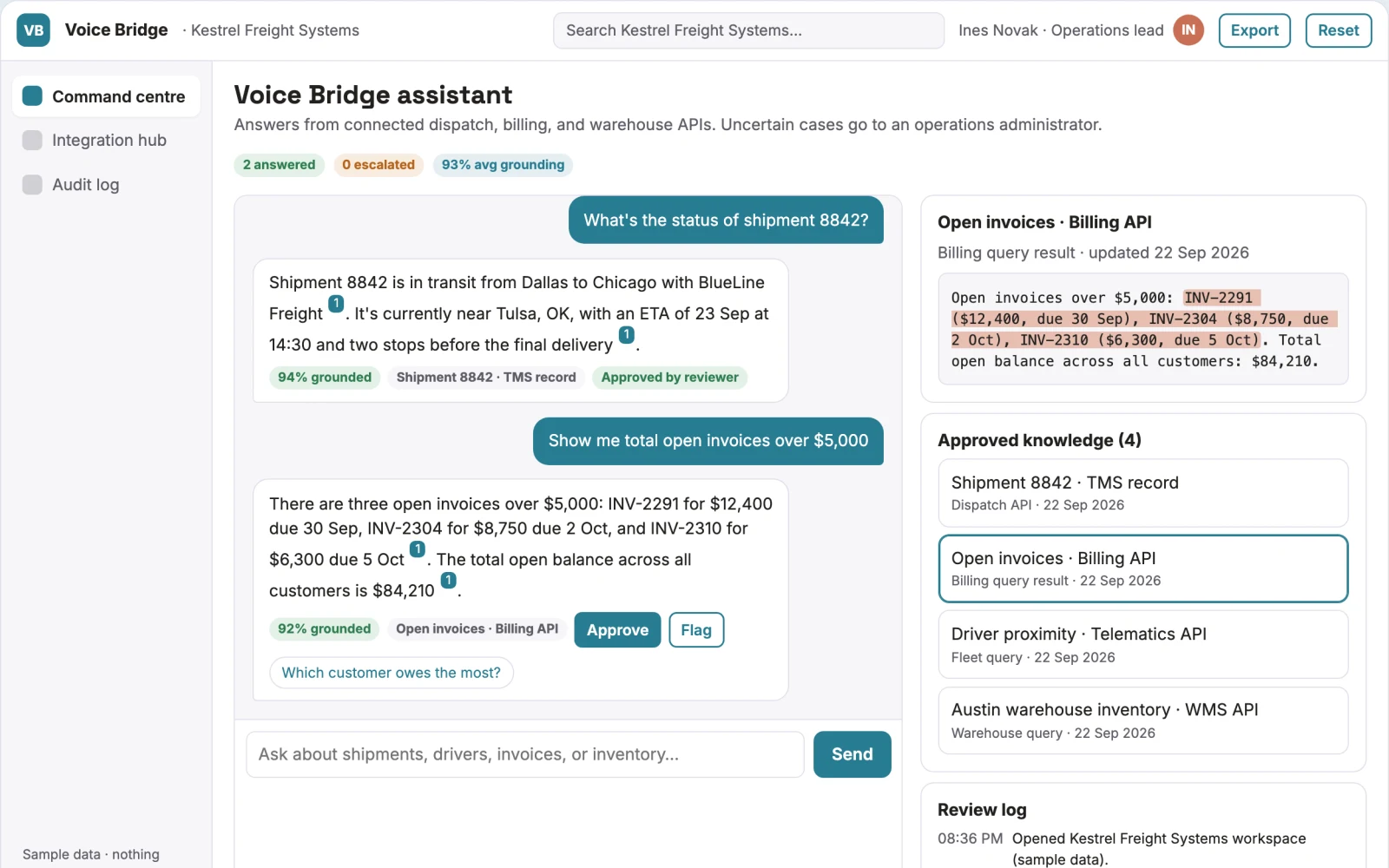
Key screens: Command centre, Integration hub, Audit log. The main screen is a command centre displaying a list of active voice sessions, recent queries, and system status indicators. It allows users to see the history of interactions and the current state of connected systems.
Admin
User roles, API key management, session history, permission levels, audit trails.
03Market gap
Alternatives buyers use today
Native mobile apps, chatbots, manual data entry, hiring support staff.
Where this wins
The difficulty of mapping complex internal data structures to natural language and the need for ongoing maintenance of API integrations.
04Why now
IT and Development teams are adopting AI for exactly this kind of repeatable work, and the cost of language and vision models has dropped far enough that a narrow, reviewed workflow pays back quickly. The buyer already feels the problem: staff spend excessive time switching between disparate software systems to answer simple questions or perform routine tasks.
05Proof & signals
Channels where buyers gather: LinkedIn, industry conferences, tech review sites.. Metrics that prove it works: Average query resolution time, user adoption rate per week..
Paid pilot
Measure the reduction in time spent on routine queries and the number of context switches required to complete a task.
06Execution plan
MVP
One logistics client, one use case for inventory checking, two core integrations (ERP and Warehouse Mgmt), manual review of API calls.
First 30 days
Week 1: System architecture and API mapping. Week 2: Voice model training and integration testing. Week 3: User acceptance testing and security audit. Week 4: Pilot launch and feedback collection.
After the pilot
Automated execution of multi-step workflows, predictive analytics based on voice queries, custom voice training for industry jargon.
Retention
Continuous updates based on new voice commands and system changes.
Integrations
ERP systems, CRM platforms, Email servers.
07Investment and running costs
| Phase | Scope | Time | Budget |
|---|---|---|---|
| MVP | One buyer segment, one recurring use case. Manual review in the loop. | 2 days | $5,000 |
| Paid pilot | Accounts, roles, review states, audit trail and the first integration, hardened for two to three paying pilot customers. | 3 days | $4,000 |
| Full product | Self-serve onboarding, billing, monitoring and the wider integration set. | 5 days | $6,000 |
| Total | $15,000 | ||
| Running | Hosting | AI usage | Total a month |
|---|---|---|---|
| MVP and paid pilot (about 3 customers) | $30–$60 | $60–$120 | $90–$180 |
| Full product (about 50 customers) | $110–$210 | $530–$1,050 | $640–$1,260 |
Revenue model to test
Hypothesis: 50 dollars per user per month.
Cost drivers
Engineering time for integration, cloud hosting for voice processing.
Safeguards
Strict role-based access control, no access to sensitive financial data without explicit approval, blocking of commands that could delete data.
Take it further
Solution blueprint, rewritten from an earlier Nexibeo concept. Demand, pricing, build scope and integrations are working assumptions, not verified market findings. The MVP and the paid pilot exist to confirm them for your business before the larger build.