Solution Database / Hospitality and Events
Nomad Crew Matchmaker
Solo trips lack shared moments and group trips suffer from mismatched work rhythms and fixed itineraries. The AI reads actual work rhythms and calendar patterns, not just stated preferences, to build groups that function well together.
01The offer
For remote workers in their late 20s to early 40s who use nomad platforms, turn work schedules, time zones and interest tags into a matched small group and a flexible itinerary. Address the recurring problem: solo trips lack shared moments and group trips suffer from mismatched work rhythms and fixed itineraries. The value hypothesis is a more fitting travel crew with less coordination effort; the pilot must establish whether that benefit is real.
- For
- Remote workers in their late 20s to early 40s who use nomad platforms
- Takes in
- Work schedules, time zones, interest tags and plain-language preferences
- Delivers
- Matched small group, flexible itinerary and shared booking checklist
- Message
- Find your travel crew, not just a destination.
- Lead magnet
- A free compatibility report showing how your work rhythm matches three potential travel mates.
02How it works
- Parse work schedules and time zones from plain language
- Cluster users by overlapping free blocks and interest tags
- Propose a destination and loose itinerary
- Adjust plans in real time when schedules shift
- Generate a shared booking checklist
- Coordinate group chat with AI-assisted summaries
Workflow
Create a profile, answer clarifying questions, review match suggestions, accept or decline, approve a destination and itinerary, adjust plans during the trip, and receive a post-trip summary. Start with work schedules, time zones and interest tags and finish with a matched small group and a flexible itinerary.
AI and people
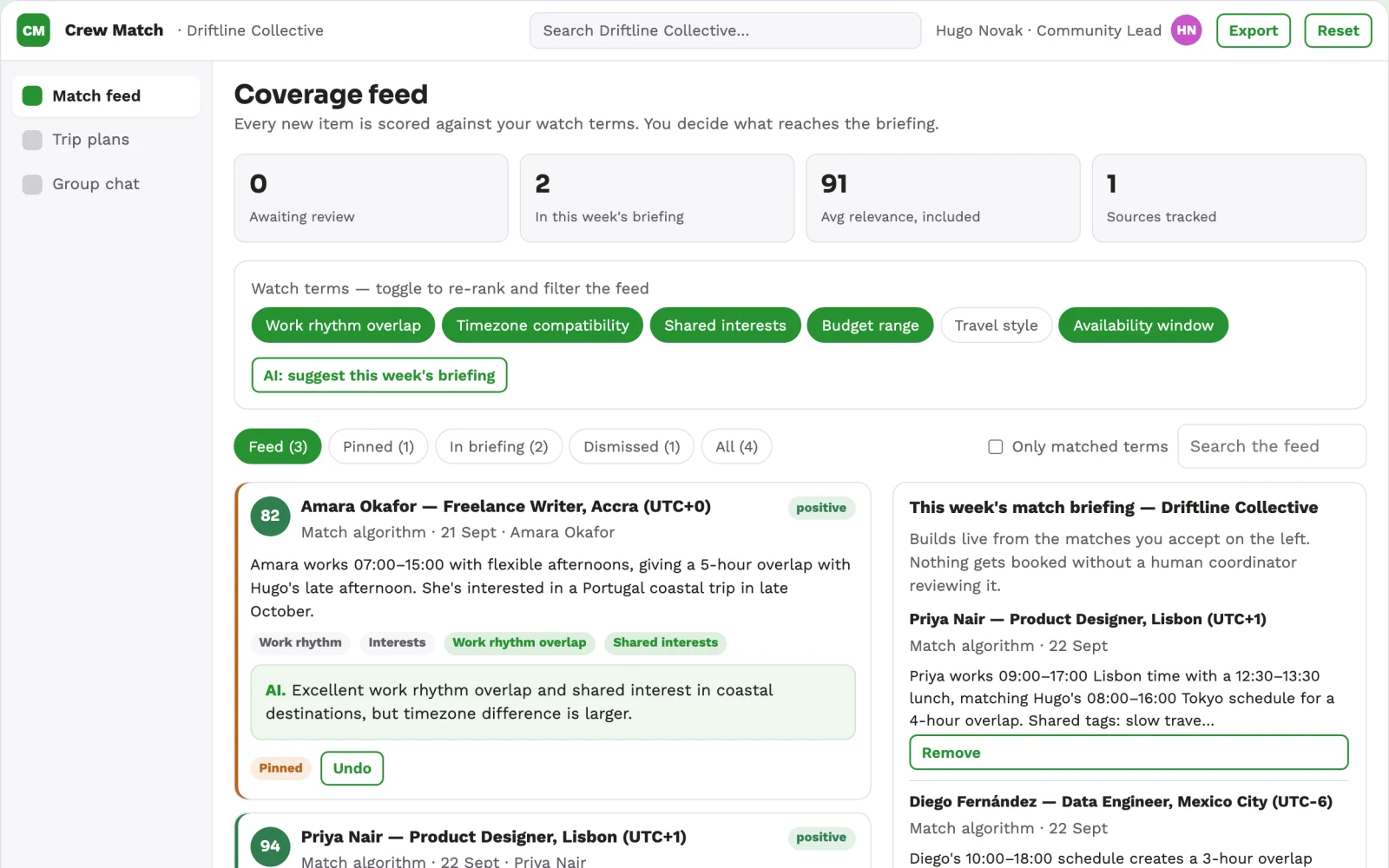
Use language models to interpret schedules and preferences, and clustering algorithms to suggest compatible groups. Keep factual attributes like time zones in structured fields. Validate compatibility scores through deterministic checks. A human coordinator reviews matches and itineraries before they are sent to users.
Screens
Key screens: Profile setup, match suggestions, trip plan. Use a profile form for work hours, time zone and interests, a match list showing compatibility scores and mutual acceptance, and a shared trip plan with itinerary and booking checklist. Let users accept or decline matches and edit the plan with natural language. Display pending, accepted and confirmed states. Provide a chat view for group coordination. In this product, the first view is profile setup, followed by match suggestions and trip plan.
Admin
User profiles, match history, trip versions, acceptance states, booking records, chat logs and a verification record for each participant.
03Market gap
Alternatives buyers use today
People use Nomad List or Outsite forums and co-living bookings. This differs by actively matching compatible individuals rather than leaving social fit to chance.
Where this wins
Over time, the matching engine improves with each trip's feedback and schedule data, creating a network effect that is hard to replicate.
04Why now
Hospitality and Events teams are adopting AI for exactly this kind of repeatable work, and the cost of language and vision models has dropped far enough that a narrow, reviewed workflow pays back quickly. The buyer already feels the problem: solo trips lack shared moments and group trips suffer from mismatched work rhythms and fixed itineraries.
05Proof & signals
Channels where buyers gather: Remote work communities, nomad forums, co-living space newsletters, and social media groups for digital nomads.. Metrics that prove it works: Two measurable outcomes: match acceptance rate and post-trip satisfaction score..
Paid pilot
A paid pilot with 20 remote workers proves the concept by measuring match acceptance rate and post-trip satisfaction. Baseline is current solo travel or mismatched group trips. Decision to proceed is based on at least 60% acceptance and 4 out of 5 satisfaction.
06Execution plan
MVP
One buyer: remote workers on Nomad List. One use case: matching three to five people for a one-week trip. First two modules: profile setup and match suggestions. Manual review of matches by a coordinator before sending.
First 30 days
Week 1: Build profile setup and verification flow. Week 2: Develop matching algorithm and compatibility scoring. Week 3: Create match suggestion screen and acceptance flow. Week 4: Test with a small group of beta users and refine the matching logic.
After the pilot
Automate itinerary generation and real-time adjustments after the paid pilot, then add booking integrations and a trust score system.
Retention
It keeps earning through monthly subscriptions for ongoing matching and a commission on bookings made through the AI's recommendations.
Integrations
Calendar systems like Google Calendar, communication tools like Slack, and booking platforms like Airbnb or Booking.com, starting with calendar sync.
07Investment and running costs
| Phase | Scope | Time | Budget |
|---|---|---|---|
| MVP | One buyer segment, one recurring use case; first modules: profile setup and match suggestions. Manual review in the loop. | 2 days | $5,500 |
| Paid pilot | Accounts, roles, review states, audit trail and the first integration, hardened for two to three paying pilot customers. | 3 days | $5,000 |
| Full product | Self-serve onboarding, billing, monitoring and the wider integration set. | 6 days | $7,000 |
| Total | $17,500 | ||
| Running | Hosting | AI usage | Total a month |
|---|---|---|---|
| MVP and paid pilot (about 3 customers) | $30–$60 | $40–$90 | $70–$150 |
| Full product (about 50 customers) | $110–$210 | $280–$560 | $390–$770 |
Revenue model to test
Test a one-time matching fee of USD 49 per trip, or a monthly subscription of USD 19 for ongoing matching.
Cost drivers
Main delivery costs are AI inference, cloud hosting, and a human coordinator for match review and safety checks.
Safeguards
Limits include no sharing of personal contact details without consent, no matching across incompatible time zones, and a mandatory verification step. It must not book travel without explicit user approval.
Take it further
Solution blueprint, rewritten from an earlier Nexibeo concept. Demand, pricing, build scope and integrations are working assumptions, not verified market findings. The MVP and the paid pilot exist to confirm them for your business before the larger build.