Solution Database / Real Estate and Construction
Trade Triage
Tenant maintenance requests are misrouted, causing delays and wasted contractor visits. Tenant requests routed to the right trade the first time, cutting misrouted call-outs.
01The offer
For property managers at build-to-rent operators and residential block managers, turn tenant messages and photos into classified, quoted, and booked maintenance jobs. Address the recurring problem: tenant maintenance requests are misrouted, causing delays and wasted contractor visits. The value hypothesis is faster, more accurate triage and booking; the pilot must establish whether that benefit is real.
- For
- Property managers at build-to-rent operators and residential block managers
- Takes in
- Tenant messages, photos, property files, contractor database
- Delivers
- Classified job list, ranked quotes, confirmed bookings, satisfaction ratings
- Message
- Stop playing phone tag: route every maintenance request to the right trade, first time.
- Lead magnet
- Free maintenance inbox audit showing misrouting rates and potential time savings.
02How it works
- Classify incoming tenant messages by trade and urgency
- Extract job details from photos and text
- Match with licensed contractors from a database
- Send standardized job briefs and parse quotes
- Present ranked shortlist for approval
- Send tenant confirmation and follow-up survey
Workflow
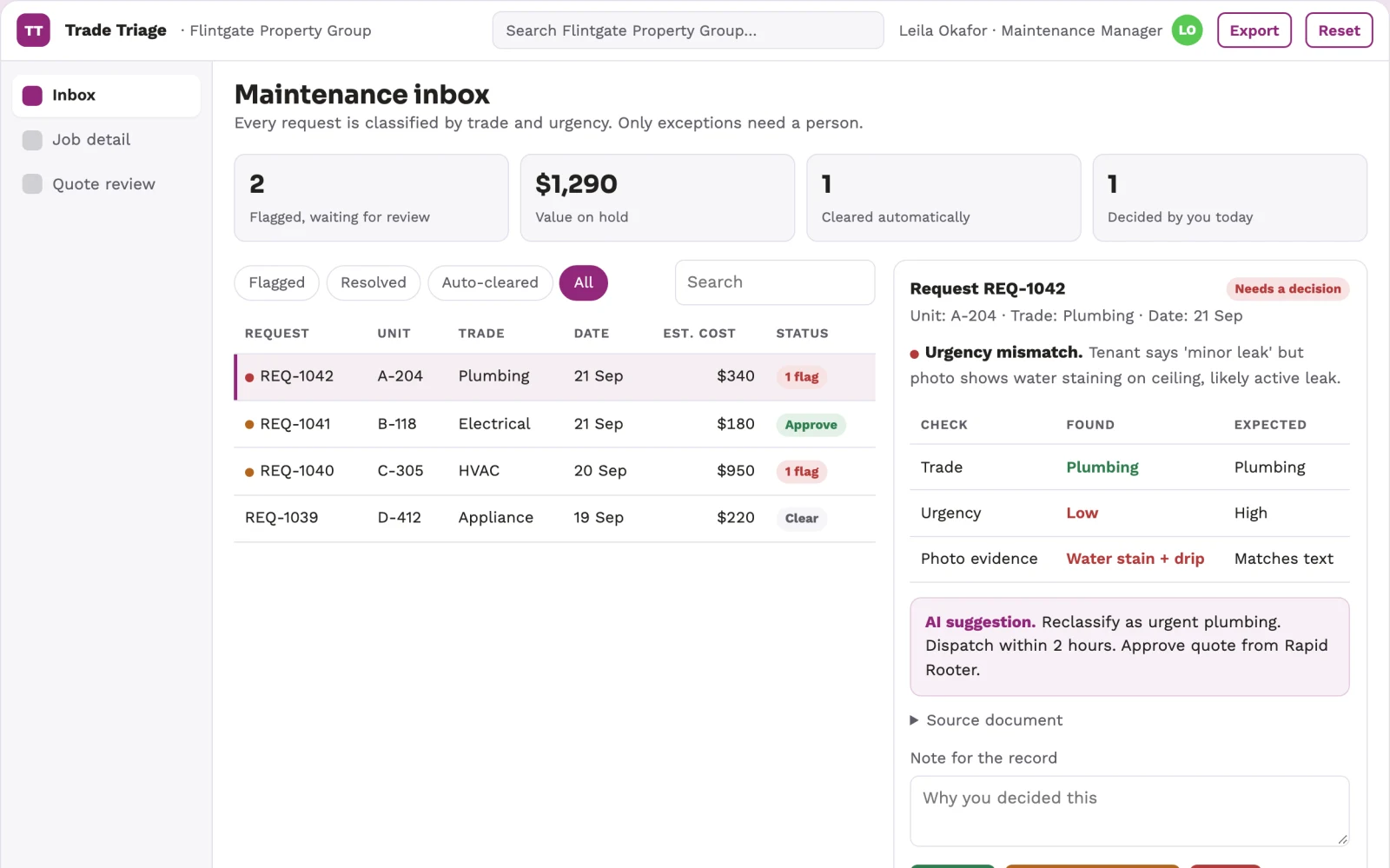
Tenant submits request, system classifies trade and urgency, cross-references contractor database, sends briefs, parses quotes, manager approves, tenant receives slot. Start with tenant messages and photos and finish with confirmed booking and satisfaction rating.
AI and people
Use multimodal models to read text and images for classification and urgency detection. Use language models to parse contractor quotes. A property manager reviews the shortlist and approves the final booking before any commitment.
Screens
Key screens: Inbox, Job detail, Quote review. Use a dashboard list of incoming requests with status badges, a detail view showing tenant message, photos, classification, and suggested trade, and a quote comparison panel where contractors' responses are ranked. Allow the manager to approve with one click, triggering tenant confirmation. Display audit trail of classification and approvals.
Admin
Property manager accounts, tenant data privacy, job versions, approval logs, contractor vetting status, audit trail of all actions.
03Market gap
Alternatives buyers use today
Manual email and phone coordination, generic facilities management software. This differs by using AI to automate the triage and quote process, not just track tickets.
Where this wins
Each job improves the classification model with feedback, and the contractor network and property file integration become proprietary assets.
04Why now
Real Estate and Construction teams are adopting AI for exactly this kind of repeatable work, and the cost of language and vision models has dropped far enough that a narrow, reviewed workflow pays back quickly. The buyer already feels the problem: tenant maintenance requests are misrouted, causing delays and wasted contractor visits.
05Proof & signals
Channels where buyers gather: Property management conferences, LinkedIn groups for build-to-rent operators, industry newsletters.. Metrics that prove it works: Reduction in average time-to-fix, percentage of jobs correctly classified on first attempt..
Paid pilot
Paid pilot with one firm, baseline: average time-to-fix and misrouting rate. Prove reduction in time-to-fix from 5 to 2 days and 90% first-time correct trade. Decision: continue if metrics met.
06Execution plan
MVP
First buyer: one property management firm. Use case: inbound email triage only. Modules: classification engine and daily digest. Manual review of all classifications before any contractor contact.
First 30 days
Week 1: Integrate with one property manager's inbox and build classification model. Week 2: Test with 50 real requests, refine accuracy. Week 3: Build daily digest and dashboard. Week 4: Run manual approval workflow with one contractor.
After the pilot
Automate quote parsing, booking confirmation, and follow-up surveys after the paid pilot.
Retention
Ongoing subscription with usage-based pricing; value grows as model improves and contractor network expands.
Integrations
Email inbox, WhatsApp Business API, property management software (e.g., AppFolio), calendar systems.
07Investment and running costs
| Phase | Scope | Time | Budget |
|---|---|---|---|
| MVP | One buyer segment, one recurring use case; first modules: classification engine and daily digest. Manual review in the loop. | 5 days | $9,000 |
| Paid pilot | Accounts, roles, review states, audit trail and the first integration, hardened for two to three paying pilot customers. | 6 days | $11,500 |
| Full product | Self-serve onboarding, billing, monitoring and the wider integration set. | 2 weeks | $15,500 |
| Total | $36,000 | ||
| Running | Hosting | AI usage | Total a month |
|---|---|---|---|
| MVP and paid pilot (about 3 customers) | $30–$60 | $40–$90 | $70–$150 |
| Full product (about 50 customers) | $110–$210 | $280–$560 | $390–$770 |
Revenue model to test
Test pricing at $2 per door per month, with a 500-door pilot generating $1,000 monthly recurring revenue.
Cost drivers
AI model usage, cloud hosting, integration development, contractor database licensing.
Safeguards
Limit to approved contractors, require human approval for all bookings, anonymize tenant data, and must not auto-book without manager sign-off.
Take it further
Solution blueprint, rewritten from an earlier Nexibeo concept. Demand, pricing, build scope and integrations are working assumptions, not verified market findings. The MVP and the paid pilot exist to confirm them for your business before the larger build.