Solution Database / IT and Development
Adaptive Cloud Gaming PC
Gamers buy expensive video cards that age quickly and sit idle most of the day. A cloud GPU that learns your play style and tunes every scene in real time, so you never buy hardware again.
01The offer
For PC gamers who upgrade hardware every two years, turn gameplay telemetry, scene data and user preferences into a continuously optimised cloud gaming session with per-scene graphics tuning and predictive adjustments. Address the recurring problem: gamers buy expensive video cards that age quickly and sit idle most of the day. The value hypothesis is a subscription that always feels current without hardware purchases; the pilot must establish whether the experience feels local enough.
- For
- PC gamers who upgrade hardware every two years
- Takes in
- Gameplay telemetry, scene data, user preferences, hardware specifications
- Delivers
- Continuously optimised cloud gaming session with per-scene graphics tuning and predictive adjustments
- Message
- Play on a top-tier GPU that learns you, never ages, and costs less than a new card every two years.
- Lead magnet
- A free one-hour trial session with a performance comparison against your current hardware.
02How it works
- Build a player profile from the first hour of play
- Adjust graphics settings per scene in real time
- Predict next moves and pre-load assets
- Generate upscaled detail for lower-end hardware
- Auto-assign newer GPU architecture for new titles
- Voice-command settings changes without menus
Workflow
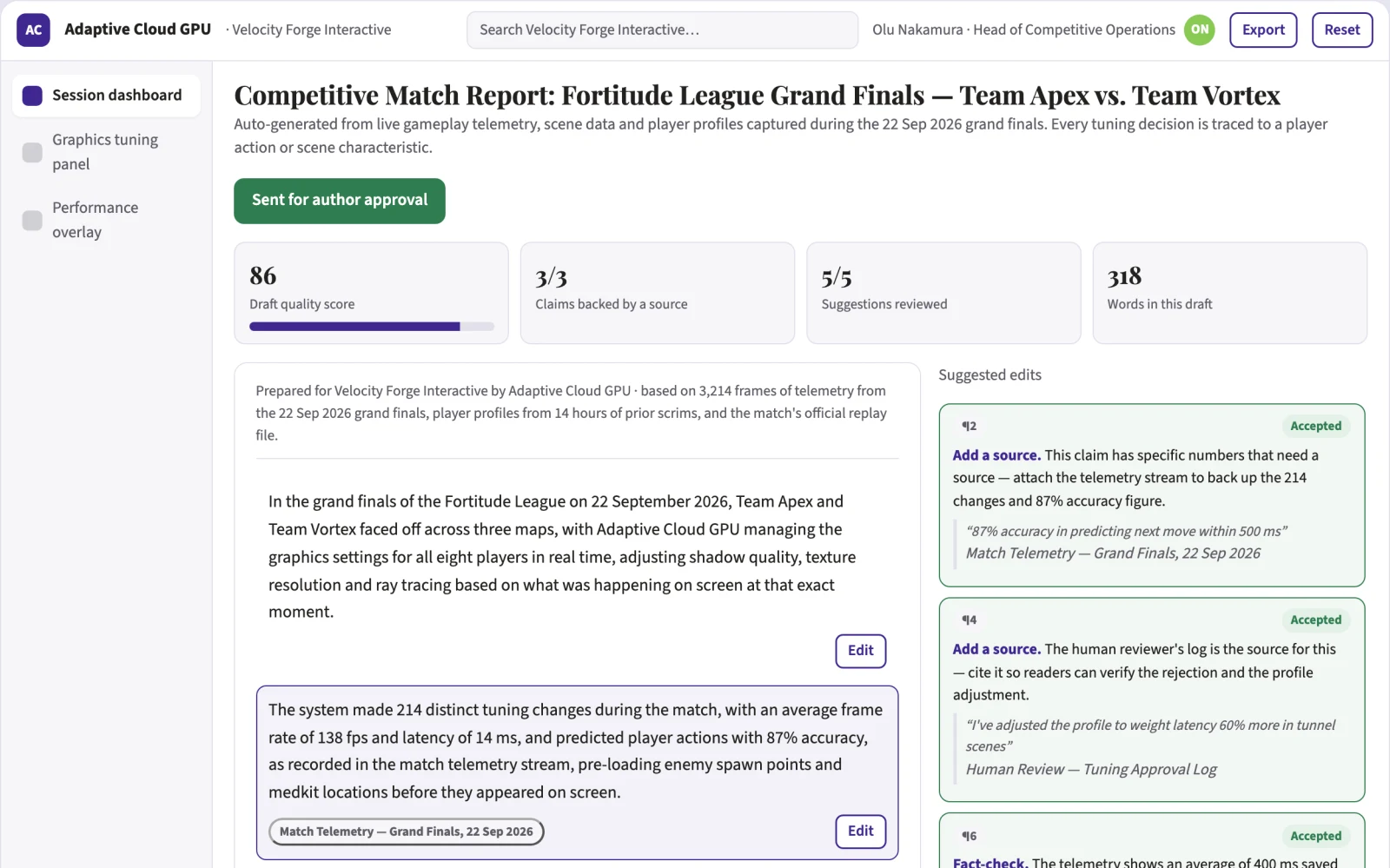
Install thin client, play an initial profiling session, review the generated profile, accept or adjust auto-tuning rules, start a game session, monitor live adjustments, and review performance summaries. Start with gameplay telemetry and scene data and finish with a continuously optimised cloud gaming session.
AI and people
Use reinforcement learning to tune graphics settings per scene and computer vision to analyse on-screen content. Predict player actions from input patterns. A human reviewer checks profile accuracy and tuning behaviour before any settings are applied automatically.
Screens
Key screens: Session dashboard, graphics tuning panel, performance overlay. Use a central gameplay view with a side panel showing live settings adjustments, frame rate and latency. Let users toggle auto-tuning on or off and view a history of changes. Display predicted next actions and suggested voice prompts. In this product, the first view is session dashboard, followed by graphics tuning panel and performance overlay.
Admin
User accounts, session history, tuning profiles, permission levels for manual overrides, versioned settings, audit trail of all adjustments and a record of hardware assignments.
03Market gap
Alternatives buyers use today
People buy new GPUs or use static cloud gaming services; this differs by adapting to individual play styles and scene content rather than offering fixed settings.
Where this wins
Player profiles and tuning models improve with usage, making the service more accurate and personalised over time, while the cloud infrastructure scales with demand.
04Why now
IT and Development teams are adopting AI for exactly this kind of repeatable work, and the cost of language and vision models has dropped far enough that a narrow, reviewed workflow pays back quickly. The buyer already feels the problem: gamers buy expensive video cards that age quickly and sit idle most of the day.
05Proof & signals
Channels where buyers gather: Discord gaming communities, sim racing forums, Twitch streams, and PC gaming subreddits.. Metrics that prove it works: Average frame rate variance per session and percentage of testers who renew after the pilot..
Paid pilot
A paid pilot with 50 sim racers over 30 days proves value by comparing average frame rate variance and session length against their previous hardware. The decision to proceed is based on at least 70% of testers reporting a local feel and renewing for a second month.
06Execution plan
MVP
One buyer: sim racers. One use case: consistent frame rates in racing titles. First two modules: basic auto-preset selection and a performance overlay. Manual review of tuning decisions before they go live.
First 30 days
Week 1: Set up cloud VM with single GPU tier and thin client. Week 2: Build basic auto-preset agent based on detected hardware and title. Week 3: Recruit 50 beta testers from Discord and ship the client. Week 4: Collect feedback, fix critical issues, and measure frame rate consistency.
After the pilot
After the paid pilot, automate per-scene tuning, add predictive asset loading, and introduce voice commands for settings changes.
Retention
The subscription continues monthly, with the AI improving tuning accuracy and adding new game support, so users stay because the service keeps getting better without extra cost.
Integrations
Game launchers, graphics APIs, streaming codecs, and user authentication systems.
07Investment and running costs
| Phase | Scope | Time | Budget |
|---|---|---|---|
| MVP | One buyer segment, one recurring use case; first modules: basic auto-preset selection and a performance overlay. Manual review in the loop. | 4 days | $7,000 |
| Paid pilot | Accounts, roles, review states, audit trail and the first integration, hardened for two to three paying pilot customers. | 5 days | $8,000 |
| Full product | Self-serve onboarding, billing, monitoring and the wider integration set. | 8 days | $11,000 |
| Total | $26,000 | ||
| Running | Hosting | AI usage | Total a month |
|---|---|---|---|
| MVP and paid pilot (about 3 customers) | $30–$60 | $60–$120 | $90–$180 |
| Full product (about 50 customers) | $110–$210 | $530–$1,050 | $640–$1,260 |
Revenue model to test
Test pricing at $29 per month for 1080p, $49 for 1440p, and $79 for 4K at 120fps.
Cost drivers
Cloud GPU rental, streaming bandwidth, model training and inference, and support staff.
Safeguards
Limits on data collection to gameplay telemetry only, permission for manual overrides, no sharing of personal data, and a safety check that prevents the AI from making changes that could cause motion sickness or discomfort.
Take it further
Solution blueprint, rewritten from an earlier Nexibeo concept. Demand, pricing, build scope and integrations are working assumptions, not verified market findings. The MVP and the paid pilot exist to confirm them for your business before the larger build.