Solution Database / Product Development
TasteMatch Beer Curator
Subscription boxes send popular picks that ignore individual taste, leaving drinkers with bottles they will not finish. A taste profile that learns from every rating and photo, not just purchase history, to predict enjoyment before the box ships.
01The offer
For craft beer enthusiasts at subscription box services, turn personal taste notes, beer ratings and label images into a personalised beer selection and taste profile. Address the recurring problem: subscription boxes send popular picks that ignore individual taste, leaving drinkers with bottles they will not finish. The value hypothesis is a more satisfying, curated box with less waste; the pilot must establish whether that benefit is real.
- For
- Craft beer enthusiasts at subscription box services
- Takes in
- Personal taste notes, beer ratings, label photos
- Delivers
- Personalised beer selection and taste profile
- Message
- Never settle for a random six-pack again, get a box that learns your taste.
- Lead magnet
- Offer a free taste profile report with three predicted beer matches.
02How it works
- Capture taste preferences in free text
- Match beers to profile using sensory models
- Rate beers with text or photo
- Update profile after each rating
- Avoid repeat beers unless requested
- Generate a monthly box recommendation
Workflow
Complete a taste quiz, review initial beer matches, receive a box, rate each beer, let the model update the profile, preview the next box, and confirm the order. Start with personal taste notes and beer ratings and finish with a personalised beer selection and taste profile.
AI and people
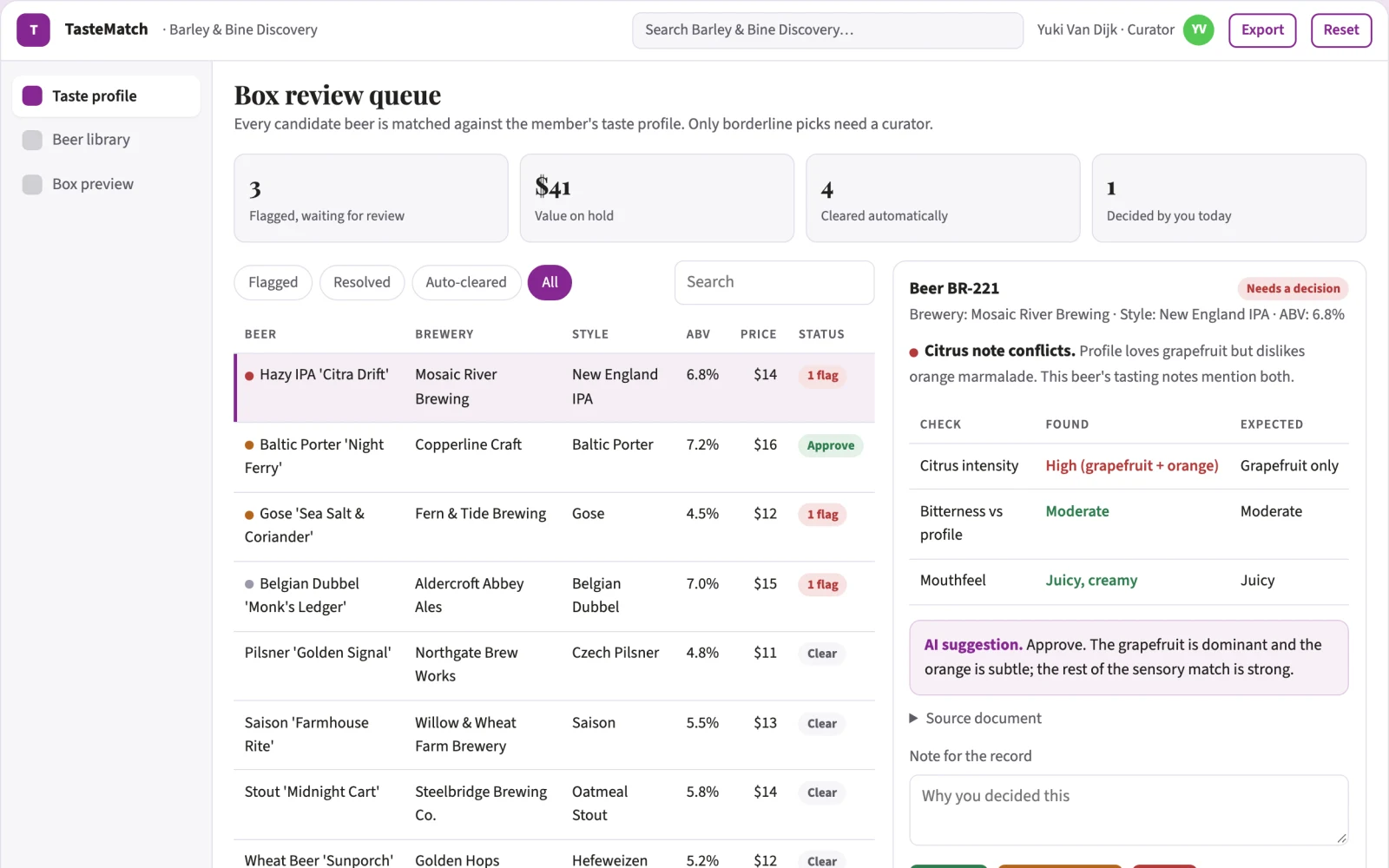
Use language models to interpret taste descriptions and ratings, and vision models to read label images. Match beers to profiles using a fine-tuned recommendation model. A human curator checks the final box selection for quality and availability before dispatch.
Screens
Key screens: Taste profile, beer library, box preview. Use a profile dashboard for preferences, a searchable beer library with filters, and a box preview showing the four selected beers with predicted match scores. Let users rate each beer with words or a photo. Display a learning progress indicator. Provide a reorder button for favourites. In this product, the first view is taste profile, followed by beer library and box preview.
Admin
User accounts, taste profile versions, box order history, rating logs, preference changes, admin review queue, and an audit trail of model updates.
03Market gap
Alternatives buyers use today
People use generic subscription boxes or browse brewery websites manually; this differs by offering a continuously learning personal curator.
Where this wins
The model improves with each rating, creating a data moat of personal preferences that competitors cannot copy without years of user behaviour.
04Why now
Product Development teams are adopting AI for exactly this kind of repeatable work, and the cost of language and vision models has dropped far enough that a narrow, reviewed workflow pays back quickly. The buyer already feels the problem: subscription boxes send popular picks that ignore individual taste, leaving drinkers with bottles they will not finish.
05Proof & signals
Channels where buyers gather: Craft beer forums, subscription box review sites, and social media groups for beer enthusiasts.. Metrics that prove it works: Two measurable outcomes: average rating per box and repeat subscription rate after three months..
Paid pilot
A paid pilot with 20 subscribers proves it by measuring box satisfaction scores against a baseline of random picks; the decision is to expand if satisfaction rises by 30 percent.
06Execution plan
MVP
First cut: craft beer subscribers, one use case for monthly boxes, modules for taste quiz and box curation, manual review of every box by a human curator.
First 30 days
Week 1: Build the taste quiz and profile storage. Week 2: Integrate a beer database and basic matching model. Week 3: Create the box preview and rating interface. Week 4: Run a manual curation pilot with ten users.
After the pilot
Automate the curation review after enough ratings, add voice ordering, and integrate brewery inventory feeds for real-time availability.
Retention
It keeps earning through monthly subscription fees and higher tiers for rare beers, with the profile improving each month to reduce churn.
Integrations
Connect to brewery inventory systems, payment gateways, and shipping carriers, starting with a simple CSV feed.
07Investment and running costs
| Phase | Scope | Time | Budget |
|---|---|---|---|
| MVP | One buyer segment, one recurring use case. Manual review in the loop. | 2 days | $5,500 |
| Paid pilot | Accounts, roles, review states, audit trail and the first integration, hardened for two to three paying pilot customers. | 3 days | $5,000 |
| Full product | Self-serve onboarding, billing, monitoring and the wider integration set. | 6 days | $6,500 |
| Total | $17,000 | ||
| Running | Hosting | AI usage | Total a month |
|---|---|---|---|
| MVP and paid pilot (about 3 customers) | $30–$60 | $50–$100 | $80–$160 |
| Full product (about 50 customers) | $110–$210 | $350–$700 | $460–$910 |
Revenue model to test
Test pricing at USD 39 per box, with a USD 59 tier for rare or aged beers, as a hypothesis.
Cost drivers
Main delivery costs are beer procurement, shipping, model inference, and human curator review time.
Safeguards
Limit profile edits to the owner, require human approval for any box before dispatch, and do not recommend beers outside the user's stated dietary or alcohol limits.
Take it further
Solution blueprint, rewritten from an earlier Nexibeo concept. Demand, pricing, build scope and integrations are working assumptions, not verified market findings. The MVP and the paid pilot exist to confirm them for your business before the larger build.