Solution Database / Product Development
Personal Jewellery Stylist
Subscription jewellery services ignore individual taste and force mass-produced pieces. A taste profile that sharpens with every monthly delivery and a network of small workshops that can fulfil one-off commissions.
01The offer
For women in their 30s and 40s who buy jewellery monthly, turn photos of existing collections, Pinterest boards and voice notes into one commissioned or curated piece shipped monthly. Address the recurring problem: subscription jewellery services ignore individual taste and force mass-produced pieces. The value hypothesis is a precise, personal match that reduces returns and increases wear; the pilot must establish whether that benefit is real.
- For
- Women in their 30s and 40s who buy jewellery monthly
- Takes in
- Photos of existing jewellery, Pinterest boards, voice notes, wear feedback
- Delivers
- One jewellery piece monthly, taste profile, design briefs, wear report
- Message
- One piece, made for you, every month.
- Lead magnet
- A free taste profile report based on three photos and one voice note.
02How it works
- Extract taste signals from photos and voice notes
- Build and update a taste map
- Match profile to workshop inventory
- Generate design briefs for commissions
- Track wear and return signals
- Manage shipping and quality checks
Workflow
Share initial signals, receive taste profile, review monthly match, approve or return piece, send feedback, receive next month's piece, and track wear history. Start with photos, Pinterest boards and voice notes and finish with one shipped piece and a refined taste profile.
AI and people
Use vision models to read jewellery style from photos and voice-to-text to convert voice notes into structured briefs. Match profiles to workshop inventory using structured attributes. A human stylist reviews each match and a quality checker verifies the piece before shipping.
Screens
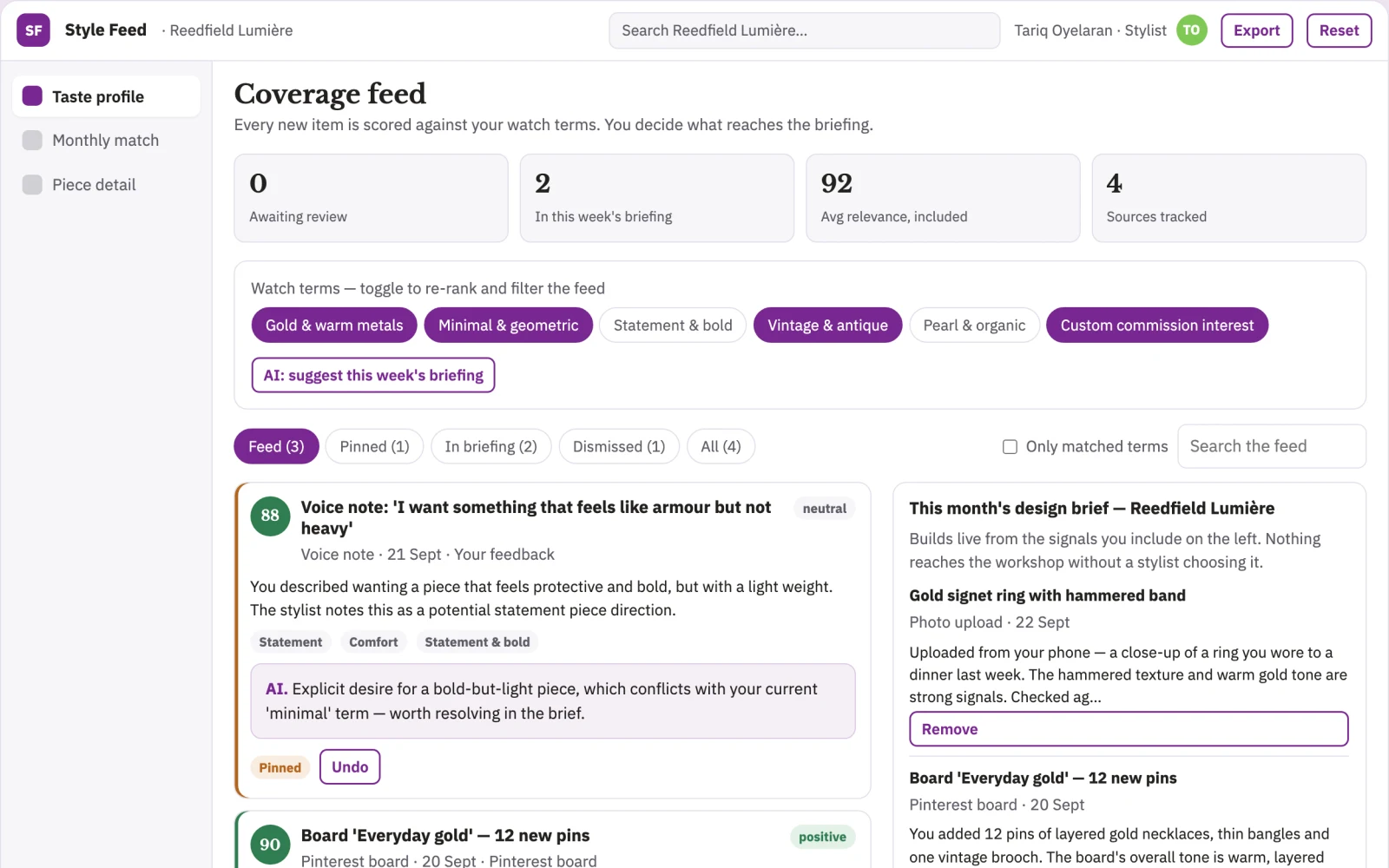
Key screens: Taste profile, monthly match, piece detail. Use a card-based dashboard for profile signals, a large central panel for the monthly match, and a right-hand panel for piece details, materials and occasion. Let users approve or return with one tap. Display wear history and preference evolution. Provide a chat interface for voice notes and feedback. In this product, the first view is taste profile, followed by monthly match and piece detail.
Admin
User accounts, taste profiles, order history, return records, workshop contracts, quality check logs, shipping status and audit trail for all matches.
03Market gap
Alternatives buyers use today
Static style quizzes and mass-produced subscription boxes. This differs by using continuous visual and voice signals and commissioning unique pieces.
Where this wins
The taste data becomes a moat over time. Each delivery and return signal improves the profile, making it harder for competitors to match the personalisation.
04Why now
Product Development teams are adopting AI for exactly this kind of repeatable work, and the cost of language and vision models has dropped far enough that a narrow, reviewed workflow pays back quickly. The buyer already feels the problem: subscription jewellery services ignore individual taste and force mass-produced pieces.
05Proof & signals
Channels where buyers gather: Instagram, Pinterest, fashion blogs, jewellery forums, word of mouth.. Metrics that prove it works: Return rate below 10% and wear rate above 80%..
Paid pilot
Run a paid pilot with 20 women for three months. Baseline is current return rate of 30% for subscription boxes. Success is return rate below 10% and 80% wear rate. Decision: expand if metrics are met.
06Execution plan
MVP
Start with 20 women in one city, one workshop network, taste profile module and monthly match module. Manual review of each match by a stylist.
First 30 days
Week 1: Recruit 20 pilot users and collect initial signals. Week 2: Build taste profile module and source five pieces from local workshops. Week 3: Ship first pieces and collect wear feedback. Week 4: Refine matching algorithm and prepare second month.
After the pilot
Automate taste extraction, workshop matching, design brief generation and quality checks. Add more workshops and regions.
Retention
Monthly subscription fee and improved taste profile that increases satisfaction and reduces churn.
Integrations
Pinterest API, Instagram API, workshop inventory systems, shipping carriers, payment gateway.
07Investment and running costs
| Phase | Scope | Time | Budget |
|---|---|---|---|
| MVP | One buyer segment, one recurring use case. Manual review in the loop. | 2 days | $5,500 |
| Paid pilot | Accounts, roles, review states, audit trail and the first integration, hardened for two to three paying pilot customers. | 3 days | $5,500 |
| Full product | Self-serve onboarding, billing, monitoring and the wider integration set. | 6 days | $7,000 |
| Total | $18,000 | ||
| Running | Hosting | AI usage | Total a month |
|---|---|---|---|
| MVP and paid pilot (about 3 customers) | $30–$60 | $40–$90 | $70–$150 |
| Full product (about 50 customers) | $110–$210 | $280–$560 | $390–$770 |
Revenue model to test
Test a monthly subscription of $120 with a $40 margin on each piece.
Cost drivers
Workshop commissions, shipping, quality checks, AI infrastructure, stylist review time.
Safeguards
Limit data collection to explicit user consent. Do not share personal style data with third parties. Ensure all pieces meet quality standards before shipping.
Take it further
Solution blueprint, rewritten from an earlier Nexibeo concept. Demand, pricing, build scope and integrations are working assumptions, not verified market findings. The MVP and the paid pilot exist to confirm them for your business before the larger build.