Solution Database / Product Development
Fit-First Wardrobe Service
Clothing subscriptions still send boxes where half the items don't fit. A fit engine that learns from every return and adjusts patterns per individual, not just per size, using real manufacturing feedback.
01The offer
For style-conscious professionals who buy clothes 4-6 times a year and hate returns, turn three smartphone photos, style preferences and occasion needs into a box of made-on-demand garments adjusted to their body. Address the recurring problem: clothing subscriptions still send boxes where half the items don't fit. The value hypothesis is a more personalised fit with less return hassle; the pilot must establish whether that benefit is real.
- For
- Style-conscious professionals who buy clothes 4-6 times a year and hate returns
- Takes in
- Three smartphone photos, style preferences, occasion needs and return feedback
- Delivers
- A box of 5 made-on-demand garments adjusted to the member's body, with fit confidence scores
- Message
- Get clothes that fit before they ship, made for your body from three photos.
- Lead magnet
- A free fit prediction report showing how current brands' sizes would fit your body.
02How it works
- Extract 40+ body measurements from three photos
- Match measurements against brand size charts and fabric stretch data
- Interview style and occasion needs via voice or text
- Generate a coherent look with adjusted digital patterns
- Send digital files to manufacturing partners
- Update preferences from return reasons
Workflow
Upload photos, complete style interview, review fit predictions, adjust preferences, approve order, send patterns to manufacturer, and receive box with 5 items. Start with three smartphone photos and style preferences and finish with a box of 5 made-on-demand garments.
AI and people
Use computer vision models to extract body measurements and language models to interpret style preferences. Predict fit per garment using size charts, reviews and fabric data. A human stylist reviews the AI picks and a fit expert checks pattern adjustments before shipping.
Screens
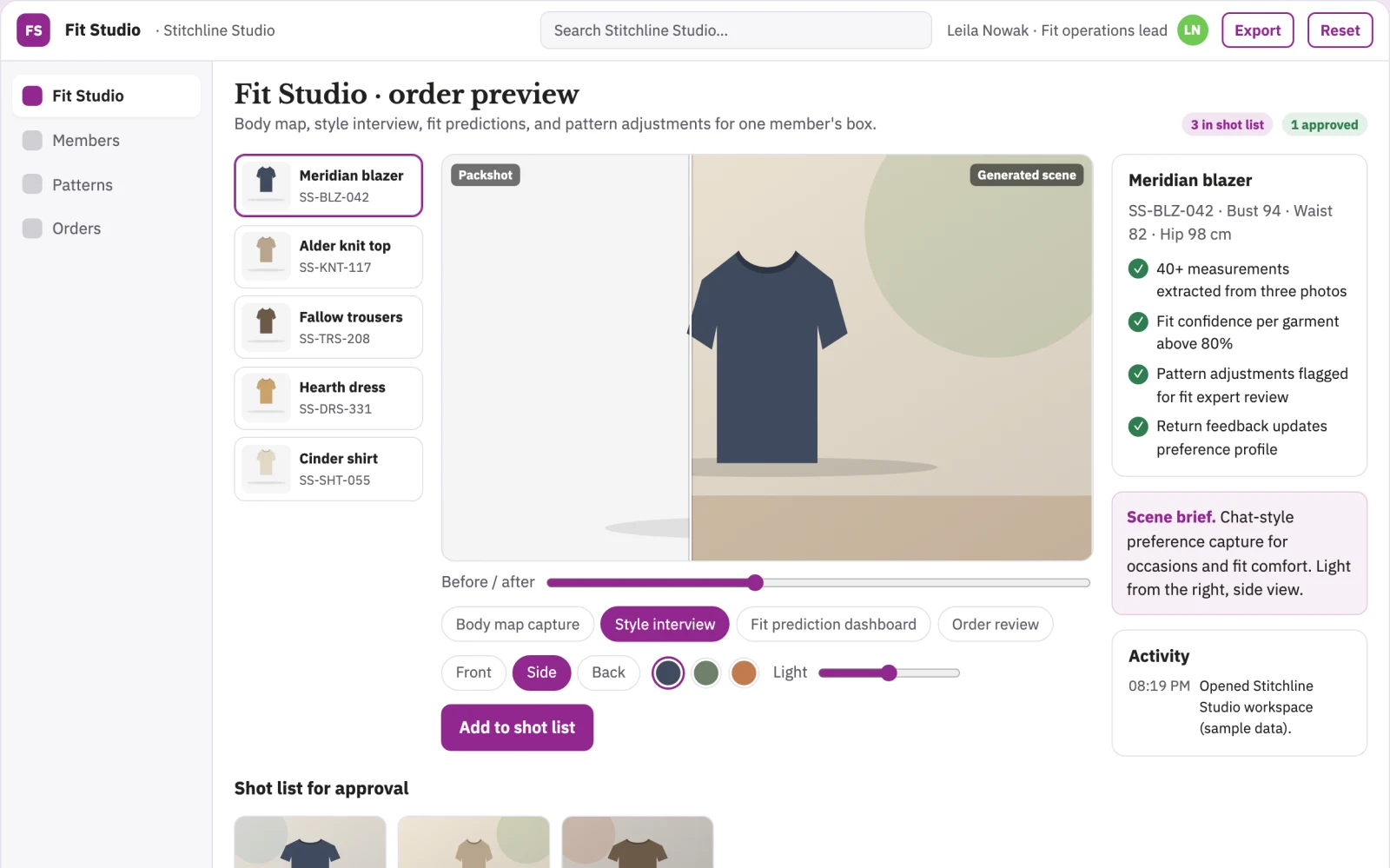
Key screens: Body map capture, style interview, fit prediction dashboard, order review. Use a guided photo upload flow with live feedback, a chat-style preference capture, a grid of predicted fit scores per garment, and a final order summary with pattern adjustments. Let users see fit confidence per item and reason codes. Display draft, changes requested and approved states. Provide a client preview link with comments anchored to the relevant garment. In this product, the first view is body map capture, followed by style interview, fit prediction dashboard and order review.
Admin
Member profiles, body map versions, order history, return reasons, stylist approvals, manufacturer records, pattern versions and an audit trail of fit predictions.
03Market gap
Alternatives buyers use today
People today use standard sizing, size charts and trial-and-error returns. This differs by predicting fit before shipping and adjusting patterns to the individual body.
Where this wins
The fit model improves with each return and body shape, creating a proprietary dataset of fit outcomes that competitors cannot replicate without similar volume.
04Why now
Product Development teams are adopting AI for exactly this kind of repeatable work, and the cost of language and vision models has dropped far enough that a narrow, reviewed workflow pays back quickly. The buyer already feels the problem: clothing subscriptions still send boxes where half the items don't fit.
05Proof & signals
Channels where buyers gather: Social media ads targeting style-conscious professionals, fashion blogs, and partnerships with personal stylists.. Metrics that prove it works: Return rate per box and average fit confidence score per garment..
Paid pilot
A paid pilot with 10 members proves the fit accuracy by comparing return rates against a baseline of 50% from standard subscriptions. Decision: proceed if return rate drops below 20%.
06Execution plan
MVP
One buyer: style-conscious professionals. One use case: 5-item monthly box. First two modules: photo-based body mapping and fit prediction with human stylist review. Manual review of all AI picks before shipping.
First 30 days
Week 1: Build photo upload and body mapping prototype. Week 2: Develop fit prediction model with existing brand data. Week 3: Integrate one manufacturing partner and stylist review workflow. Week 4: Launch pilot with 10 members and collect fit feedback.
After the pilot
Automate pattern adjustment for common body shapes, integrate more manufacturing partners, add fabric stretch prediction, and use return data to retrain fit models weekly.
Retention
Monthly subscription renews with a new box, and the AI improves fit over time, reducing returns and increasing kept-item revenue.
Integrations
Manufacturing partner APIs, size chart databases, fabric data sources, payment processing and customer relationship management systems.
07Investment and running costs
| Phase | Scope | Time | Budget |
|---|---|---|---|
| MVP | One buyer segment, one recurring use case; first modules: photo-based body mapping and fit prediction with human stylist review. Manual review in the loop. | 4 days | $7,500 |
| Paid pilot | Accounts, roles, review states, audit trail and the first integration, hardened for two to three paying pilot customers. | 5 days | $8,000 |
| Full product | Self-serve onboarding, billing, monitoring and the wider integration set. | 8 days | $11,500 |
| Total | $27,000 | ||
| Running | Hosting | AI usage | Total a month |
|---|---|---|---|
| MVP and paid pilot (about 3 customers) | $40–$80 | $150–$310 | $190–$390 |
| Full product (about 50 customers) | $160–$320 | $2,100–$4,200 | $2,260–$4,520 |
Revenue model to test
Test pricing at USD 49 per month subscription, plus USD 89 per kept garment, with a 5-item box.
Cost drivers
Manufacturing partner fees per piece, AI inference for vision and fit models, stylist review time, and return logistics for failed fits.
Safeguards
Limit photo uploads to authorised members, restrict pattern adjustments to approved manufacturers, require stylist approval before shipping, and never share body measurements without consent. It must not ship garments without a human fit check.
Take it further
Solution blueprint, rewritten from an earlier Nexibeo concept. Demand, pricing, build scope and integrations are working assumptions, not verified market findings. The MVP and the paid pilot exist to confirm them for your business before the larger build.