Solution Database / Hospitality and Events
LAN Party Coordination Suite
Organising a LAN party means weeks of back-and-forth about hardware, game licences, and network setup, with one missing cable or driver stalling the night. A single system that pre-checks hardware, licences, and network config before the event, then auto-detects and patches issues live, so the host only plugs in and plays.
01The offer
For event hosts and HR managers organising small group gaming events, turn a date, player list, and game preferences into a pre-configured network setup, reserved hardware, and a live troubleshooting assistant. Address the recurring problem: setup coordination burns a Saturday afternoon and fails on small physical or technical hiccups. The value hypothesis is a smoother, faster event with less manual logistics; the pilot must establish whether that benefit is real.
- For
- Event hosts and HR managers organising small group gaming events
- Takes in
- Event date, player count, preferred games, player account IDs
- Delivers
- Pre-configured network setup file, reserved hardware kit, live monitoring dashboard, troubleshooting assistant
- Message
- Book the date, we handle the rest: hardware, network, and game config sorted by AI.
- Lead magnet
- A free demo showing a sample event setup with a simulated inventory check and network config for Counter-Strike 2.
02How it works
- Book an event with date, player count, and preferred games
- Check hardware inventory and reserve kit
- Verify game licences across player accounts via API
- Generate a pre-configured network setup file
- Auto-detect devices and patch drivers on the day
- Rebalance teams or spawn AI bots if a player drops out
Workflow
Book a date, select player count and games, cross-check hardware inventory, verify licences, generate network config, guide physical setup, and monitor live stability. Start with a date, player list, and game preferences and finish with a pre-configured network setup, reserved hardware, and a live troubleshooting assistant.
AI and people
Use language models to interpret booking requests and generate setup instructions, and rule-based agents to cross-check inventory and licences. Use voice models for the on-day assistant. A human host confirms physical setup and reviews any driver patches before play starts.
Screens
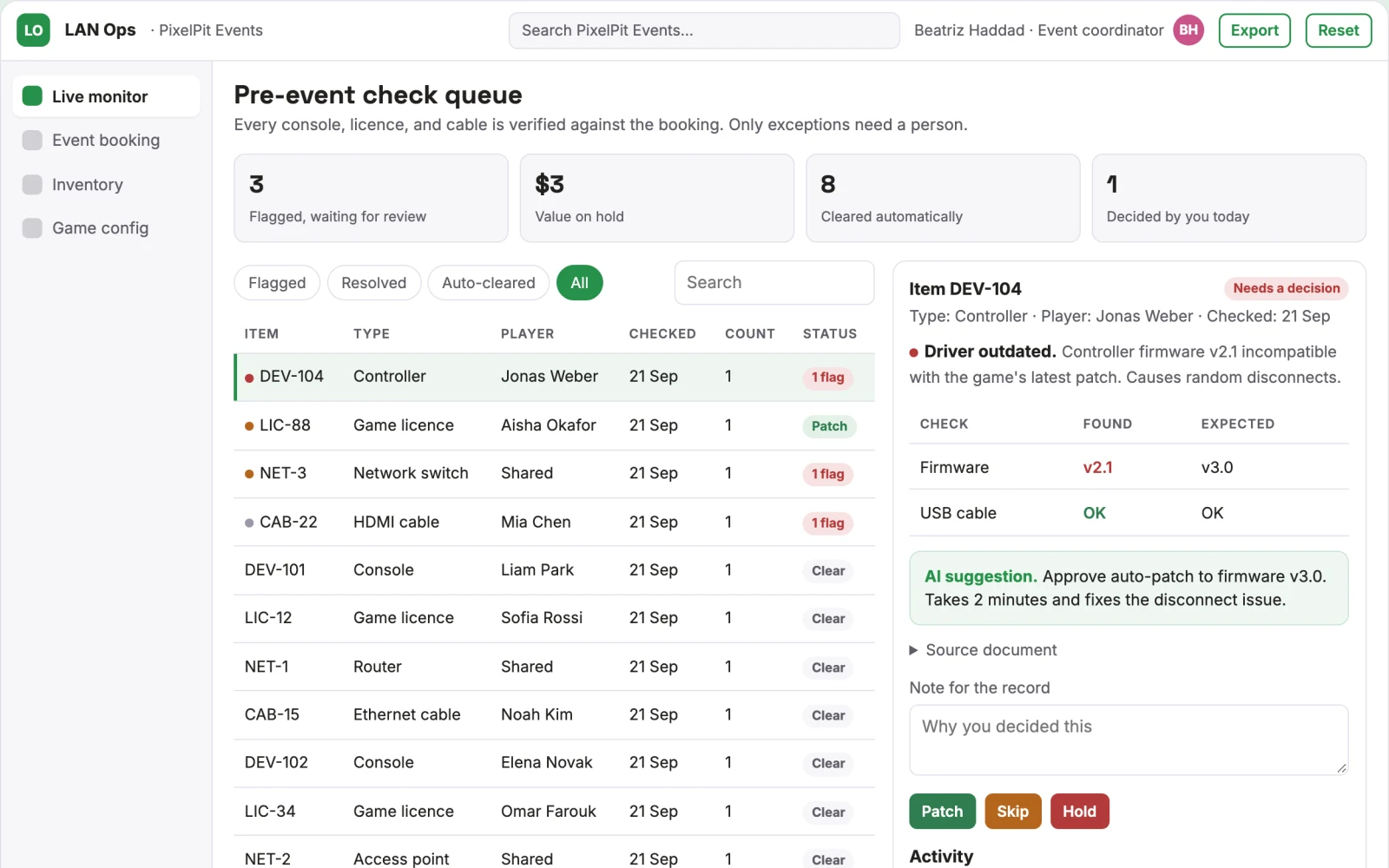
Key screens: Event booking, inventory check, game config, live monitor. Use a booking form for date, player count, and games, then an inventory dashboard showing reserved hardware and gaps. Provide a game config screen with licence checks and pre-load status. On the day, a live monitor shows network health, device detection, and driver patches. In this product, the first view is event booking, followed by inventory check, game config, and live monitor.
Admin
Event ownership, player roles, hardware reservations, config versions, approval states, audit trail of licence checks and patches, and a record of physical kit condition.
03Market gap
Alternatives buyers use today
People use spreadsheets, group chats, and manual router setup today. This differs by automating the coordination layer and providing live, AI-driven troubleshooting instead of relying on one tech-savvy friend.
Where this wins
Each event logs hardware health, licence states, and network behaviour, building a dataset that improves predictive maintenance and config accuracy, making the service more reliable and harder to replicate.
04Why now
Hospitality and Events teams are adopting AI for exactly this kind of repeatable work, and the cost of language and vision models has dropped far enough that a narrow, reviewed workflow pays back quickly. The buyer already feels the problem: organising a LAN party means weeks of back-and-forth about hardware, game licences, and network setup, with one missing cable or driver stalling the night.
05Proof & signals
Channels where buyers gather: Gaming community forums, social media groups for LAN enthusiasts, HR event planning platforms, and corporate team-building agencies.. Metrics that prove it works: Average setup time reduced from 3 hours to under 1 hour; percentage of events with zero technical stalls during play..
Paid pilot
Run a paid pilot with five friend groups, measuring setup time and number of support calls versus their previous manual process. Baseline is 3 hours of setup and 2 support calls; success is under 1 hour and zero calls. Decision to expand if 4 of 5 groups rebook.
06Execution plan
MVP
One buyer: small friend groups. One use case: Counter-Strike 2 with a fixed hardware kit of identical laptops and a pre-configured router. First two modules: booking and inventory check, plus game config. Manual review of licences and setup card before the event.
First 30 days
Week 1: Build booking page and inventory check module. Week 2: Integrate game licence API for one title and generate network config. Week 3: Test with a fixed hardware kit and printed setup card. Week 4: Run a live pilot with one friend group and collect feedback.
After the pilot
Automate licence verification across more titles, add voice assistant for on-day troubleshooting, integrate with hardware diagnostics for predictive maintenance, and offer corporate team-building packages with custom branding.
Retention
Offer a subscription for recurring events with hardware maintenance and priority support, plus add-on services like custom game configs or corporate branding.
Integrations
Steam or console APIs for game licences, router configuration interfaces, hardware diagnostic tools, and a simple booking calendar.
07Investment and running costs
| Phase | Scope | Time | Budget |
|---|---|---|---|
| MVP | One buyer segment, one recurring use case; first modules: booking and inventory check, plus game config. Manual review in the loop. | 2 days | $5,500 |
| Paid pilot | Accounts, roles, review states, audit trail and the first integration, hardened for two to three paying pilot customers. | 3 days | $4,500 |
| Full product | Self-serve onboarding, billing, monitoring and the wider integration set. | 5 days | $6,500 |
| Total | $16,500 | ||
| Running | Hosting | AI usage | Total a month |
|---|---|---|---|
| MVP and paid pilot (about 3 customers) | $30–$60 | $40–$90 | $70–$150 |
| Full product (about 50 customers) | $110–$210 | $280–$560 | $390–$770 |
Revenue model to test
Test pricing at $150 per event for up to 8 players, $250 for up to 16, with corporate packages at $500 including setup support.
Cost drivers
Hardware rental or purchase, shipping between events, cloud inference for AI agents, API access to game libraries, and support staff for physical logistics.
Safeguards
Limit booking to a fixed hardware kit and supported games, require host confirmation of physical setup, log all licence checks and patches, and never auto-install software without host approval. It must not access player accounts beyond licence verification.
Take it further
Solution blueprint, rewritten from an earlier Nexibeo concept. Demand, pricing, build scope and integrations are working assumptions, not verified market findings. The MVP and the paid pilot exist to confirm them for your business before the larger build.