Solution Database / Customer Support
Always-On Call Assistant
Small teams lose afternoons to missed calls and voicemail ping-pong. A full call centre that costs less than a part-time receptionist, with your own knowledge as the source of truth and a two-line summary after every call.
01The offer
For owner-operators at small repair shops, law firms and home services, turn your phone line, FAQ pages and order systems into a 24-hour call handling service that answers, triages and resolves customer calls. Address the recurring problem: customers who do not reach a human hang up and buy elsewhere. The value hypothesis is a full call centre that costs less than a part-time receptionist; the pilot must establish whether that benefit is real.
- For
- Owner-operators at small repair shops, law firms and home services
- Takes in
- Phone number, FAQ pages, documents, Slack channels, order system access
- Delivers
- Resolved customer calls, text or email summaries, escalation transfers
- Message
- Never miss another customer call, day or night, with an AI team that knows your business.
- Lead magnet
- A free 15-minute test call on your own phone line, showing how the agent answers three of your most common questions.
02How it works
- Answer inbound calls with natural multi-turn speech
- Pull facts from connected knowledge sources
- Check order status or book appointments via existing tools
- Escalate to a human with a quiet whisper of context
- Send a two-line summary by text or email after each call
- Track call volume and resolution rates per line
Workflow
Connect a phone number, share knowledge sources, review the agent's answers, take a live test call, adjust responses, go live, and review daily summaries. Start with phone number, FAQ pages and order system access and finish with resolved calls and text summaries.
AI and people
Use voice-to-voice models for natural conversation and retrieval-augmented generation to answer from your own knowledge base. Keep factual answers such as return policies and opening hours in structured fields. Validate call summaries through deterministic checks. A human owner reviews call transcripts and flags any hallucinated answers before the agent is trusted with more complex queries.
Screens
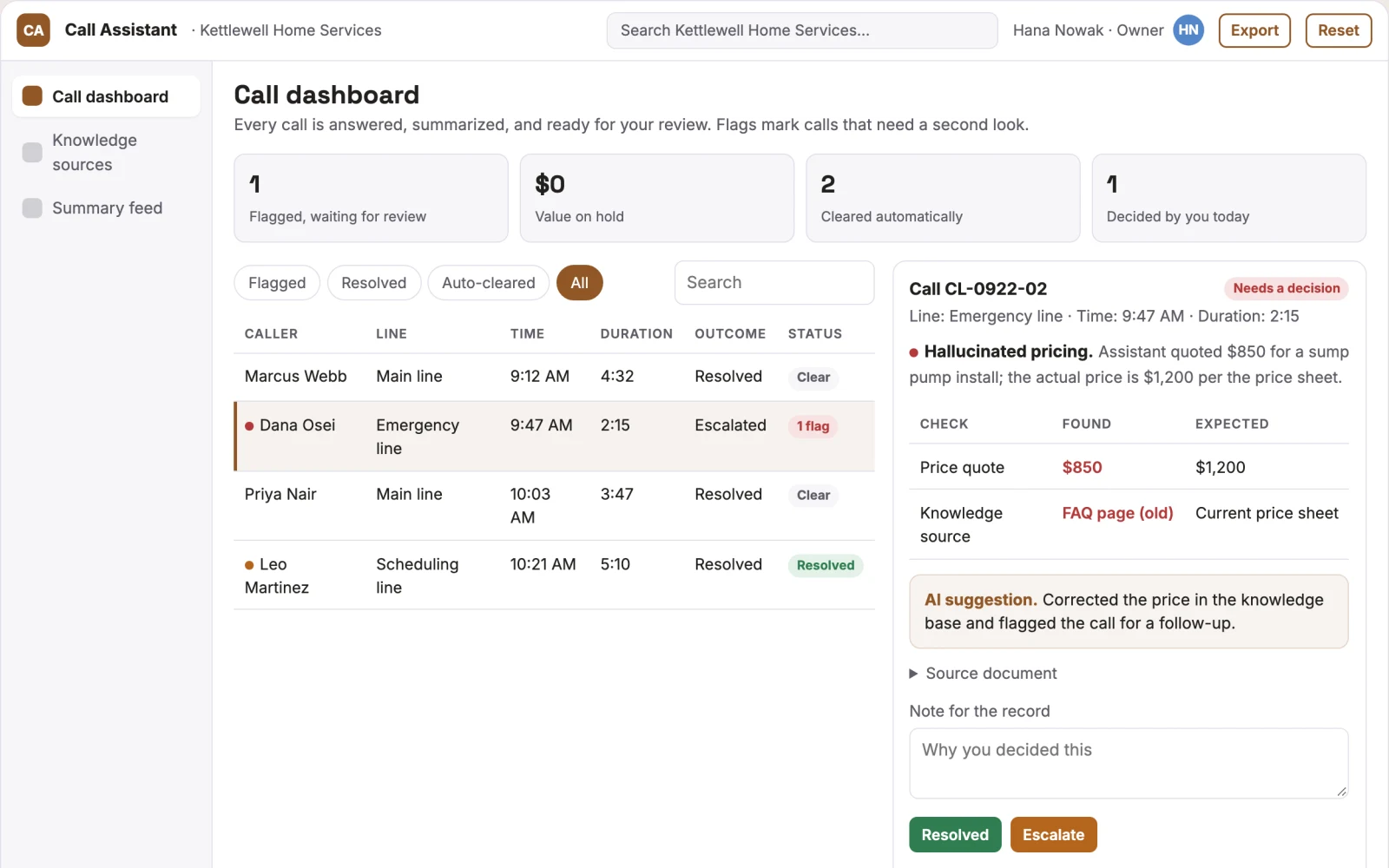
Key screens: Call dashboard, knowledge source manager, call summary feed. Use a live call dashboard showing active and recent calls, a knowledge source manager to add or refresh FAQ pages and documents, and a summary feed with two-line text or email summaries per call. Let users mark calls as resolved or escalated. Display call duration, outcome and any transferred calls. In this product, the first view is call dashboard, followed by knowledge source manager and call summary feed.
Admin
Line ownership, knowledge source versions, call transcript access, escalation rules, summary delivery preferences, audit trail of all calls and changes to knowledge sources.
03Market gap
Alternatives buyers use today
Voicemail, phone trees, part-time receptionists, or third-party call centres. This differs by being always on, learning from your own documents, and costing less than a human while providing summaries and escalations.
Where this wins
The more calls the agent handles, the better it learns your specific vocabulary, common questions and escalation patterns, making the knowledge base and response tuning harder to replicate.
04Why now
Customer Support teams are adopting AI for exactly this kind of repeatable work, and the cost of language and vision models has dropped far enough that a narrow, reviewed workflow pays back quickly. Rising compliance and audit expectations make a documented, reviewable process worth more than an ad hoc one. The buyer already feels the problem: small teams lose afternoons to missed calls and voicemail ping-pong.
05Proof & signals
Channels where buyers gather: Local business associations, small business forums, social media groups for repair shops and home services, and direct outreach to owners who list phone numbers publicly.. Metrics that prove it works: Percentage of calls resolved without human intervention; average time to respond to a missed call..
Paid pilot
A paid pilot with three businesses for one month proves the value by comparing missed call rate and callback time before and after. Baseline: average missed calls per day and average time to return voicemails. Decision: continue if resolved call rate exceeds 80% and owners save at least two hours per week.
06Execution plan
MVP
One buyer, one use case: a single voice agent connected to a Twilio number, reading one FAQ page and answering the five most common questions. First two modules: call answering and SMS summary. Manual review of transcripts before any agent response is reused.
First 30 days
Week 1: Set up Twilio number and connect one FAQ page. Week 2: Build the voice agent and test with five scripted questions. Week 3: Run live calls with a friendly beta customer and review transcripts. Week 4: Launch with SMS summaries and measure resolution rate.
After the pilot
After the paid pilot, automate order status lookups, appointment booking, and proactive callbacks for missed calls. Add sentiment detection and automatic escalation triggers.
Retention
The agent becomes embedded in daily operations, and the knowledge base grows with each call, making it harder to switch back to voicemail or a human receptionist.
Integrations
Twilio for phone numbers, webhooks to order systems or booking tools, and email or SMS for summaries. Start with Twilio and a static FAQ page.
07Investment and running costs
| Phase | Scope | Time | Budget |
|---|---|---|---|
| MVP | One buyer segment, one recurring use case; first modules: call answering and SMS summary. Manual review in the loop. | 2 days | $5,500 |
| Paid pilot | Accounts, roles, review states, audit trail and the first integration, hardened for two to three paying pilot customers. | 3 days | $4,500 |
| Full product | Self-serve onboarding, billing, monitoring and the wider integration set. | 5 days | $6,500 |
| Total | $16,500 | ||
| Running | Hosting | AI usage | Total a month |
|---|---|---|---|
| MVP and paid pilot (about 3 customers) | $30–$60 | $40–$90 | $70–$150 |
| Full product (about 50 customers) | $110–$210 | $280–$560 | $390–$770 |
Revenue model to test
Test pricing at USD 299 per month for up to 200 resolved calls, with USD 0.50 per additional call. No setup fee.
Cost drivers
Twilio voice minutes, voice model API usage, knowledge base hosting, and one support engineer for onboarding and tuning.
Safeguards
Limit the agent to approved knowledge sources only. Require human review of any new response before it is used. Never transfer calls without the caller's consent. Must not invent policies, share personal data, or make commitments outside the knowledge base. Audit all calls and keep transcripts for 90 days.
Take it further
Solution blueprint, rewritten from an earlier Nexibeo concept. Demand, pricing, build scope and integrations are working assumptions, not verified market findings. The MVP and the paid pilot exist to confirm them for your business before the larger build.