Solution Database / Customer Support
Outsourced support optimization service
Support costs grow without visibility into avoidable work. Implementation and post-change quality measurement within one fixed scope.
01The offer
For founders of online businesses with small support teams, turn ticket exports, procedures and staffing records into improvement roadmap and implemented support workflows. Address the recurring problem: support costs grow without visibility into avoidable work. The value hypothesis is a more complete, reviewable deliverable with less repeated preparation; the pilot must establish whether that benefit is real.
- For
- Founders of online businesses with small support teams
- Takes in
- Ticket exports, procedures and staffing records
- Delivers
- Improvement roadmap and implemented support workflows
- Message
- Outsourced support optimization service for founders of online businesses with small support teams. Implementation and post-change quality measurement within one fixed scope. Demonstrate the claim through a support workflow friction audit.
- Lead magnet
- A support workflow friction audit
02How it works
- Map contact drivers
- Inspect routing
- Identify automation candidates
- Redesign macros
- Implement approved workflows
- Measure quality changes
Workflow
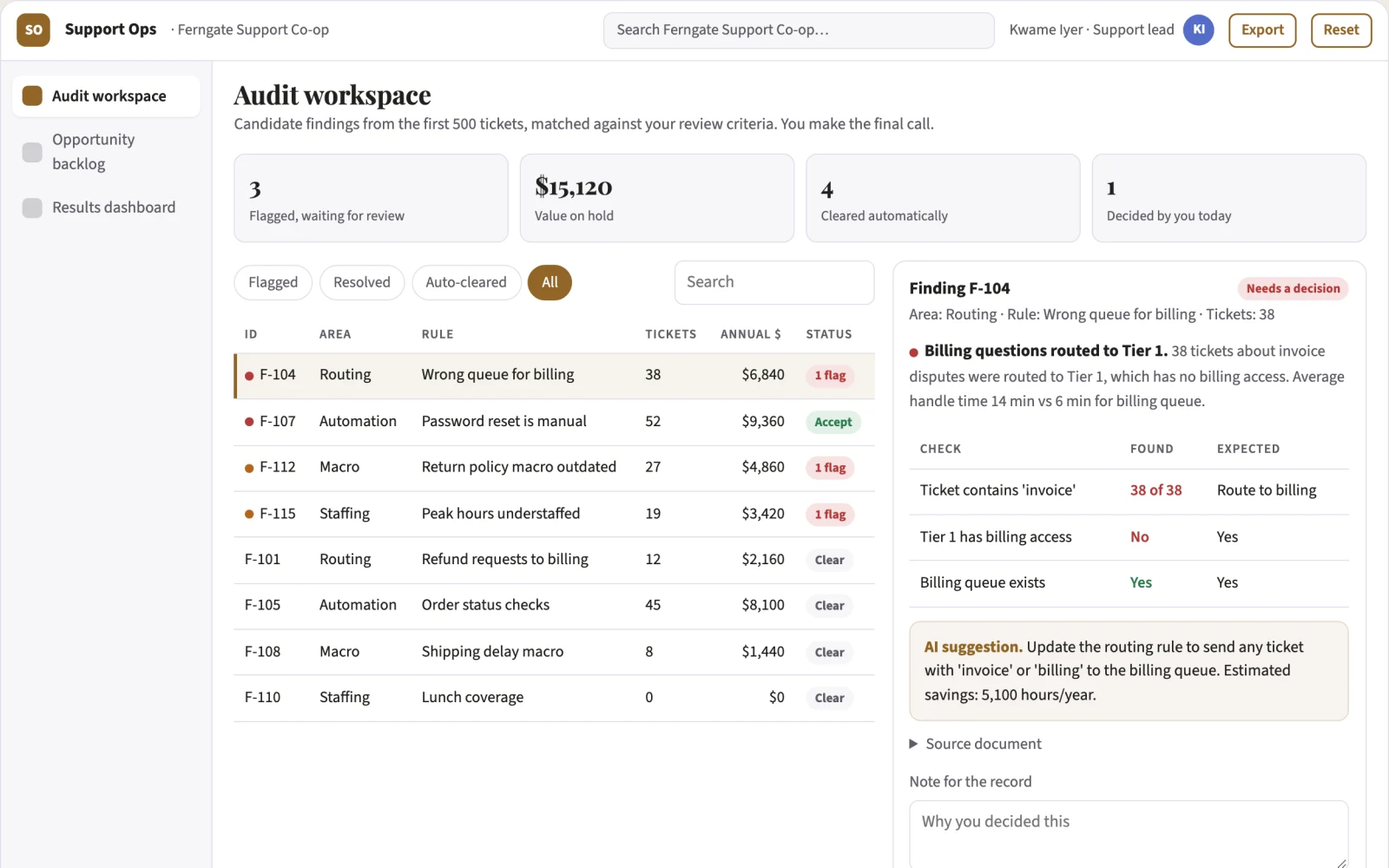
Agree review criteria, ingest a sample, generate candidate findings, inspect supporting evidence, let reviewers confirm or dismiss each item, assign corrections, and recheck the affected material. Start with ticket exports, procedures and staffing records and finish with improvement roadmap and implemented support workflows.
AI and people
Propose possible inconsistencies, omissions and rubric matches. Combine extraction with deterministic checks where rules are explicit. Reviewers make the final judgment. Keep false positives and missed cases visible during evaluation.
Screens
Key screens: Audit workspace, opportunity backlog, results dashboard. Open on a review queue ordered by reviewer-selected priorities. Show each finding beside the original evidence and applicable rule. Provide accept, dismiss and needs-information controls with reasons. A separate report view summarizes confirmed findings and unresolved items, not raw AI flags. In this product, the first view is audit workspace, followed by opportunity backlog and results dashboard.
Admin
Versioned review criteria, evidence links, reviewer decisions, disagreement handling, correction assignments, recheck status and exportable review history.
03Market gap
Alternatives buyers use today
Manual reviewers, checklists, generic scanning tools and specialist audit services. Differentiate on this specific proposed advantage: implementation and post-change quality measurement within one fixed scope. Test it against the buyer's current method on the same task. Competitor coverage and uniqueness have not been established.
Where this wins
A domain-specific review rubric and rights-cleared examples of confirmed defects, false alarms and reviewer reasoning. For this solution, build around implementation and post-change quality measurement within one fixed scope. This advantage requires execution and accumulated customer trust; the base model alone is not a defensible asset.
04Why now
Customer Support teams are adopting AI for exactly this kind of repeatable work, and the cost of language and vision models has dropped far enough that a narrow, reviewed workflow pays back quickly. The buyer already feels the problem: support costs grow without visibility into avoidable work.
05Proof & signals
Channels where buyers gather: Small-business operator communities. Metrics that prove it works: Handling time with quality maintained, paid renewals.
Paid pilot
Have a qualified reviewer independently assess the same sample. Compare confirmed findings, false alarms and omissions. Repeat on unseen material before agreeing recurring volume. For this solution, use ticket exports, procedures and staffing records and evaluate improvement roadmap and implemented support workflows. Agree success thresholds with the buyer before starting; collect a baseline for handling time with quality maintained, paid renewals. A positive signal is payment and repeat use with acceptable quality and delivery cost, not a favorable demo reaction alone.
06Execution plan
MVP
Begin with founders of online businesses with small support teams and one recurring use case. Build the first two modules: map contact drivers; inspect routing. Provide operator assistance for the third module: identify automation candidates. Deliver improvement roadmap and implemented support workflows through a manual review queue. Perform other necessary full-scope functions manually during the pilot. Include all applicable access, accuracy and professional-review controls from the start.
First 30 days
Week 1: interview five prospective buyers in this segment: founders of online businesses with small support teams. Ask to see a recent example of the problem and their current process. Week 2: prepare this demonstration using authorized or synthetic material: a support workflow friction audit. Week 3: present it through small-business operator communities and seek one narrowly scoped paid pilot. Week 4: review handling time with quality maintained, paid renewals, total delivery effort and a concrete renewal decision before increasing scope.
After the pilot
After paid pilots establish value, automate the remaining modules: redesign macros; implement approved workflows; measure quality changes. Add one validated source integration, reusable customer configuration and recurring delivery. Expand to additional teams, document formats or languages only after testing the new scope.
Retention
Offer recurring reviews and rechecks of previously confirmed issues. Expand document or case types after validating the new rubric with qualified reviewers.
Integrations
Support inboxes, help centers, order records and customer feedback systems. Source repositories, task trackers and report exports. Keep findings as review proposals until authorized owners accept the resulting actions. These are candidate integration categories, not verified supported connectors.
07Investment and running costs
| Phase | Scope | Time | Budget |
|---|---|---|---|
| MVP | One buyer segment, one recurring use case; first modules: map contact drivers; inspect routing. Manual review in the loop. | 4 days | $7,500 |
| Paid pilot | Accounts, roles, review states, audit trail and the first integration, hardened for two to three paying pilot customers. | 5 days | $8,000 |
| Full product | Remaining modules: redesign macros; implement approved workflows; measure quality changes. Self-serve onboarding, billing, monitoring and the wider integration set. | 8 days | $11,500 |
| Total | $27,000 | ||
| Running | Hosting | AI usage | Total a month |
|---|---|---|---|
| MVP and paid pilot (about 3 customers) | $30–$60 | $80–$160 | $110–$220 |
| Full product (about 50 customers) | $110–$210 | $880–$1,750 | $990–$1,960 |
Revenue model to test
Test USD 500-2,000 for a defined audit sample and report. Offer recurring review priced by reviewed items and specialist hours. Software-only access can follow a reliable reviewed service. All prices require validation.
Cost drivers
Document or media processing, model evaluation, expert review, false-positive handling, rechecks and customer-specific rubric calibration.
Safeguards
Keep customer account access scoped. Escalate missing evidence and consequential exceptions to staff. Review quality alongside any speed measure. Validate source access and reviewer availability during the pilot. Maintain customer-level access, data deletion controls and a record of final approvals.
Take it further
Concept proposal expanded from the 315-solution conversation. Demand, pricing, differentiation, build scope and integration feasibility are hypotheses, not verified market findings. Category link is inspiration rather than evidence of business viability.