Solution Database / Operations
Overstock Listing Agent
Unsold gaming inventory sits because listing each item manually is not worth the return. A single photo turns an entire shelf into live listings with AI pricing and negotiation, cutting listing time from minutes to seconds per item.
01The offer
For operations leads at independent game stores and online resellers, turn photos of excess gaming inventory into priced, published listings with automated buyer communication. Address the recurring problem: unsold gaming inventory sits because listing each item manually is not worth the return. The value hypothesis is a faster, cheaper way to move overstock; the pilot must establish whether the AI listing quality and pricing accuracy are trusted.
- For
- Operations leads at independent game stores and online resellers
- Takes in
- Photos of gaming inventory, seller preferences for pricing and condition
- Delivers
- Published listings, AI-generated descriptions, dynamic pricing, prepaid shipping labels
- Message
- Turn a photo of your overstock into a selling machine: AI prices, lists, and negotiates for you.
- Lead magnet
- Free trial that processes up to 10 items from one photo, showing the time saved and potential revenue.
02How it works
- Upload photos of single items or shelves
- Identify each product, edition, and condition
- Generate title, description, and price from live market data
- Publish listings to connected marketplaces
- Auto-respond to buyer questions and negotiate offers
- Generate prepaid shipping labels on sale
Workflow
Upload photo, AI identifies items, review and edit suggestions, publish listings, AI handles inquiries, accept or reject offers, generate shipping label on sale. Start with photos of excess gaming inventory and finish with priced, published listings with automated buyer communication.
AI and people
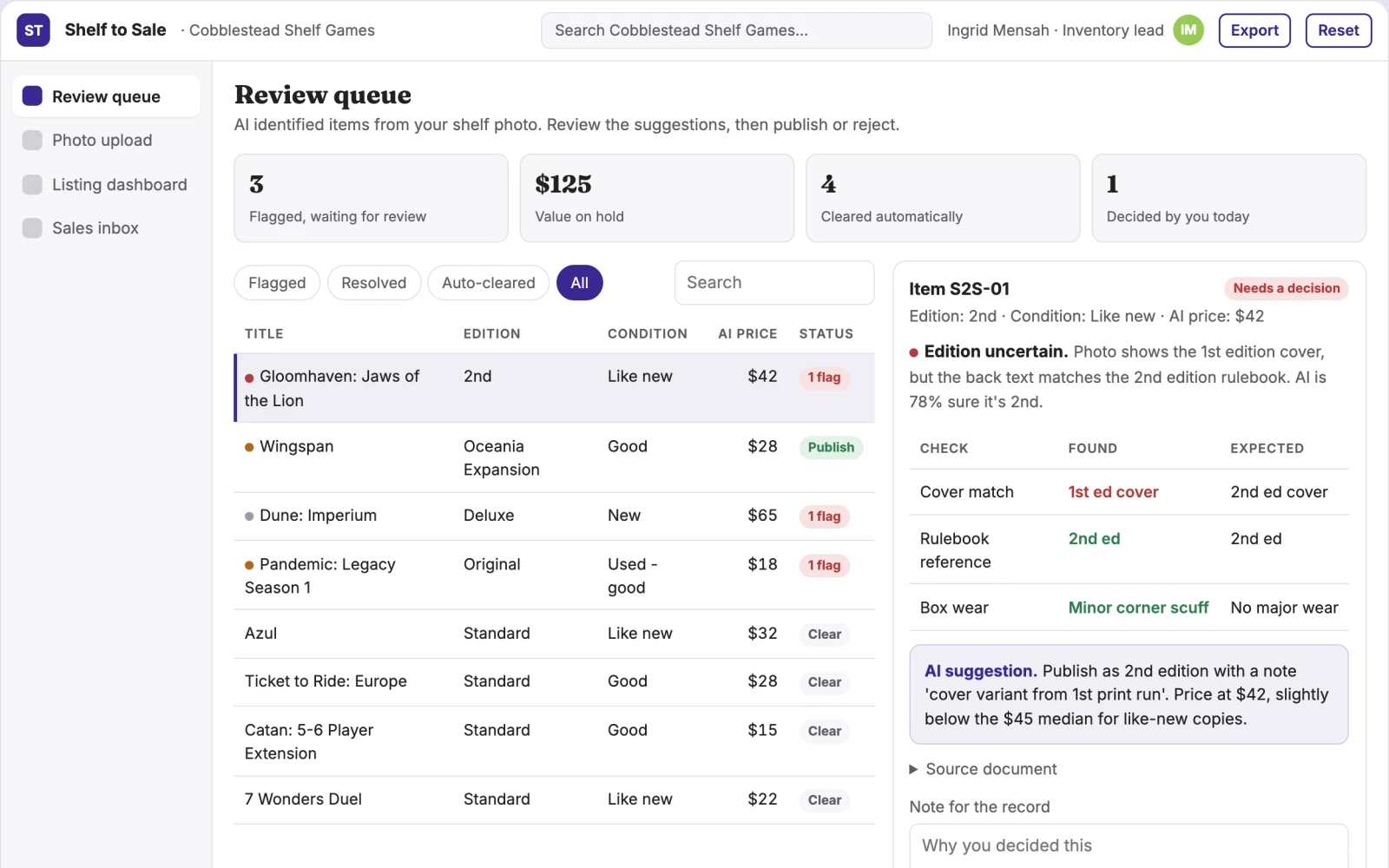
Use vision models to identify products and assess condition, language models to write descriptions, and pricing algorithms based on market data. A human reviews all AI-generated listings before publishing, checking for misidentified editions or condition errors.
Screens
Key screens: Photo upload, inventory review, listing dashboard, sales inbox. Use a drag-and-drop upload area for photos, a review grid showing AI-identified items with confidence scores, a dashboard with live listings and sales, and an inbox for buyer messages. Let users edit or reject AI suggestions before publishing. Display statuses: pending, live, sold, and disputed. In this product, the first view is photo upload, followed by inventory review and listing dashboard.
Admin
Seller accounts, listing versions, approval workflow, audit trail of all AI actions, dispute logging, and role-based permissions for staff.
03Market gap
Alternatives buyers use today
Manual listing tools like eBay bulk upload, or hiring staff to list items. This differs by automating the entire process from photo to sale, reducing human effort and errors.
Where this wins
The AI models improve with each item processed, learning niche game editions and condition nuances, making the system more accurate and harder to replicate.
04Why now
Operations teams are adopting AI for exactly this kind of repeatable work, and the cost of language and vision models has dropped far enough that a narrow, reviewed workflow pays back quickly. The buyer already feels the problem: unsold gaming inventory sits because listing each item manually is not worth the return.
05Proof & signals
Channels where buyers gather: Industry forums for game store owners, online reseller communities, and social media groups focused on liquidation and overstock.. Metrics that prove it works: Average listing time per item; sell-through rate of overstock within 30 days..
Paid pilot
A paid pilot with 5 independent game stores, measuring listing time per item and sell-through rate over 30 days. Baseline: manual listing takes 10 minutes per item. Success: reduce to under 1 minute and increase sell-through by 20%.
06Execution plan
MVP
One buyer type (independent game stores), one use case (Nintendo Switch games), first two modules: photo upload and AI listing generation with manual review. Manual review of all listings before publishing.
First 30 days
Week 1: Build photo upload and AI identification for Switch games. Week 2: Integrate eBay listing API and generate descriptions. Week 3: Add manual review queue and publish flow. Week 4: Test with 3 pilot stores and refine pricing accuracy.
After the pilot
Automate buyer negotiation, multi-marketplace publishing, and inventory forecasting after the paid pilot.
Retention
The system learns each seller's pricing preferences and inventory patterns, making it faster and more accurate over time, reducing churn.
Integrations
Start with eBay and Shopify APIs for listing and checkout, then add Amazon and other marketplaces.
07Investment and running costs
| Phase | Scope | Time | Budget |
|---|---|---|---|
| MVP | One buyer segment, one recurring use case; first modules: photo upload and AI listing generation with manual review. Manual review in the loop. | 2 days | $5,000 |
| Paid pilot | Accounts, roles, review states, audit trail and the first integration, hardened for two to three paying pilot customers. | 3 days | $4,000 |
| Full product | Self-serve onboarding, billing, monitoring and the wider integration set. | 5 days | $6,000 |
| Total | $15,000 | ||
| Running | Hosting | AI usage | Total a month |
|---|---|---|---|
| MVP and paid pilot (about 3 customers) | $30–$60 | $40–$90 | $70–$150 |
| Full product (about 50 customers) | $110–$210 | $280–$560 | $390–$770 |
Revenue model to test
Test a 12% transaction fee per sale, with a flat $99/month subscription for sellers with more than 50 listings per month.
Cost drivers
AI inference costs (vision and language models), marketplace integration fees, and customer support for disputes.
Safeguards
Limit AI to only list items with high confidence scores, require human approval for all listings, restrict negotiation within seller-set price floors, and never auto-accept offers without seller consent. Must not list items without review or share seller data with competitors.
Take it further
Solution blueprint, rewritten from an earlier Nexibeo concept. Demand, pricing, build scope and integrations are working assumptions, not verified market findings. The MVP and the paid pilot exist to confirm them for your business before the larger build.