Solution Database / Real Estate and Construction
Room Redesign AI
Hiring an interior designer costs thousands and takes weeks, leaving most people to decorate by guesswork. A single photo plus voice refinement produces a curated, shoppable design in minutes, unlike generic furniture apps.
01The offer
For renters and new homeowners, turn a single room photo and a style description into a furnished 3D plan with shoppable product links. Address the problem that hiring an interior designer costs thousands and takes weeks, while guesswork leads to ill-fitting and mismatched purchases. The value hypothesis is a fast, affordable, and personalised design service; the pilot must confirm that the AI-generated designs feel curated and useful.
- For
- Renters and new homeowners who want a designed space without the $2,000+ designer fee
- Takes in
- Room photo and a style description
- Delivers
- Furnished 3D plan and shoppable product list with total cost
- Message
- Redesign your room in minutes with AI, and buy the exact pieces from your screen.
- Lead magnet
- Offer a free 'first look' render for any room photo, no signup required.
02How it works
- Upload a room photo and select a style
- Analyse the room's dimensions, light, and existing furniture
- Generate a photorealistic render with new furniture
- Refine the design via text or voice commands
- Match suggested products to online retailers
- Export a shoppable list with prices and links
Workflow
Upload photo, choose style, analyse space, generate render, refine with voice or text, review product list, and export shoppable list. Start with a room photo and style description and finish with a furnished 3D plan and shoppable product list.
AI and people
AI uses a vision model to parse room geometry and objects from the photo, a generative model to produce photorealistic renders, and an agent to find matching products from online stores. A human designer reviews the final render and product list to ensure taste and coherence before the user sees it.
Screens
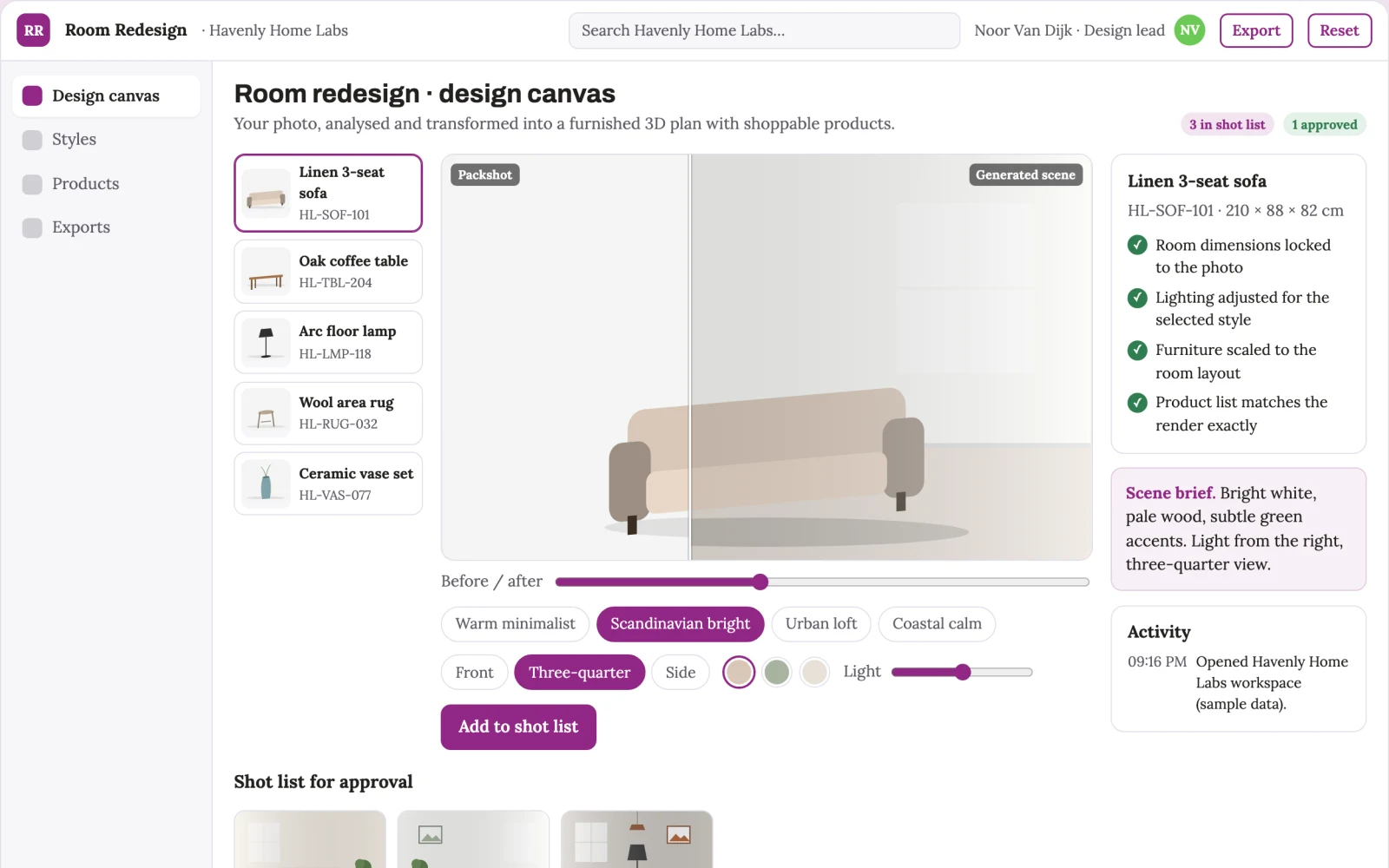
Key screens: Upload, Style Select, Design Canvas. Start with a simple upload screen where the user adds a room photo and picks a style. Then show a style selection screen with preset options like 'warm minimalist'. The main screen is the design canvas: a large photorealistic render of the redesigned room, with a side panel listing suggested products with prices and links. Users can type or speak a refinement like 'make it lighter' and see the render update. A final screen shows the shoppable list and total cost.
Admin
User accounts, design versions, saved rooms, order history, and an audit trail of AI changes and human approvals.
03Market gap
Alternatives buyers use today
People use human interior designers (expensive and slow) or furniture store apps with limited tools. This differs by being fast, affordable, and fully shoppable.
Where this wins
Every design session generates preference data and feedback, improving the AI's taste and making the output more personalised and harder to replicate.
04Why now
Real Estate and Construction teams are adopting AI for exactly this kind of repeatable work, and the cost of language and vision models has dropped far enough that a narrow, reviewed workflow pays back quickly. Rising compliance and audit expectations make a documented, reviewable process worth more than an ad hoc one. The buyer already feels the problem: hiring an interior designer costs thousands and takes weeks, leaving most people to decorate by guesswork.
05Proof & signals
Channels where buyers gather: Social media ads (Instagram, Pinterest), home improvement blogs, and partnerships with real estate agents.. Metrics that prove it works: 1. Average time from photo upload to final design (target under 30 minutes). 2. User satisfaction score on the design quality (target 4.5/5)..
Paid pilot
A paid pilot with 20 renters measures the time from photo to final design and the number of product returns avoided. Baseline is a typical designer engagement (2 weeks, $2,000). Decision: if 80% of users complete a design in under 30 minutes and rate the output as 'good' or better, proceed to full launch.
06Execution plan
MVP
First cut: renters and new homeowners, one use case (single room redesign), first two modules (photo upload and render generation), manual review of every render by a designer before delivery.
First 30 days
Week 1: Build the photo upload and style selection flow. Week 2: Integrate a vision model for room analysis and a generative model for renders. Week 3: Add product matching from IKEA and Wayfair APIs. Week 4: Test with 10 users, refine the UI, and prepare the MVP for pilot.
After the pilot
After the paid pilot, automate the human review step with a quality model, add voice refinement, and integrate more retailers for product matching.
Retention
Subscription model keeps users engaged with unlimited redesigns, and affiliate commissions provide recurring revenue from repeat purchases.
Integrations
Start with IKEA and Wayfair product APIs, then expand to other retailers. Also integrate with cloud storage for photos and payment processing.
07Investment and running costs
| Phase | Scope | Time | Budget |
|---|---|---|---|
| MVP | One buyer segment, one recurring use case. Manual review in the loop. | 5 days | $9,500 |
| Paid pilot | Accounts, roles, review states, audit trail and the first integration, hardened for two to three paying pilot customers. | 6 days | $11,500 |
| Full product | Self-serve onboarding, billing, monitoring and the wider integration set. | 2 weeks | $15,500 |
| Total | $36,500 | ||
| Running | Hosting | AI usage | Total a month |
|---|---|---|---|
| MVP and paid pilot (about 3 customers) | $40–$80 | $150–$310 | $190–$390 |
| Full product (about 50 customers) | $160–$320 | $2,100–$4,200 | $2,260–$4,520 |
Revenue model to test
Test pricing at $29 per room design or $19/month for unlimited redesigns, with affiliate commissions from retailers as a secondary stream.
Cost drivers
Main costs are cloud GPU inference for vision and generation models, plus human reviewer time for quality checks.
Safeguards
Users must own the photo rights. AI must not generate designs with unsafe or offensive content. Human review is mandatory before any design is shown. Limit the number of redesigns per day to prevent abuse. Audit trail tracks all AI actions and human approvals.
Take it further
Solution blueprint, rewritten from an earlier Nexibeo concept. Demand, pricing, build scope and integrations are working assumptions, not verified market findings. The MVP and the paid pilot exist to confirm them for your business before the larger build.