Gamer Health Coverage
Professional gamers lose income when their hands give out and traditional insurance misunderstands repetitive strain, burnout or equipment failure. Cover built for professional gamers, with premiums that follow real training load and claims paid in hours.
01The offer
For esports team managers and full-time streamers, turn gameplay telemetry, wearable biometric data and medical documents into real-time risk-adjusted coverage and instant claims decisions. Address the recurring problem: professional gamers lose income when their hands give out and traditional insurance misunderstands repetitive strain, burnout or equipment failure. The value hypothesis is a faster, more personalised policy that adapts to daily strain, with claims paid in hours not weeks; the pilot must establish whether regulators accept dynamic pricing and whether the risk model holds.
- For
- Esports team managers and full-time streamers earning over $80k a year
- Takes in
- Gameplay telemetry, wearable biometric data, self-reported practice hours, medical reports, hardware diagnostics
- Delivers
- Risk-adjusted insurance policy, rest alerts, instant claims payments, equipment replacement coverage
- Message
- Insurance that watches your hands and mind, so you can play without fear.
- Lead magnet
- Free one-month risk assessment for a player's hand and wrist health, with a sample premium quote.
02How it works
- Ingest wearable and gameplay telemetry nightly
- Recalculate risk scores and premiums automatically
- Parse uploaded medical documents for diagnosis and validity
- Trigger rest nudges and voice alerts when risk spikes
- Monitor hardware diagnostics for equipment failure risk
- Pay out approved claims within hours via bank transfer
Workflow
Connect gaming accounts and wearable, collect baseline health metrics, run nightly risk recalculation, review alerts and premium changes, upload a claim document, verify diagnosis with AI, and release payment. Start with gameplay telemetry, biometric data and medical reports and finish with risk-adjusted coverage and instant claims decisions.
AI and people
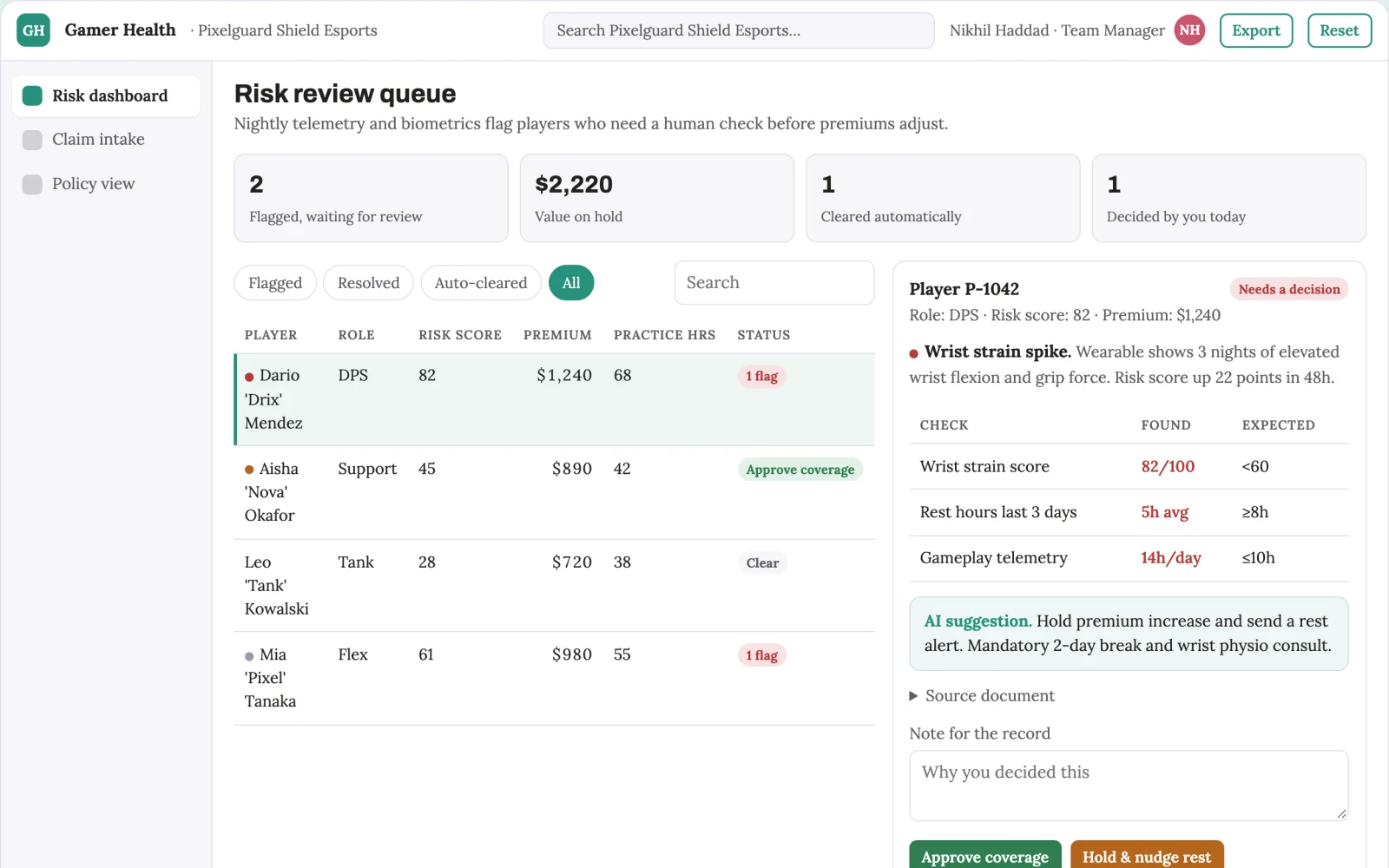
Use language models to read and extract diagnoses from medical documents, and a separate model trained on injury patterns to interpret telemetry and biometrics. A human underwriter reviews any premium change above a threshold and a claims officer confirms the diagnosis before payment.
Screens
Key screens: Risk dashboard, claim intake, policy view. Use a live dashboard showing each player's risk score, premium trend and rest alerts, with a central feed of daily updates. The claim intake screen lets users upload a photo of a medical report and tracks parsing status. The policy view shows current coverage, adjustments and history. In this product, the first view is risk dashboard, followed by claim intake and policy view.
Admin
Accounts for managers and players, policy versions, premium change history, claim records, audit trail for all AI decisions, role-based access for underwriters and claims officers.
03Market gap
Alternatives buyers use today
Traditional health or disability insurance with static premiums and weeks-long underwriting; this differs by using live data and instant claims.
Where this wins
The injury prediction model improves with every claim and telemetry data point, creating a proprietary dataset that new entrants cannot replicate without years of claims history.
04Why now
Insurance teams are adopting AI for exactly this kind of repeatable work, and the cost of language and vision models has dropped far enough that a narrow, reviewed workflow pays back quickly. The buyer already feels the problem: professional gamers lose income when their hands give out and traditional insurance misunderstands repetitive strain, burnout or equipment failure.
05Proof & signals
Channels where buyers gather: Esports team managers, gaming conventions, streamer communities on Discord and Twitch, sports insurance brokers.. Metrics that prove it works: Two measurable outcomes: average time from claim submission to payment, and percentage of players with reduced injury incidents after rest alerts..
Paid pilot
Run a paid pilot with one esports team for 30 days. Baseline is their current claims rate and premium cost. Success is a 20% reduction in injury-related downtime and a claim paid in under 24 hours, with a decision to expand to more teams.
06Execution plan
MVP
First buyer is esports team managers insuring their rosters. Use case is hand and wrist injury coverage. First two modules are risk dashboard and claim intake. Manual review of all premium changes and claims before payment.
First 30 days
Week 1: Build risk dashboard and wearable integration. Week 2: Train document parsing on sample medical reports. Week 3: Set up claim intake and manual review workflow. Week 4: Run a pilot with one esports team and collect feedback.
After the pilot
Automate premium adjustments within a set band, integrate with more wearables and game platforms, add burnout and mental health coverage, and offer direct-to-consumer policies for solo streamers.
Retention
Monthly subscription with continuous risk monitoring; players stay because switching insurers means losing their risk history and lower premiums built over time.
Integrations
Start with a common wearable API (e.g. Apple Health or Garmin), game platform APIs for telemetry (e.g. Steam, Riot), and a bank payment API for payouts.
07Investment and running costs
| Phase | Scope | Time | Budget |
|---|---|---|---|
| MVP | One buyer segment, one recurring use case. Manual review in the loop. | 7 days | $12,000 |
| Paid pilot | Accounts, roles, review states, audit trail and the first integration, hardened for two to three paying pilot customers. | 8 days | $16,000 |
| Full product | Self-serve onboarding, billing, monitoring and the wider integration set. | 3 weeks | $21,500 |
| Total | $49,500 | ||
| Running | Hosting | AI usage | Total a month |
|---|---|---|---|
| MVP and paid pilot (about 3 customers) | $50–$100 | $80–$160 | $130–$260 |
| Full product (about 50 customers) | $190–$380 | $880–$1,750 | $1,070–$2,130 |
Revenue model to test
Test pricing at $49 per player per month, with a performance-based adjustment of up to 20% up or down based on risk score.
Cost drivers
Model training and inference, wearable integration, claims processing staff, regulatory compliance and legal review.
Safeguards
Must not adjust premiums without human review for changes above 10% in a week. Must not share biometric data with third parties. Must not deny claims without a human override. Must provide clear rest alerts and never encourage overtraining.
Take it further
Solution blueprint, rewritten from an earlier Nexibeo concept. Demand, pricing, build scope and integrations are working assumptions, not verified market findings. The MVP and the paid pilot exist to confirm them for your business before the larger build.