Automated Game Lore Wiki
Official game documentation is often incomplete and outdated while community knowledge is scattered across multiple platforms. A knowledge base that updates itself daily from official sources, ensuring accuracy and completeness without manual editing
01The offer
For product leads at independent game studios, turn patch notes, developer streams and game data exports into a structured, searchable knowledge base. Address the problem of information silos where critical game details are lost in Discord threads and Reddit discussions. The value is a centralised, always current resource that reduces community support burden.
- For
- Product leads at independent game studios
- Takes in
- Patch note URLs, developer stream links, game data exports, approved community guides
- Delivers
- A structured, searchable knowledge base with source-linked pages and a public changelog
- Message
- Turn your patch notes into a living wiki that updates itself
- Lead magnet
- A free audit of your current community documentation
02How it works
- Ingest official communication feeds
- Extract structured entities like items and quests
- Generate narrative pages with cross-references
- Detect contradictions between versions
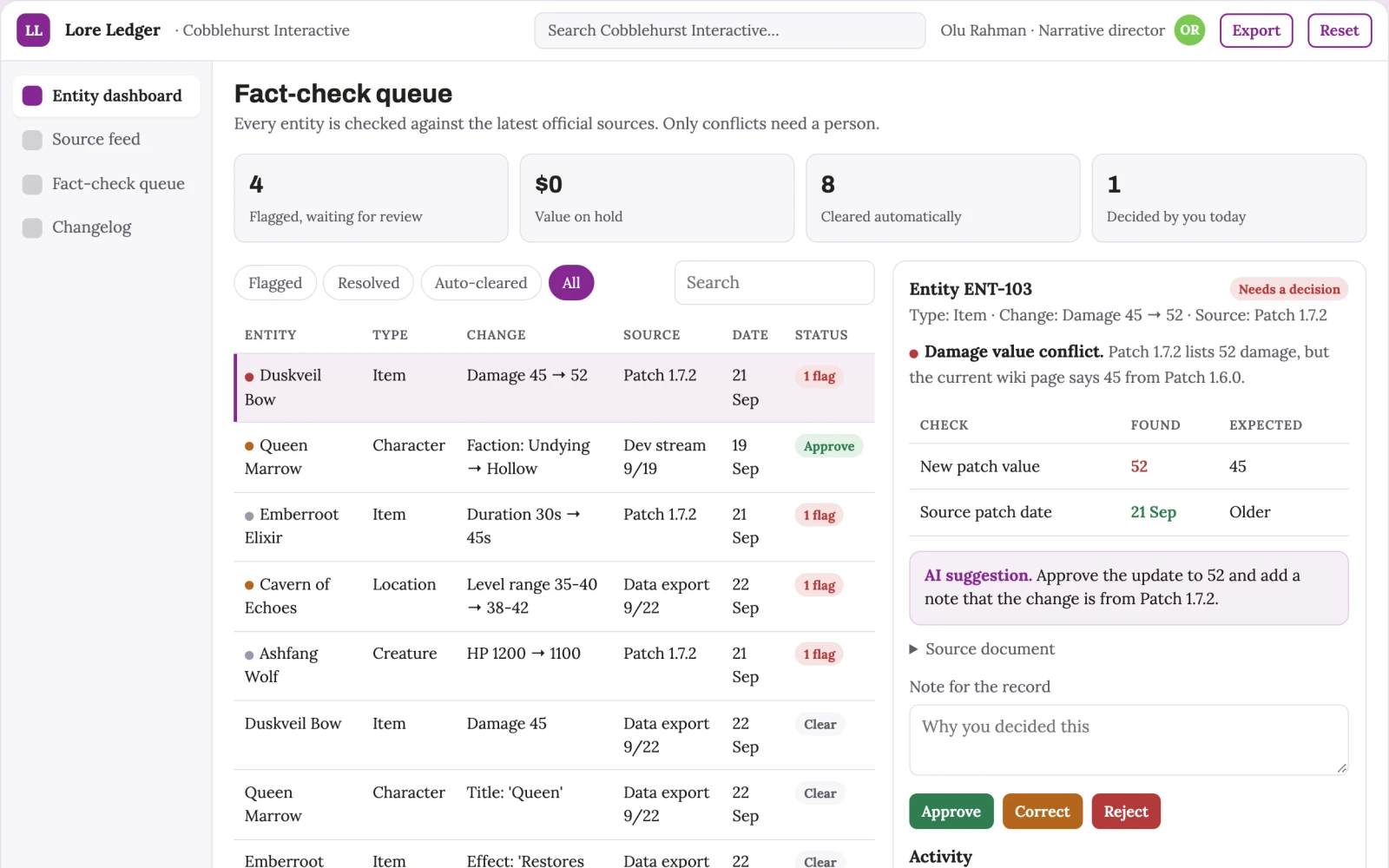
- Flag conflicts for human review
- Publish nightly updates with source attribution
Workflow
Connect data sources, ingest historical data, run entity extraction, generate initial pages, run fact-checking, review flagged conflicts, publish site. Start with patch notes, developer streams and game data exports and finish with a structured, searchable knowledge base.
AI and people
Use language models to parse unstructured text and extract entities. Use retrieval-augmented generation to write pages based on official sources. A human reviewer must verify lore accuracy and resolve contradictions before publication.
Screens
Key screens: Entity dashboard, source feed monitor, fact-check queue, changelog view. Use a dashboard to list all game entities, a feed monitor to show incoming official updates, a queue for human review of conflicts, and a changelog to track edits. The main screen is the entity dashboard, followed by the source feed monitor and fact-check queue.
Admin
User roles for studio staff, version control for page edits, approval workflows for content, audit logs for source attribution, and access controls for public facing site
03Market gap
Alternatives buyers use today
Manual wiki editing, community-maintained wikis like Fandom, and static documentation sites
Where this wins
Accumulated data on game lore and version history creates a unique dataset that improves accuracy over time, making it harder for competitors to replicate
04Why now
Creatives teams are adopting AI for exactly this kind of repeatable work, and the cost of language and vision models has dropped far enough that a narrow, reviewed workflow pays back quickly. The buyer already feels the problem: official game documentation is often incomplete and outdated while community knowledge is scattered across multiple platforms.
05Proof & signals
Channels where buyers gather: Indie game dev forums, Steam community hubs, Discord servers. Metrics that prove it works: Number of questions answered without Discord search, accuracy rate of generated pages.
Paid pilot
Provide the site to the studio and measure the reduction in support tickets related to game mechanics and lore
06Execution plan
MVP
Build for one indie studio with a single game. Ingest three months of patch notes and five blog posts. Generate pages for 200 core entities. Manual review of all generated content
First 30 days
Week 1: Set up ingestion pipelines for patch notes and streams. Week 2: Run entity extraction on historical data and generate initial pages. Week 3: Implement fact-checking logic and set up review queue. Week 4: Launch site and gather feedback on accuracy
After the pilot
Automated daily monitoring of official channels, real-time updates to the site, and integration with community support tools
Retention
Monthly subscription for continuous updates and new game support
Integrations
Steam patch notes, YouTube API, game data exports (JSON/XML)
07Investment and running costs
| Phase | Scope | Time | Budget |
|---|---|---|---|
| MVP | One buyer segment, one recurring use case. Manual review in the loop. | 2 days | $5,500 |
| Paid pilot | Accounts, roles, review states, audit trail and the first integration, hardened for two to three paying pilot customers. | 3 days | $5,000 |
| Full product | Self-serve onboarding, billing, monitoring and the wider integration set. | 6 days | $7,000 |
| Total | $17,500 | ||
| Running | Hosting | AI usage | Total a month |
|---|---|---|---|
| MVP and paid pilot (about 3 customers) | $30–$60 | $50–$100 | $80–$160 |
| Full product (about 50 customers) | $110–$210 | $350–$700 | $460–$910 |
Revenue model to test
$500 per month per game
Cost drivers
AI API costs for text processing and storage
Safeguards
Strict source linking to prevent hallucinations, manual approval gates for lore-heavy content, and version rollback capabilities
Take it further
Solution blueprint, rewritten from an earlier Nexibeo concept. Demand, pricing, build scope and integrations are working assumptions, not verified market findings. The MVP and the paid pilot exist to confirm them for your business before the larger build.