Solution Database / Operations
Fresh Route Coordinator
Farmers harvest without knowing who will buy and waste resources driving half empty trucks. A fully automated coordination layer that turns a logistics business into a self-running morning routine.
01The offer
For market gardeners, turn daily harvest photos and local demand into a live delivery route and sold inventory, and the problem it addresses. The value hypothesis is a zero-waste logistics layer that runs automatically each morning; the pilot must establish whether that benefit is real.
- For
- Market gardeners with a van
- Takes in
- Daily harvest photographs and crop varieties
- Delivers
- Live catalogue, delivery route sheet and sold inventory list
- Message
- Turn your morning harvest into a sold inventory before the truck leaves.
- Lead magnet
- A free demonstration of the morning route generation.
02How it works
- Identify crop and grade via photo
- Set dynamic pricing based on freshness
- Cluster orders by neighbourhood
- Generate shortest delivery loop
- Handle voice reorders and substitutions
- Print or speak route instructions
Workflow
Capture harvest, identify and price items, view live orders, generate route, pack by stop, and deliver. Start with daily harvest photos and finish with a completed delivery route and sold inventory.
AI and people
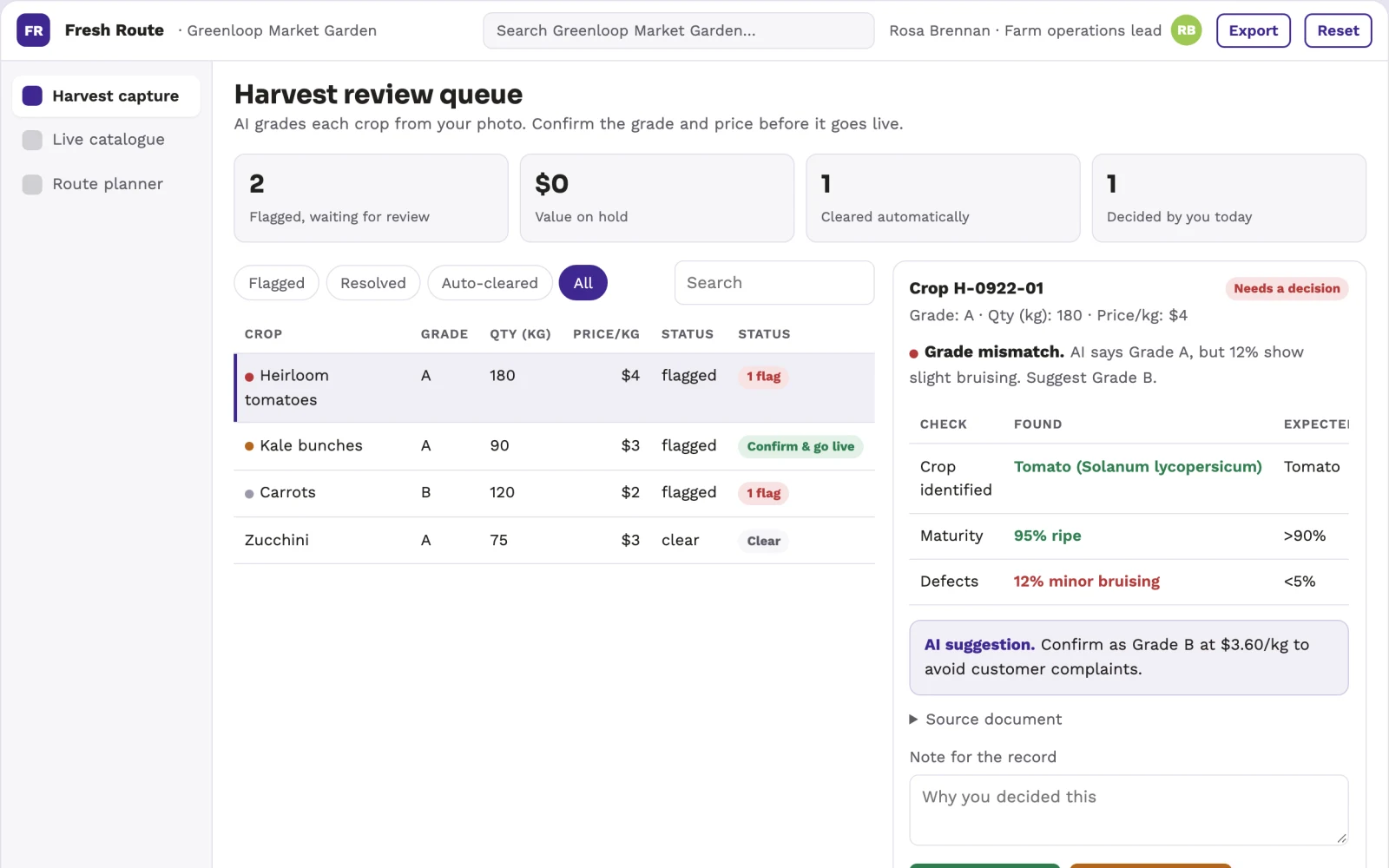
Use computer vision to recognise and grade produce from photos. Use routing algorithms to optimise collection and drop off loops. Use voice agents to handle customer reorders and substitutions. A farmer confirms the harvest grade and pricing before the route is generated.
Screens
Key screens: Harvest capture, live catalogue, route planner. Use a camera interface for crop identification, a grid view for neighbourhood orders, and a map view for the delivery loop. Display real time inventory levels and order status. In this product, the first view is harvest capture, followed by live catalogue and route planner.
Admin
Farmer accounts, order history, route versions, approval states, inventory audit trail and delivery status tracking.
03Market gap
Alternatives buyers use today
Wholesale markets, grocery stores and manual WhatsApp coordination groups.
Where this wins
Network effects between farms and the density of local delivery routes.
04Why now
Operations teams are adopting AI for exactly this kind of repeatable work, and the cost of language and vision models has dropped far enough that a narrow, reviewed workflow pays back quickly. The buyer already feels the problem: farmers harvest without knowing who will buy and waste resources driving half empty trucks.
05Proof & signals
Channels where buyers gather: Local community groups and neighbourhood social media pages.. Metrics that prove it works: Percentage of harvest sold and reduction in transport costs..
Paid pilot
Run a pilot with one market gardener to prove zero waste and increased revenue compared to wholesale prices.
06Execution plan
MVP
One market gardener, one neighbourhood, thirty households invited via local group. The farmer photographs six crop types each morning. A single retrieval augmented generation agent writes the catalogue, confirms orders, and prints a route sheet. No app to install. No inventory dashboard. Just a photo, a list, and a drive.
First 30 days
Week 1: Set up one farm account and invite thirty households. Week 2: Test the vision model on six crop types. Week 3: Refine pricing and routing logic. Week 4: Analyse waste reduction and order volume.
After the pilot
Route density increases and neighbouring farms join the standby network to ensure catalogue fullness.
Retention
Repeat orders from households and route density growth.
Integrations
Local Facebook groups for household invitations and basic payment gateways.
07Investment and running costs
| Phase | Scope | Time | Budget |
|---|---|---|---|
| MVP | One buyer segment, one recurring use case. Manual review in the loop. | 2 days | $5,500 |
| Paid pilot | Accounts, roles, review states, audit trail and the first integration, hardened for two to three paying pilot customers. | 3 days | $4,500 |
| Full product | Self-serve onboarding, billing, monitoring and the wider integration set. | 5 days | $6,500 |
| Total | $16,500 | ||
| Running | Hosting | AI usage | Total a month |
|---|---|---|---|
| MVP and paid pilot (about 3 customers) | $30–$60 | $40–$90 | $70–$150 |
| Full product (about 50 customers) | $110–$210 | $280–$560 | $390–$770 |
Revenue model to test
Test a 15 percent commission on each sale.
Cost drivers
Compute costs for vision and routing models and the standby network of partner farms.
Safeguards
Delivery radius limits, substitution approval rules and grade rejection thresholds.
Take it further
Solution blueprint, rewritten from an earlier Nexibeo concept. Demand, pricing, build scope and integrations are working assumptions, not verified market findings. The MVP and the paid pilot exist to confirm them for your business before the larger build.