Instant Product Advisor
Customers leave empty-handed because staff cannot provide quick answers about product details or alternatives. A sales assistant that runs on the customer's existing phone without requiring app downloads or hardware installation
01The offer
For shop owners at independent boutiques and specialty stores, turn product labels and images into instant customer answers and checkout capability. Address the problem: customers leave because they cannot get quick answers about fit or materials. The value hypothesis is a self-service sales agent that operates on existing devices without app installation; the pilot must establish whether this reduces staff workload and increases conversion rates.
- For
- Shop owners at independent boutiques and specialty stores
- Takes in
- Product images, label text, web data, shop product database
- Delivers
- A customer-facing URL with camera recognition and Q&A capabilities, and a populated product catalog
- Message
- Turn your phone into a 24/7 salesperson for your shop
- Lead magnet
- A free demonstration of scanning your inventory and generating a customer-facing URL
02How it works
- Scan product labels with camera
- Extract attributes from images and web data
- Generate a customer-facing QR code
- Identify products in real time via camera
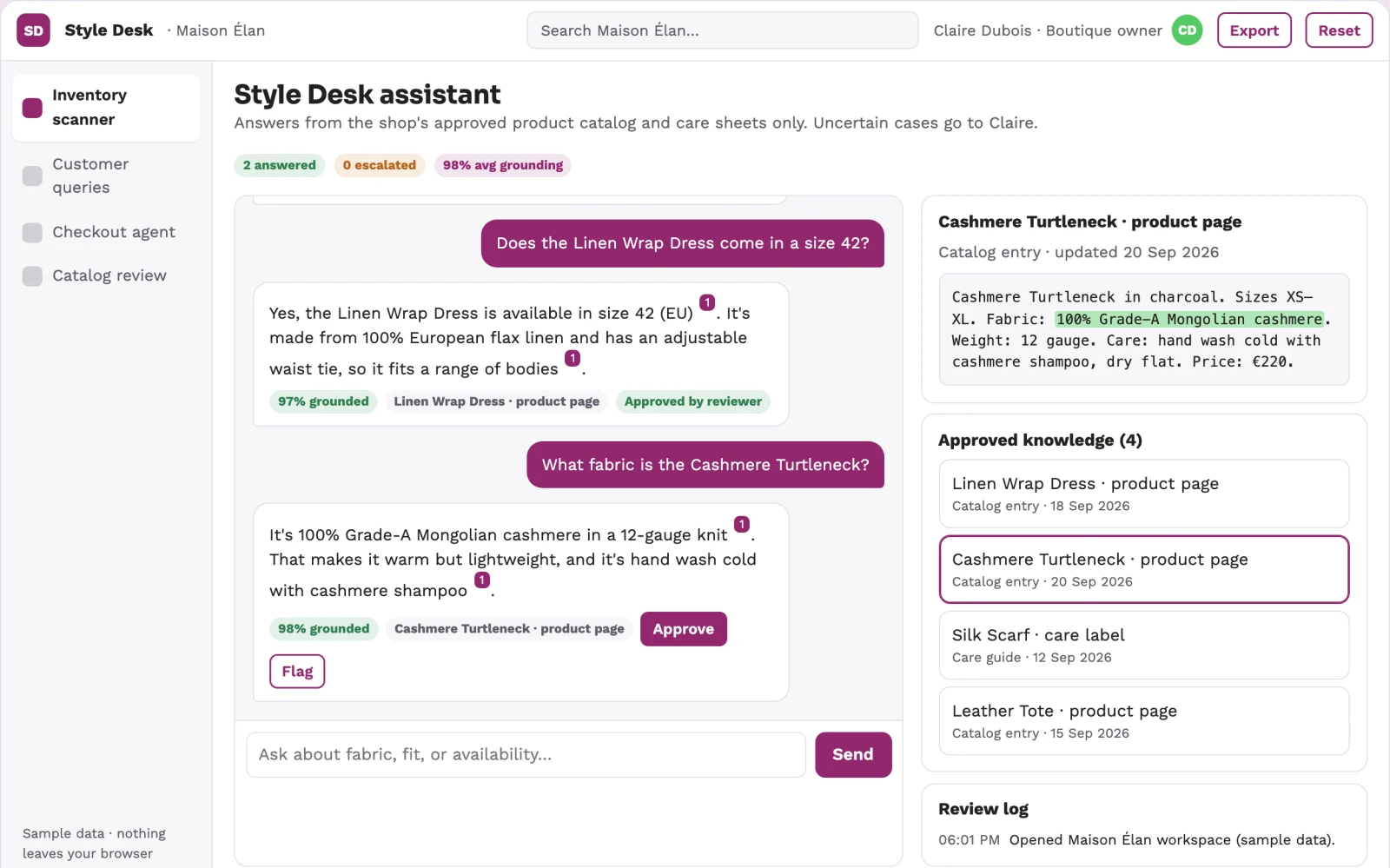
- Answer natural language questions about products
- Generate payment links for checkout
Workflow
Upload product images, scan labels to extract data, review extracted data, generate a customer URL, answer customer questions, process checkout requests, and hand over the item. Start with product images and finish with a completed sale.
AI and people
Use vision models to identify products from camera feeds and language models to answer questions using the shop's own data. Validate product attributes against the database. A shop owner reviews the extracted data before it is used to ensure accuracy.
Screens
Key screens: Inventory scanner, customer query interface, checkout agent. Use a camera viewfinder for scanning items, a chat interface for answering questions, and a payment link generator for checkout. The first view is the inventory scanner, followed by the customer query interface and checkout agent.
Admin
Shop owner accounts, product database versions, approval states for extracted data, usage logs, and subscription management
03Market gap
Alternatives buyers use today
Staff training, printed brochures, and manual checkout. This differs by providing instant, AI-driven answers and self-service checkout on the customer's device
Where this wins
The value comes from the proprietary dataset of product attributes extracted by the vision model, which becomes more accurate as more shops use it
04Why now
Sales teams are adopting AI for exactly this kind of repeatable work, and the cost of language and vision models has dropped far enough that a narrow, reviewed workflow pays back quickly. The buyer already feels the problem: customers leave empty-handed because staff cannot provide quick answers about product details or alternatives.
05Proof & signals
Channels where buyers gather: Direct outreach to boutique owners, social media marketing, and partnerships with retail software providers. Metrics that prove it works: Number of products catalogued, number of customer interactions, and conversion rate of assisted sales.
Paid pilot
Prove it by having a shop owner scan 50 products and track the number of customer questions answered and sales completed via the system compared to baseline.
06Execution plan
MVP
The first cut: one shop owner, one product category, the scanner module and the basic Q&A module, manual review of extracted data
First 30 days
Week 1: Build the inventory scanner and data extraction module. Week 2: Develop the customer-facing web app with camera recognition. Week 3: Integrate the Q&A agent with the shop's product data. Week 4: Launch the pilot with one boutique.
After the pilot
Automated checkout processing, multi-language support, inventory management integration, and advanced analytics on customer queries
Retention
Earn recurring revenue through monthly subscriptions and increase value by adding more products and features over time
Integrations
Shopify for online store data, payment gateways for checkout
07Investment and running costs
| Phase | Scope | Time | Budget |
|---|---|---|---|
| MVP | One buyer segment, one recurring use case. Manual review in the loop. | 2 days | $5,000 |
| Paid pilot | Accounts, roles, review states, audit trail and the first integration, hardened for two to three paying pilot customers. | 3 days | $4,000 |
| Full product | Self-serve onboarding, billing, monitoring and the wider integration set. | 5 days | $6,000 |
| Total | $15,000 | ||
| Running | Hosting | AI usage | Total a month |
|---|---|---|---|
| MVP and paid pilot (about 3 customers) | $30–$60 | $60–$120 | $90–$180 |
| Full product (about 50 customers) | $110–$210 | $530–$1,050 | $640–$1,260 |
Revenue model to test
Monthly subscription priced at 190 USD for small shops and 490 USD for larger stores based on product count and interaction volume
Cost drivers
API costs for vision and language models, server hosting for the web app, and customer support
Safeguards
Limit the number of products per subscription tier, restrict access to the admin panel, and ensure the AI does not hallucinate product details not in the database
Take it further
Solution blueprint, rewritten from an earlier Nexibeo concept. Demand, pricing, build scope and integrations are working assumptions, not verified market findings. The MVP and the paid pilot exist to confirm them for your business before the larger build.