Live Blog Avatar
A blog sits on your site doing nothing for the sales team on a call. The avatar answers only from approved, cited blog content, so sales teams trust it as a live expert rather than a generic chatbot.
01The offer
For sales teams at B2B SaaS companies with a content library, turn approved blog posts, charts and brand voice into a live interactive avatar that answers prospect questions during calls. Address the recurring problem: the right content exists but is never used at the right moment. The value hypothesis is shorter sales cycles and fewer fumbled answers; the pilot must establish whether prospects actually engage with the avatar.
- For
- Sales teams at B2B SaaS companies with a content library
- Takes in
- Blog posts, charts, brand voice guide, optional 30-second video for likeness
- Delivers
- Live interactive avatar room, cited answers, question analytics
- Message
- Turn your best blog posts into a live expert that answers sales calls for you.
- Lead magnet
- A free demo showing one of their blog posts turned into a live avatar answering three sample questions.
02How it works
- Ingest blog posts into a locked knowledge graph
- Generate a script in the author's voice
- Render a photorealistic avatar with slides
- Host a live interactive video room
- Answer questions using retrieval augmented generation
- Log analytics on questions and engagement
Workflow
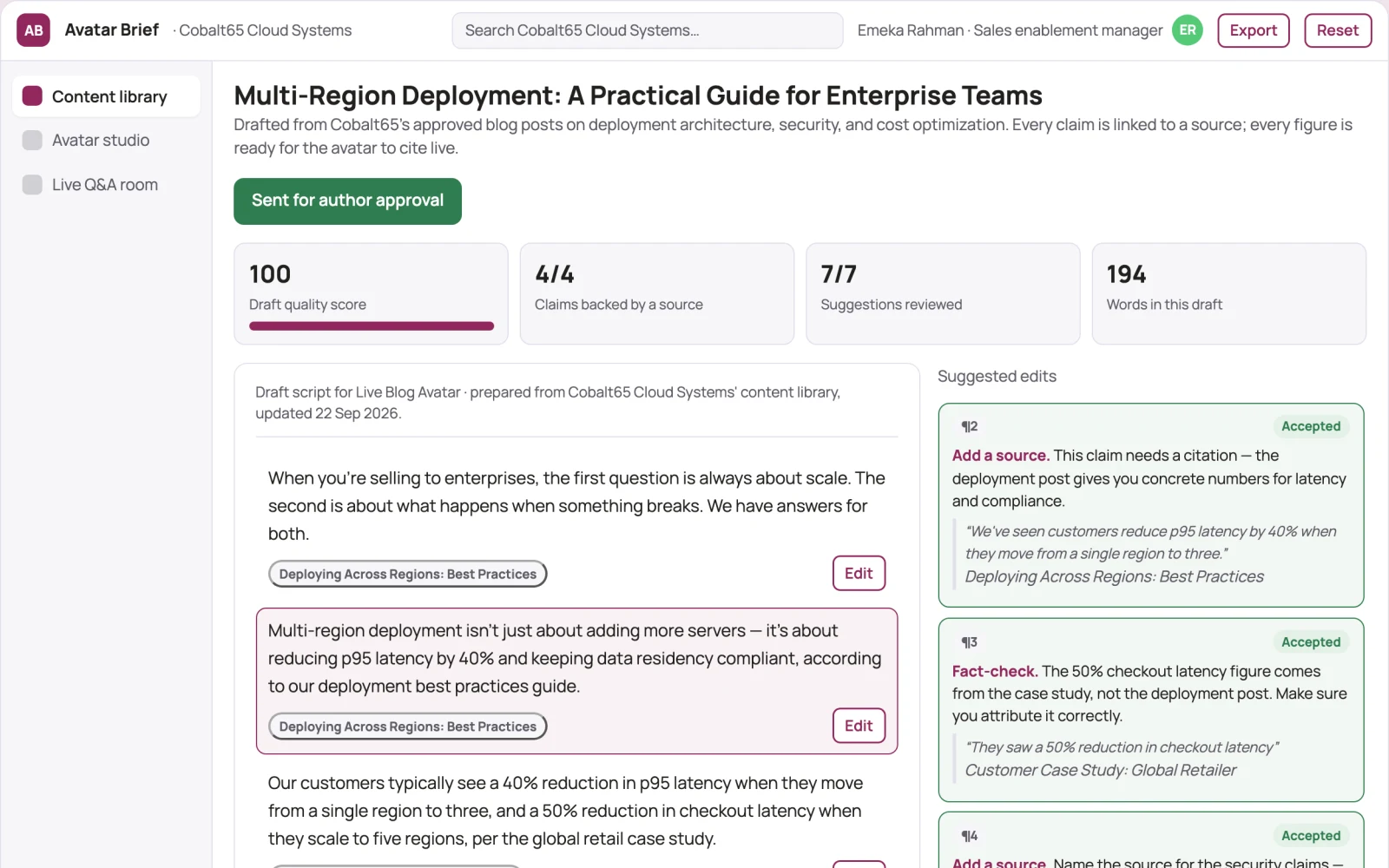
Connect blog, ingest posts, select or clone avatar, generate video, review for accuracy, share live link, and monitor Q&A analytics. Start with blog posts, charts and brand voice and finish with a live interactive avatar room with cited answers.
AI and people
Use language models to build the knowledge graph, generate scripts and answer questions via retrieval augmented generation locked to approved posts. Use text to speech and video generation for the avatar. A human editor reviews the script and avatar output for factual accuracy and brand tone before any link goes live.
Screens
Key screens: Content library, avatar studio, live Q&A room. Use a searchable list of ingested posts, a studio for selecting avatar and generating the video, and a live room with video player, question input and citation panel. Let users preview the avatar before sharing. Display source-linked answers with timestamps. Provide analytics on asked questions. In this product, the first view is content library, followed by avatar studio and live Q&A room.
Admin
Accounts for sales reps and editors, content versioning, avatar permission levels, approval workflow for new posts, audit trail of all Q&A sessions, and limits on concurrent live rooms.
03Market gap
Alternatives buyers use today
Salespeople manually searching blogs, sending links, or using generic chatbots. This differs by making the content a live, on-brand presenter that cites sources in real time.
Where this wins
The locked knowledge graph tied to each client's evolving content library becomes a proprietary asset; the more posts ingested and refined, the harder it is to replicate the accuracy and brand fit.
04Why now
Sales teams are adopting AI for exactly this kind of repeatable work, and the cost of language and vision models has dropped far enough that a narrow, reviewed workflow pays back quickly. The buyer already feels the problem: a blog sits on your site doing nothing for the sales team on a call.
05Proof & signals
Channels where buyers gather: LinkedIn for B2B sales leaders, content marketing communities, and direct outreach to SaaS companies with active blogs.. Metrics that prove it works: Reduction in time to answer prospect questions during calls; increase in number of blog posts referenced in sales conversations..
Paid pilot
Run a paid pilot with one sales team for 30 days. Baseline: average time to answer a prospect question during a call and number of follow-up emails needed. Decision: continue if avatar answers reduce follow-up time by 30% and at least 50% of prospects engage with the avatar.
06Execution plan
MVP
One buyer: sales team at a B2B SaaS company. One use case: one blog post turned into an interactive video with one default avatar. First two modules: content ingestion and basic Q&A player. Manual review of script and answers before sharing.
First 30 days
Week 1: Build content ingestion and knowledge graph for one post. Week 2: Integrate text to speech and basic avatar render. Week 3: Build interactive Q&A player with retrieval. Week 4: Test with one sales team and refine accuracy.
After the pilot
Automate avatar cloning from uploaded video, auto-refresh knowledge graph on new posts, integrate with CRM to log Q&A sessions, and add multi-avatar libraries for different topics.
Retention
Monthly subscription with recurring value from new blog posts and updated answers; analytics on question trends justify ongoing use and upsell to more avatars.
Integrations
Start with a blog RSS feed or URL import, then add CRM systems like Salesforce and HubSpot for session logging.
07Investment and running costs
| Phase | Scope | Time | Budget |
|---|---|---|---|
| MVP | One buyer segment, one recurring use case; first modules: content ingestion and basic Q&A player. Manual review in the loop. | 2 days | $5,500 |
| Paid pilot | Accounts, roles, review states, audit trail and the first integration, hardened for two to three paying pilot customers. | 3 days | $5,500 |
| Full product | Self-serve onboarding, billing, monitoring and the wider integration set. | 6 days | $7,000 |
| Total | $18,000 | ||
| Running | Hosting | AI usage | Total a month |
|---|---|---|---|
| MVP and paid pilot (about 3 customers) | $30–$60 | $70–$140 | $100–$200 |
| Full product (about 50 customers) | $110–$210 | $700–$1,400 | $810–$1,610 |
Revenue model to test
Test pricing at $500 per month per sales team for up to 20 active posts, with a $2,000 setup fee for avatar cloning and custom integration.
Cost drivers
Cloud GPU time for video generation, text to speech API usage, storage for video files, and human review hours for script and answer quality.
Safeguards
Restrict answers to approved posts only, require human review of generated scripts, lock knowledge base to specific content versions, and block any answer outside the source material. It must not generate opinions or unapproved claims.
Take it further
Solution blueprint, rewritten from an earlier Nexibeo concept. Demand, pricing, build scope and integrations are working assumptions, not verified market findings. The MVP and the paid pilot exist to confirm them for your business before the larger build.