Solution Database / Healthcare
Ambient Clinical Note Assistant
Documentation burdens consume evenings and reduce time with patients. Clinical notes drafted from the consultation on the device, so patient data never leaves the room until the clinician approves it.
01The offer
For clinicians at small GP practices, turn consultation audio and dialogue into structured clinical notes and draft records, and the problem it addresses is evenings spent typing notes from memory or shorthand. The value hypothesis is a draft ready for review before the patient leaves, reducing administrative burnout; the pilot must establish whether this saves time and improves patient focus.
- For
- Clinicians at small GP practices
- Takes in
- Consultation audio, patient dialogue, clinical note templates
- Delivers
- Structured clinical notes, draft records, audit trail of the consultation
- Message
- Capture the consultation, not just the words.
- Lead magnet
- Free demonstration of a 15-minute consultation draft
02How it works
- Capture audio in real time
- Distinguish speaker roles
- Transcribe dialogue to text
- Map text to structured templates
- Provide secure review and approval
- Export to EHR systems
Workflow
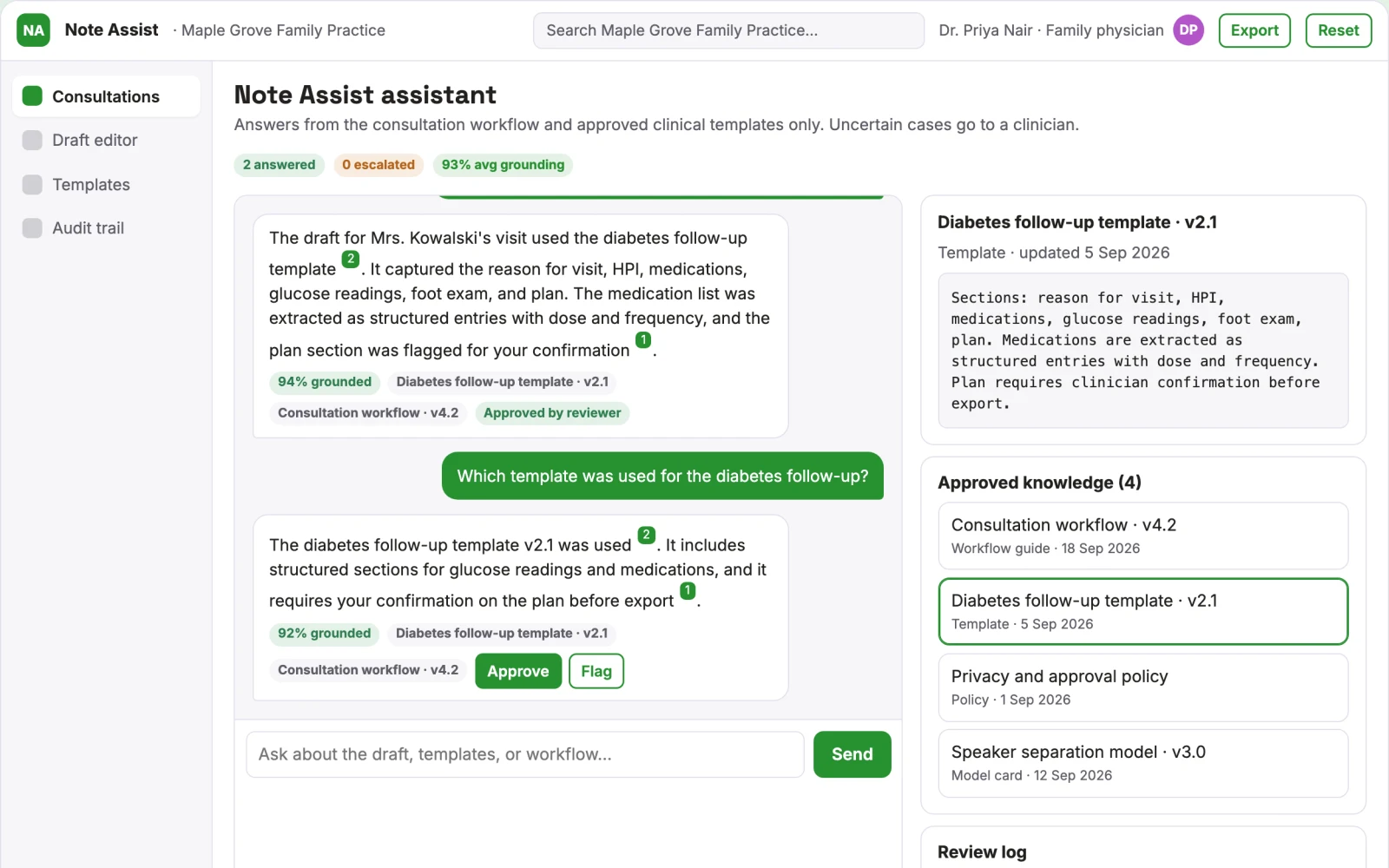
Start consultation, capture audio, generate draft, review and edit, approve note, save to EHR. Start with consultation audio and dialogue and finish with structured clinical notes and draft records.
AI and people
Use speech-to-text and language models to structure dialogue into clinical templates. Detect speaker intent and context. A clinician reviews the draft for clinical accuracy and privacy compliance before saving.
Screens
Key screens: Consultation dashboard, draft editor, template configuration. Use a central dashboard showing the consultation timer and draft status. Display the draft note in a split view with the original audio transcript. Allow inline editing and template switching. In this product, the first view is the consultation dashboard, followed by the draft editor.
Admin
User roles, template management, approval workflows, audit logs of edits, data retention policies
03Market gap
Alternatives buyers use today
Manual typing, generic transcription services, other SaaS note-taking tools
Where this wins
Privacy compliance (GDPR/HIPAA) and deep integration with specific clinical workflows/templates
04Why now
Healthcare teams are adopting AI for exactly this kind of repeatable work, and the cost of language and vision models has dropped far enough that a narrow, reviewed workflow pays back quickly. The buyer already feels the problem: documentation burdens consume evenings and reduce time with patients.
05Proof & signals
Channels where buyers gather: Medical conferences, healthcare IT publications, practice management associations. Metrics that prove it works: Reduction in documentation time per day, clinician satisfaction score.
Paid pilot
Run for two weeks with one clinician. Baseline: 2 hours of documentation time per day. Decision: If time saved exceeds subscription cost, expand to two rooms.
06Execution plan
MVP
One clinician, one consultation room, one template, one EHR integration
First 30 days
Week 1: Install hardware in one room. Week 2: Configure templates and EHR link. Week 3: Train staff on review process. Week 4: Review data privacy and accuracy metrics.
After the pilot
Multi-room support, multi-clinician support, advanced analytics, voice biometrics
Retention
Renew based on continued time savings and data security compliance
Integrations
EHR systems (HL7 FHIR), secure audio storage
07Investment and running costs
| Phase | Scope | Time | Budget |
|---|---|---|---|
| MVP | One buyer segment, one recurring use case. Manual review in the loop. | 4 days | $7,500 |
| Paid pilot | Accounts, roles, review states, audit trail and the first integration, hardened for two to three paying pilot customers. | 5 days | $8,500 |
| Full product | Self-serve onboarding, billing, monitoring and the wider integration set. | 9 days | $12,000 |
| Total | $28,000 | ||
| Running | Hosting | AI usage | Total a month |
|---|---|---|---|
| MVP and paid pilot (about 3 customers) | $50–$100 | $60–$120 | $110–$220 |
| Full product (about 50 customers) | $190–$380 | $530–$1,050 | $720–$1,430 |
Revenue model to test
Test pricing at 150 USD per clinician per month
Cost drivers
Hardware procurement, cloud processing, support staff
Safeguards
Strict consent recording, automatic deletion of audio after note approval, role-based access
Take it further
Solution blueprint, rewritten from an earlier Nexibeo concept. Demand, pricing, build scope and integrations are working assumptions, not verified market findings. The MVP and the paid pilot exist to confirm them for your business before the larger build.