Solution Database / Healthcare
Pediatric Symptom Triage Assistant
Parents wake up to a sick child and struggle to determine if it is an emergency or requires home care. Night-time symptom triage for children that hands parents straight to the right telemedicine doctor when it matters.
01The offer
For parents of young children, turn symptom descriptions, photos and voice recordings into a structured triage plan and care instructions. This addresses the problem of panic and uncertainty during night-time illness and the risk of unnecessary emergency room visits.
- For
- Parents of young children
- Takes in
- Symptom descriptions, photos, voice recordings, child profile
- Delivers
- Structured triage plan, care instructions, risk assessment, doctor summary
- Message
- Get a clear care plan for your sick child in seconds, not hours
- Lead magnet
- Free 3-day trial of triage features
02How it works
- Capture symptoms via text, photo or voice
- Cross-reference age and medical history
- Analyse visual data for skin conditions
- Generate structured care instructions
- Identify red flags requiring immediate care
- Generate summary for medical professionals
Workflow
Capture symptom, upload photo, record voice, AI analysis, review care plan, book doctor if needed, receive summary for doctor. Start with symptom descriptions, photos and voice recordings and finish with a structured triage plan and care instructions.
AI and people
Use multimodal models to analyse symptom descriptions, photos and voice recordings against medical knowledge bases. A parent must verify the child's identity and review the care plan before taking action.
Screens
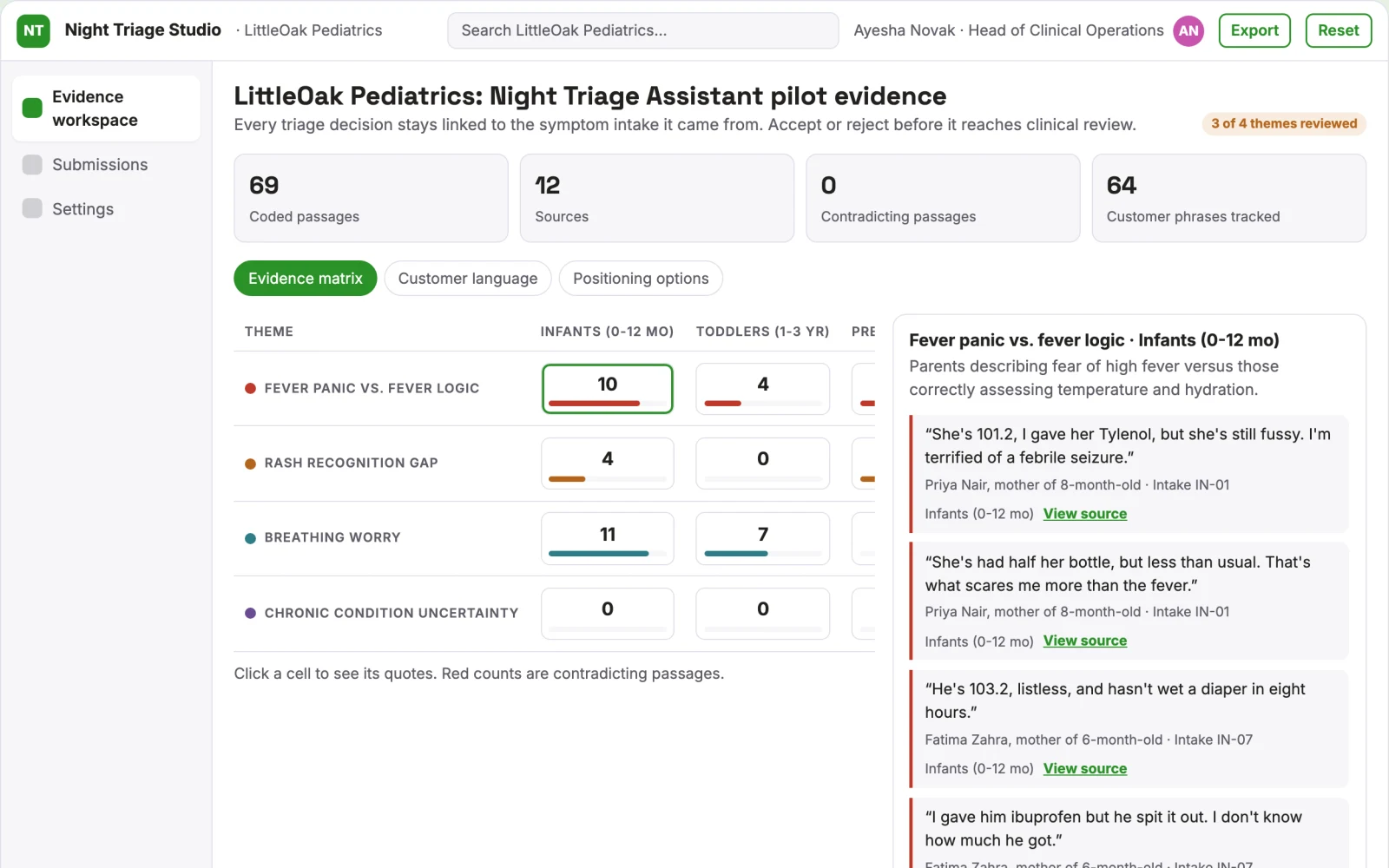
Key screens: Symptom intake, analysis dashboard, doctor booking. Use a central intake screen for text, photo and voice inputs, a dashboard showing the triage result and care plan, and a booking interface for video consultations. The first view is the symptom intake screen followed by the analysis dashboard.
Admin
User profiles, history logs, care plan versions, audit trail of interactions
03Market gap
Alternatives buyers use today
People use Google search, nurse hotlines or drive to the ER. This solution provides structured, multimodal analysis and immediate care planning
Where this wins
Accumulation of medical data and regulatory compliance creates a high barrier to entry
04Why now
Healthcare teams are adopting AI for exactly this kind of repeatable work, and the cost of language and vision models has dropped far enough that a narrow, reviewed workflow pays back quickly. The buyer already feels the problem: parents wake up to a sick child and struggle to determine if it is an emergency or requires home care.
05Proof & signals
Channels where buyers gather: Social media, parenting forums, pediatric clinics. Metrics that prove it works: User satisfaction score and reduction in unnecessary ER visits.
Paid pilot
A paid pilot with 50 families proves value by reducing unnecessary ER visits compared to the baseline of calling nurse lines or driving to the hospital.
06Execution plan
MVP
First cut is a subscription service for parents to triage minor illnesses using text and photos with manual review of the AI output
First 30 days
Week 1: Build symptom intake module. Week 2: Develop triage logic and care plan generator. Week 3: Test with 50 parents from local clinics. Week 4: Refine based on feedback and safety checks.
After the pilot
Voice interaction integration, automatic generation of doctor consultation summaries, and white-labeling for pediatric clinics
Retention
Subscription renewal and upselling to video consultations
Integrations
Telemedicine platforms, electronic health records
07Investment and running costs
| Phase | Scope | Time | Budget |
|---|---|---|---|
| MVP | One buyer segment, one recurring use case. Manual review in the loop. | 5 days | $9,500 |
| Paid pilot | Accounts, roles, review states, audit trail and the first integration, hardened for two to three paying pilot customers. | 6 days | $12,000 |
| Full product | Self-serve onboarding, billing, monitoring and the wider integration set. | 2 weeks | $16,000 |
| Total | $37,500 | ||
| Running | Hosting | AI usage | Total a month |
|---|---|---|---|
| MVP and paid pilot (about 3 customers) | $50–$100 | $80–$160 | $130–$260 |
| Full product (about 50 customers) | $190–$380 | $880–$1,750 | $1,070–$2,130 |
Revenue model to test
Test a monthly subscription of 9 USD
Cost drivers
AI compute costs, data storage, medical liability insurance
Safeguards
The system must not provide a diagnosis, must always default to seeing a doctor for emergencies, and requires parental consent for all data processing
Take it further
Solution blueprint, rewritten from an earlier Nexibeo concept. Demand, pricing, build scope and integrations are working assumptions, not verified market findings. The MVP and the paid pilot exist to confirm them for your business before the larger build.